River · also known as Vaupés
Uaupés
Only species with a profile on Seriously Fish are counted.
- Species
- 9
- Families
- 4
- Photographed
- 9 of 9
- Difficulty rated
- 9 of 9
Basin
Also in the Amazon basinspecies recorded from both
Shares fishes with rivers elsewherespecies recorded from both
Runs through
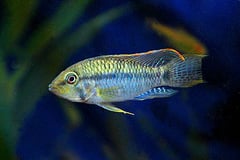
Apistogramma brevis
Cichlidae · Kullander, 1980
Apistogramma brevis is a dwarf cichlid from the Rio Uaupés basin in far northwestern Brazil and the Rio Tiquié in southern Colombia. It has also been recorded in the upper Rio Negro and Rio Orinoco, and inhabits slow-moving blackwater streams where the pH can drop as low as 4.0 or 5.0. Coded A168, it is the type species of the A. brevis group, and breeding is not too difficult if very soft, acidic water can be provided.

Apistogramma elizabethaeA208
Cichlidae · Kullander, 1980
Apistogramma elizabethae is a dwarf cichlid from the rio Uaupés and adjacent rio Içana, both tributaries of the upper rio Negro in Brazil. Coded A208, it is among the more sought-after Apistogramma in the hobby. Içana fish tend to have more blue on the head than those from the Uaupés, a reddish population is traded as A. elizabethae 'super red', and none of the forms should be mixed in aquaria.

Apistogramma sp. 'breitbinden'A164
Cichlidae · authority not recorded
Apistogramma sp. 'breitbinden' is an undescribed dwarf cichlid from the upper Rio Negro in Brazil, the Venezuelan Orinoco and the Inirida in Colombia. The German name means 'broad-banded' and refers to the uniformly broad suborbital stripe of males. Known in the hobby for several decades, it is often imported as bycatch among shipments of wild-collected A. iniridae, and some populations carry the DATZ codes A164, A165 and A167.
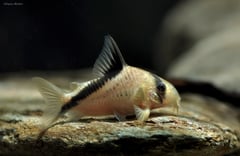
Hoplisoma meliniFalse Bandit Cory
Callichthyidae · (Lönnberg & Rendahl, 1930)
The false bandit cory, Hoplisoma melini, long known as Corydoras melini, is an armoured catfish from tributaries of the rios Negro, Caquetá and Orinoco in Brazil and Colombia. Its oblique dark bar along the back splits into two above the caudal peduncle, a feature shared only with H. davidsandsi, from which the dark markings on its flanks separate it. The rio Tiquié population is known in the hobby as 'C084', and a similar, slightly larger form from Peru as 'C085'.
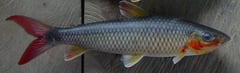
Leporinus brunneus
Anostomidae · Myers, 1950
Leporinus brunneus is an anostomid from the rios Madeira and Negro in Brazil, the Orinoco in Venezuela and Colombia, and the Casiquiare canal. The largest officially recorded specimen measured 256 mm, and an aquarium with base dimensions of at least 210 by 60 cm is needed.
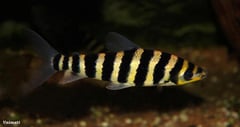
Leporinus fasciatusBanded Leporinus
Anostomidae · Bloch, 1794
The banded leporinus, Leporinus fasciatus, is an anostomid from the Amazon and Orinoco systems and coastal Guyana, Suriname and French Guiana. Young fish are often sold without warning of their size and requirements, and it is fairly ubiquitous in public aquarium displays. It is frequently confused with L. affinis, and its dark body bars multiply with age, from five in young fish to around ten in adults.

Paracheirodon axelrodiCardinal Tetra
Characidae · Schultz, 1956
The cardinal tetra, Paracheirodon axelrodi, is a small characid from the rio Negro and Orinoco drainages of Brazil, Colombia and Venezuela. Immensely popular in the hobby, it is now commercially bred on a large scale, but a significant proportion of trade fish are still wild caught or come from community-led projects such as Project Piaba. Rio Negro and Orinoco populations differ in colour pattern, and wild fish are less tolerant of deteriorating water conditions than commercially-produced ones.

Satanoperca daemonThreespot Eartheater
Cichlidae · Heckel, 1840
The threespot eartheater, Satanoperca daemon, is a cichlid from the rio Negro, Casiquiare and upper Orinoco systems in Brazil, Venezuela and Colombia. It is mostly observed in acidic, mineral-poor blackwater. Relatively common in the aquarium trade, it is by no means easy to maintain, needing particular attention to space, diet, water quality and chemistry. Two dark blotches on the flank separate it from the similar S. lilith, which has only one.

Tucanoichthys tucano
Characidae · Géry & Römer, 1997
Tucanoichthys tucano is a miniature characid known only from the rio Uaupés system in the upper Negro basin, Brazil. Adults are less than 17 mm SL, with a conspicuous dark lateral stripe, and the type locality is a small blackwater creek. Much sought after, it is peaceful but not an ideal community fish, given its small size and somewhat specialised requirements.