Taenioides cirratus
Bearded Worm Goby
Last revised 2026Edit this page
On this page11 sections
Quick factsEdit
Difficulty3 of 8 measures
- Space
- very large tank
- Water
- needs a steady pH
- Temp
- flexible
- Diet
- unknown
- Temperament
- unknown
- Social
- unknown
- Compatibility
- unknown
Other demands
Each of these can raise the rating on its own, whatever the measures above say.
- Hardiness
- unknown
- Needs a very large tank
The bearded worm goby, Taenioides cirratus, is a mud-burrowing goby of coastal, usually estuarine waters from India to Japan and New Caledonia. It digs networks of sloping tunnels in the substrate, and has greatly reduced eyes, teeth on the outside of its mouth and the ability to breathe air and survive out of water for some time. Growing to 300 mm SL, it will eat anything small enough and is probably best kept in a species set-up.
Distribution
EditIndia, Bangladesh, Andaman Islands, Thailand, China, Hong Kong, Japan, Taiwan, Philippines, Indonesia, New Caledonia and Papua New Guinea.
Habitat
Write a noteEditInhabits coastal, usually estuarine waters where it lives in burrows in the muddy substrate.
Aquarium size
Write a noteEditLikely to be quite inactive. An aquarium of 48" x 12" x 12" (75cm x 12cm x 12cm) - 70 litres should suffice.
Maintenance
Write a noteEditThe most important aspects would seem to be the provision of brackish (1.005-1.015 sg) water and a soft, deep substrate into which the fish can burrow. Dim lighting is advisable, seeing as this fish spends the majority of its life in the dark. Other decor does not really seem necessary.
Water conditions
EditTemperature: Given its natural distribution, a temperature in the range 72-82°F (22-27°C) would seem advisable.
pH: 7.5-8.5
Hardness: It's an estuarine species, so hardness of 10-20°H would seem appropriate.
Diet
Write a noteEditApparently feeds on crustaceans and small fish in nature, and is therefore likely to accept the usual frozen and live fare such as bloodworm, brine shrimp and chopped prawn in the aquarium.
These recommendations come from this profile’s own figures. They contain affiliate links, so we may earn a commission.
Behaviour and compatibility
Write a noteEditShould certainly not be kept with anything small enough to be considered food. Given its weird looks and special requirements it's probably worthy of a species setup.
Sexual dimorphism
Write a noteEditUnknown.
Reproduction
Write a noteEditUnknown and in all honesty unlikely to occur. It isn't even fully known how it reproduces in nature.
Notes
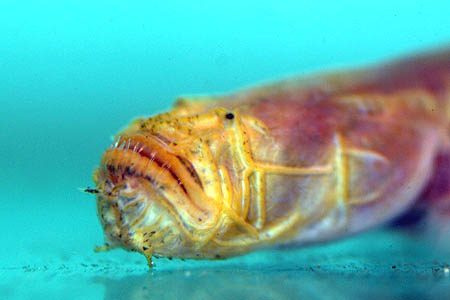
EditSomething for the true oddball enthusiast, this bizarre looking goby has been imported at least once over the last few years. It's a mud-burrowing species that digs networks of sloping tunnels in the substrate in nature. Apparently each series of burrows has several openings, one of which has a mound outside. According to Itani and Uchino (2003), this mound suggests that the fish "actively process sediment". Even more odd is its appearance (see picture). It has greatly reduced eyes, specialised bronchial chambers which mean it can breathe air (allowing it so survive out of water for some time) and most crazy of all has teeth on the outside of its mouth!
Species images · 2
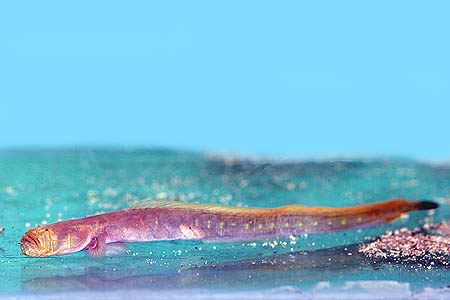
These photographs are used with each photographer's permission.
Send a photographProfile completeness16 of 24
Community
Questions about Taenioides cirratus?
Ask on Discord