River
Arauca
Only species with a profile on Seriously Fish are counted.
- Species
- 4
- Families
- 4
- Photographed
- 4 of 4
- Difficulty rated
- 4 of 4
Basin
Also in the Orinoco basinspecies recorded from both
Shares fishes with rivers elsewherespecies recorded from both
Runs through

Apistogramma hoignei
Cichlidae · Meinken, 1965
Apistogramma hoignei is a dwarf cichlid from the Río Orinoco basin in Venezuela, including the Apure, Arauca and Caura drainages. It is also known from much of the lower Orinoco mainstream. Coded A116 under the DATZ system, it has similar-looking, possibly conspecific populations referred to as A117 or A118, and inhabits slower-moving tributaries, backwaters and creeks where leaf litter collects.
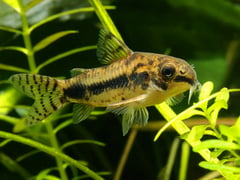
Hoplisoma habrosumSalt and Pepper Cory
Callichthyidae · (Weitzman, 1960)
The salt and pepper cory, Hoplisoma habrosum, long known as Corydoras habrosus, is a tiny armoured catfish from left bank tributaries of the upper Orinoco in Colombia and Venezuela. Most records come from the Río Apure watershed in the Llanos, where it apparently favours lagoons, streams, inundated forest and grassland with little flow. Also called 'dainty cory' and 'Venezuelan pygmy cory', it has 2-3 dark markings along the side of the body, against 4-5 in the similar H. cochui.
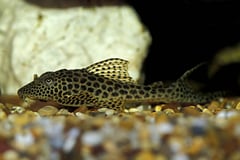
Isorineloricaria acuariusBlue Fin Thresher Pleco
Loricariidae · Ray & Armbruster, 2016
Isorineloricaria acuarius is a suckermouth catfish from the Apure and middle Orinoco drainages in the Venezuelan Llanos, where it lives on sandy runs in whitewater rivers. Traded as L093 and L195, the blue fin thresher pleco, it was sold as Hypostomus villarsi until it was described in 2016. I. villarsi is a different fish from the Lake Maracaibo basin, with a sharp ridge on each side of the head where I. acuarius has a rounded one.

Megalamphodus sweglesiRed Phantom Tetra
Characidae · Géry, 1961
The red phantom tetra, Megalamphodus sweglesi, is a small characid endemic to the upper and middle Río Orinoco watershed in Colombia and Venezuela. It apparently favours minor tributaries, oxbows and flooded forests, and in Venezuela is often found in morichals. Bred commercially in several countries, it has been traded in more than one colour form, and Zarske (2014) concluded that the particularly red form sold as 'red' or 'var. rubra' is conspecific.