River
Guárico
Only species with a profile on Seriously Fish are counted.
- Species
- 5
- Families
- 5
- Photographed
- 5 of 5
- Difficulty rated
- 5 of 5
Basin
Also in the Orinoco basinspecies recorded from both
Shares fishes with rivers elsewherespecies recorded from both
Runs through
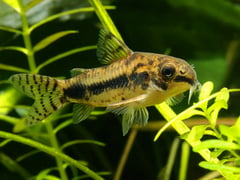
Hoplisoma habrosumSalt and Pepper Cory
Callichthyidae · (Weitzman, 1960)
The salt and pepper cory, Hoplisoma habrosum, long known as Corydoras habrosus, is a tiny armoured catfish from left bank tributaries of the upper Orinoco in Colombia and Venezuela. Most records come from the Río Apure watershed in the Llanos, where it apparently favours lagoons, streams, inundated forest and grassland with little flow. Also called 'dainty cory' and 'Venezuelan pygmy cory', it has 2-3 dark markings along the side of the body, against 4-5 in the similar H. cochui.

Hyphessobrycon metaePurple Tetra
Characidae · Eigenmann & Henn, 1914
The purple tetra, Hyphessobrycon metae, is a characid endemic to the middle Río Orinoco watershed in Colombia and Venezuela. Also known as 'Río Meta tetra', it is often misidentified, and H. peruvianus has repeatedly appeared under its name. The dark band on the caudal peduncle, without a broad dark band along the lower body, separates it from H. peruvianus and H. loretoensis.
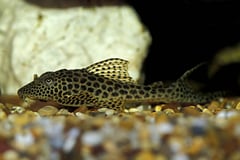
Isorineloricaria acuariusBlue Fin Thresher Pleco
Loricariidae · Ray & Armbruster, 2016
Isorineloricaria acuarius is a suckermouth catfish from the Apure and middle Orinoco drainages in the Venezuelan Llanos, where it lives on sandy runs in whitewater rivers. Traded as L093 and L195, the blue fin thresher pleco, it was sold as Hypostomus villarsi until it was described in 2016. I. villarsi is a different fish from the Lake Maracaibo basin, with a sharp ridge on each side of the head where I. acuarius has a rounded one.
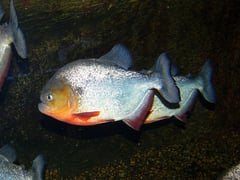
Pygocentrus caribaBlack Spot Piranha
Serrasalmidae · (Humboldt, 1821)
The black spot piranha, Pygocentrus cariba, is restricted to the Río Orinoco basin in Colombia and Venezuela. Many of its habitats lie within the llanos, and it has been recorded from river channels, tributaries and floodplain lakes, many of them acidic blackwater environments. Specimens over 100 mm SL have a large humeral spot and few spots on the body, which separates it from P. nattereri. It is best maintained alone.
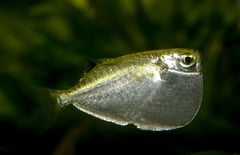
Thoracocharax stellatusSpotfin Hatchetfish
Gasteropelecidae · (Kner, 1858)
The spotfin hatchetfish, Thoracocharax stellatus, is the most widespread neotropical hatchetfish, recorded from much of South America. It is told from its only congener, T. securis, by a prominent dark spot in the dorsal fin, and is sometimes traded as 'platinum hatchetfish'. It feeds almost entirely on insects, and a tightly fitting cover is needed because it can clear several metres in one jump.