Poecilia sphenops
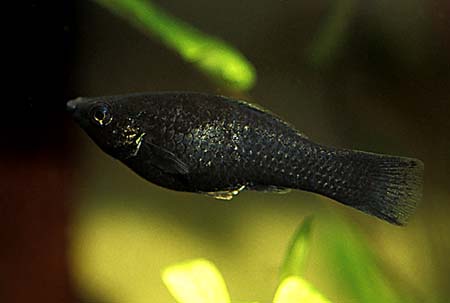
Short-finned Molly/Black Molly
Last revised 2016Edit this page
On this page11 sections
Quick factsEdit
Difficulty5 of 8 measures
- Space
- large tank
- Water
- flexible
- Temp
- flexible
- Diet
- unknown
- Temperament
- peaceful
- Social
- unknown
- Compatibility
- unknown
Other demands
Each of these can raise the rating on its own, whatever the measures above say.
- Hardiness
- hardy
The short-finned molly, Poecilia sphenops, is a livebearer whose native range runs north from Venezuela and Colombia to Mexico. Many colour morphs exist, including the black molly, and years of inbreeding and over-production have left many of them weak and prone to disease. All the morphs do better in slightly brackish conditions and are much more prone to disease in fresh water that is not hard and alkaline.
Etymology
EditPoecilia: from the Greek poikilo, meaning ‘variable, variegated’.
Distribution
EditIt's native range runs north from Venezuela and Colombia to Mexico, with isolated populations on some Caribbean islands. Wild fish are rare in the hobby these days though, with the vast majority of the ones on sale being mass-produced in the Far East and Eastern Europe. Introduced or feral populations also exist in a handful of other countries, including the United States, Japan, Singapore and even parts of Eastern Europe.
Aquarium size
Write a noteEdit90 ∗ 30 ∗ 30 cm36 ∗ 12 ∗ 12 in
Maintenance
Write a noteEditA planted tank is preferable but this species must be maintained in moderately hard or harder water, with a basic pH. When kept in soft or acidic water, the fish weakens fairly rapidly, frequently indicated by shimmying, fungus, and/or clamped fins. Salt is not necessary, as it is the “hard” minerals (calcium, magnesium) that are crucial to the long-term health of this species.
Water conditions
EditTemperature: 21 – 28 °C70 – 82 °F
pH: 7.0-8.5
Hardness: 15-30 dH
These recommendations come from this profile’s own figures. They contain affiliate links, so we may earn a commission.
Diet
Write a noteEditOmnivorous by nature, feeding on a variety of zoobenthos and detritus in the wild. and will accept most foods offered but a good proportion of the diet should be composed of vegetable matter such as blanched spinach or vegetable flake.
Behaviour and compatibility
Write a noteEditPeaceful but should only be kept with fish that can tolerate the same water conditions. Not recommended for the general community due to this. Good tankmates include other poecilia, some rainbowfish and hard water tolerant barbs and tetras.
Sexual dimorphism
Write a noteEditThe male is smaller, more colourful and possesses a gonopodium.
Reproduction
Write a noteEditVery easy if the correct water conditions are provided. Reproduces in standard livebearer fashion. As with other species the males can be somewhat incessant in their pursuit of females so we recommend that several females should be kept to every male in order to dissipate this. Areas of dense planting will also help. Gestation takes around 8 weeks and large broods of up to 120 fry are not uncommon. The adult fish will predate on the young so the best method of raising them is to remove the gravid female to a separate tank and allow her to give birth there before returning her to the main aquarium. The use of breeding nets or traps is not recommended as their small size is not suitable for raising fry. The fry are quite large and will accept brine shrimp nauplii or powdered flake from birth.
Notes
EditA hugely popular aquarium fish. Many aquarium-bred colour morphs of this species are available, including the ubiquitous black molly. There are also Gold, Green, Lyretail, Silver and Dalmation varieties. Some of these are the results of P. sphenops being crossed with P. latipinna. The 2 species will also interbreed readily in the aquarium and in order to avoid this we suggest keeping only one of them per tank. There also exists a (in our opinion) grotesque 'balloon' variety of this fish in which the body is malformed and rounded, giving a balloon-like appearance. This condition can cause swimbladder and digestive problems and may bring about premature death.
In the wild form this fish is very hardy but years of inbreeding and over-production have resulted in many of the mollies available in the hobby today being very weak genetically and prone to disease. This is particularly true of the common black morph.
Often recommended to beginners as a suitable community fish it should be noted that all the morphs do better in slightly brackish conditions and are much more prone to disease when maintained in freshwater that is not hard and alkaline. In fact this species is a popular choice to cycle new marine aquariums and can live a happy life in full marine conditions.
Species images · 2
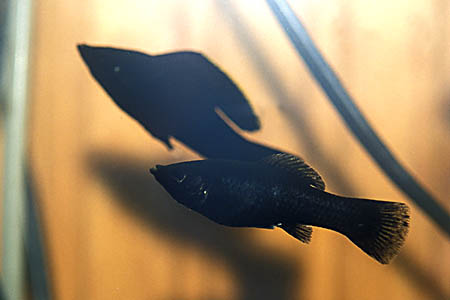
These photographs are used with each photographer’s permission.
Send a photographProfile completeness19 of 24
79% complete
Also missing: a recorded distribution, habitat.
Community
Questions about Poecilia sphenops?
Ask on Discord