Ctenopoma kingsleyae
Tailspot Ctenopoma
Last revised 2026Edit this page
On this page11 sections
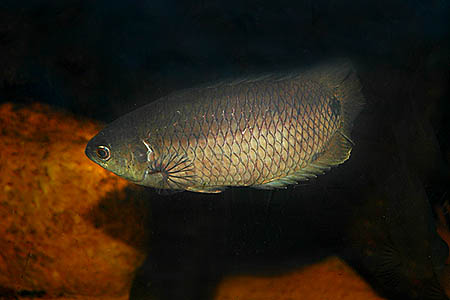
Quick factsEdit
Difficulty4 of 8 measures
- Space
- large tank
- Water
- flexible
- Temp
- needs a steady temperature
- Diet
- unknown
- Temperament
- eats smaller fish
- Social
- unknown
- Compatibility
- unknown
Other demands
Each of these can raise the rating on its own, whatever the measures above say.
- Hardiness
- unknown
Before you buy
Needs a tight-fitting lid as this species is known to jump
The tank cover should contain no gaps, as it's a notorious jumper.
The tailspot ctenopoma, Ctenopoma kingsleyae, is an anabantoid with an enormous range, recorded from Mauritania and Senegal to Gabon and the DR Congo. One of the more aggressive members of the genus, it can be particularly nasty towards conspecifics and will eat small fish. It is named after the explorer Mary Kingsley, and there are reports of specimens surviving in aquaria for over 30 years.
Distribution
EditHas an enormous natural range throughout much of western and central Africa. It's been recorded in Mauritania, Senegal, Gambia, GuineaBissau, Guinea, Sierra Leone, Liberia, Ivory Coast, Ghana, Togo, Benin, Nigeria, Cameroon, Gabon and Democratic Republic of Congo.
Habitat
Write a noteEditMainly inhabits areas of coastal rainforest.
Aquarium size
Write a noteEditA single specimen could be housed in a standard 48" x 12" x12" (120cm x 30cm x 30cm) - 108 litre tank. If you want to keep it with other species, though, a tank of at least 60" x 45cm x 45cm (150cm x 45cm x 45cm) - 303.75 litres in size would be needed.
Maintenance
Write a noteEditLike other Ctenopoma, this species does best in a dimly lit environment. Either use subdued lighting, or add a layer of floating plants to provide the preferred conditions. Add hiding places in the form of dense thickets of plants, chunks of bogwood, or rocky formations. It's an active species, so leave some areas of the tank open for swimming. The tank cover should contain no gaps, as it's a notorious jumper.
Water conditions
EditTemperature: 25 – 28 °C77 – 82 °F
pH: 6.0-8.0
Hardness: 5-20°H
Diet
Write a noteEditIt's a predator by nature, and although it does require a meaty diet, there's no need to feed live fish in the aquarium. Prawns, mussels, earthworms and similar foods are all accepted without fuss. Dried foods are taken willingly too.
These recommendations come from this profile’s own figures. They contain affiliate links, so we may earn a commission.
Behaviour and compatibility
Write a noteEditThis species is a predator and will eat any fish small enough to swallow, so it's definitely not a species for the general community. It's peaceful towards tankmates too large to eat, and towards its own kind given enough space. In a big tank with plenty of cover, it could be combined with other similarly-sized, robust species. A couple of these along with Mormyrids, Synodontis catfish and perhaps some Polypterus would make for an interesting setup. If geography is not an issue, it can be kept with similarly-sized, peaceful cichlids, larger characins, cyprinids and Loricariids.
Sexual dimorphism
Write a noteEditThe male is noticeably spinier around the gill covers and under the eyes.
Reproduction
Write a noteEditRarely achieved in the hobby. Few reports are available. The breeding tank should be large and contain lots of floating plants. The fish usually spawn at night in the typical anabantoid embrace, following a pursuit of the female by her partner. The eggs float to the surface and come to rest in the surface vegetation. It is best to remove the parents at this stage. The fry can be fed infusoria or liquid fry food initially, followed by newly hatched brine shrimp after a few days more.
It is thought that C. kingsleyae and other egg-scattering Ctenopoma may well be seasonal spawners as a pair will often spawn regularly for several months and then stop for a while. This does not appear to be related to water temperature or other parameters. There is also a general school of thought that the species doesn't become sexually mature until it reaches 5-10 years old.
Notes
EditThis species can be exceptionally long-lived and there are reports of specimens surviving in aquaria for over 30 years. It is named after the explorer Mary Kingsley, and often goes by the common name of Kingsley's climbing perch. While Ctenopoma are closely related to the Asian climbing perch (Anabas sp.), they are not known to have the ability to cross areas of land like this species.
Like others in the suborder Anabantoidei, the species possesses an accessory breathing organ known as the labyrinth organ. So-called due to its maze-like structure, this organ allows the fish to breathe atmospheric air to a certain extent. It is formed by a modification of the first gill arch, and consists of many highly vascularised, folded flaps of skin. The structure of the organ varies in complexity between species, tending to be more well-developed in those inhabiting particularly oxygen-deprived conditions.
Species images · 1
These photographs are used with each photographer's permission.
Send a photographDistribution
Profile completeness18 of 24
75% complete
Also missing: aquarium size, taxonomic authority, etymology.
Contributors
Improved by
- Mark1
The number beside each name is how many contributions that person has had accepted on Seriously Fish.
Community
Questions about Ctenopoma kingsleyae?
Ask on Discord