Distribution
Species with no country or region
These species are not on the map or on any country or region page. Most of their profiles give the place in the Distribution section.
- No country or region
- 510 of 1,822
- Photographed
- 455 of 510
- Difficulty rated
- 508 of 510
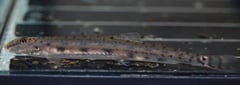
Acanthopsoides sp. 'A01'
Cobitidae · authority not recorded
Acanthopsoides sp. 'A01' is an unidentified dwarf horse-face loach of unknown origin, likely to be collected in Thailand or Peninsular Malaysia. Like several of its congeners in the trade it has proven very tricky to identify. It spends some of its time completely buried, so it needs a soft, sandy substrate, and it is best kept in a group of six or more. SF member Mark Duffill has recovered fry from an adult pair kept on their own in a small tank.
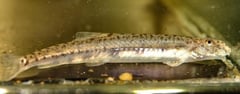
Acanthopsoides sp. 'A02'
Cobitidae · authority not recorded
Acanthopsoides sp. 'A02' is an unidentified dwarf horse-face loach of unknown origin, likely to be collected in Thailand or Peninsular Malaysia. Like several of its congeners in the trade it has proven very tricky to identify. A soft, sandy substrate is essential because it spends some of its time completely buried, and it is highly gregarious and best kept in a group of six or more.
Ancistomus sp. L163Big Spot Peckoltia
Loricariidae · authority not recorded
The big spot peckoltia (L163) is an undescribed suckermouth catfish collected from the Rio Pará in the Brazilian Amazon. Trade fish are often confused with the very similar L013, and the two are only easily told apart as they mature: L163 keeps its spotted pattern while L013 tends to become duller. It is placed in the genus Ancistomus. Newly imported fish should have a rounded belly and eyes that are not sunken.
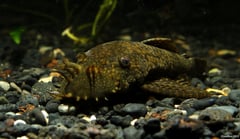
Ancistrus sp. '3'Common Bristlenose Catfish
Loricariidae · authority not recorded
The common bristlenose catfish, Ancistrus sp. '3', is the loricariid sold everywhere as the 'bristlenose', of unknown origin and bred commercially. It was once thought close to the Argentinian A. cirrhosus, but genetic data suggests otherwise, and some consider it a hybrid. Adult males carry fleshy tentacles on the head, and the species spawns in caves with the male guarding the brood.

Andinoacara sp. 'Orinoco'
Cichlidae · authority not recorded
Andinoacara sp. 'Orinoco' is an apparently undescribed cichlid from unspecified localities in the Río Orinoco basin, presumably in Venezuela. It was traded as 'Aequidens' sp. 'Orinoco' and, following Musilová et al. (2009), appears to be a member of Andinoacara. Relatively peaceful for a cichlid of its size, it is a biparental substrate spawner and relatively simple to breed.
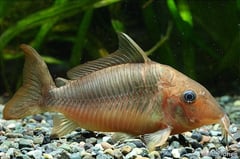
Brochis britskiiGiant Brochis
Callichthyidae · Nijssen & Isbrücker, 1983
The giant brochis, Brochis britskii, long known as Corydoras britskii, is an armoured catfish restricted to the upper rio Paraguay in Mato Grosso state, Brazil. It grows to around 90 mm SL and can be told from B. splendens and B. multiradiata, the other two species long kept in Brochis, by its 15 to 18 dorsal-fin rays. It forms aggregations in smaller tributaries and still waters such as backwaters, oxbows and marginal lakes.
Brochis geryi
Callichthyidae · authority not recorded
Brochis geryi, long known as Corydoras geryi, is an armoured catfish from the Río Mamoré basin in Bolivia. Not commonly seen, it is one of the larger corys in the hobby at around 7 cm.
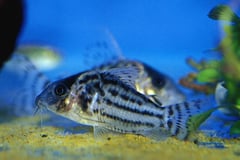
Brochis ornata
Callichthyidae · authority not recorded
Brochis ornata, long known as Corydoras ornatus, is a larger armoured catfish from the lower Rio Tapajós basin in Brazil, growing to around 70 mm SL. Its habitat is not recorded and no captive breeding information is available. Very peaceful, it should be kept in a group over fine sand, with plenty of cover and well-oxygenated water.
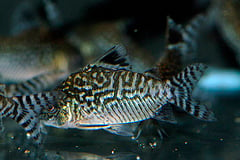
Brochis reticulataReticulated Cory
Callichthyidae · authority not recorded
The reticulated cory, Brochis reticulata, long known as Corydoras reticulatus, is an armoured catfish from the lower Amazon basin in Brazil, also known as the network cory. One of the commoner species seen in dealers' tanks, it is a good cory for the beginner. Very peaceful, it should be kept in a group of at least six, and like other corys it is sensitive to dirty substrates.
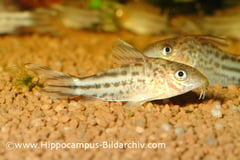
Brochis robineaeFlagtail Cory
Callichthyidae · authority not recorded
The flagtail cory, Brochis robineae, long known as Corydoras robineae, is an armoured catfish from the upper Rio Negro in Brazil, also known as the bannertail cory. It is found in the main river and its tributaries. Not the easiest Corydoras to induce to spawn, it can still be bred in a similar way to many other species in the genus. Very peaceful, it should be kept in a group of at least six.
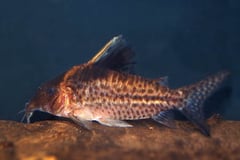
Brochis robustaRobust Cory
Callichthyidae · authority not recorded
Brochis robusta, long known as Corydoras robustus, is an armoured catfish endemic to the Rio Purus drainage in Brazil. It grows to around 95 mm SL, and as they mature males in particular develop an extended first dorsal-fin ray. It is not seen all that often in the trade, and in nature it inhabits small tributaries, creeks, areas of flooded forest and sand banks.
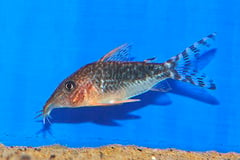
Brochis seussi
Callichthyidae · authority not recorded
Brochis seussi, long known as Corydoras seussi, is an armoured catfish from the Rio Mamoré basin and Rio Poranga in Brazil, also referred to by its C-number, C027. Very similar in appearance to Hoplisoma gossei, it can be distinguished by its less rounded snout. Very peaceful, it should be kept in a group of at least six.
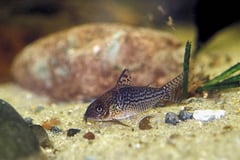
Brochis sodalisFalse Network Cory
Callichthyidae · authority not recorded
The false network cory, Brochis sodalis, long known as Corydoras sodalis, is an armoured catfish from the upper Amazon in Loreto, Peru, and Amazonas state, Brazil. It inhabits small tributaries, creeks, pools and areas of flooded forest. Very peaceful, it is best kept in a group of at least six, and it can be spawned in a similar way to other Corydoras.
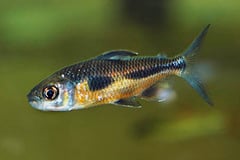
Bryconaethiops boulengeriBoulenger's Featherfin Tetra
Alestidae · authority not recorded
Boulenger's featherfin tetra, Bryconaethiops boulengeri, is a large alestid characin from the Congo river basin and Lake Tanganyika. Rarely imported, it is a peaceful shoaling species for a community of larger fish, and is farmed commercially for food in its native countries. It grows to 250 mm SL.

Buccochromis lepturusSlender Tail Hap
Cichlidae · authority not recorded
The slender tail hap, Buccochromis lepturus, is a large cichlid endemic to Lake Malawi, also known as the green lepturus. Adults live in deeper water throughout the lake, though juveniles can be seen in quite shallow water around the shorelines. Its pelagic nature makes it difficult to catch for export, so it is rarely seen for sale. It grows to 400 mm SL, and small fish will end up on the menu.

Buccochromis nototaeniaStripeback Hap
Cichlidae · authority not recorded
The stripeback hap, Buccochromis nototaenia, is a predatory cichlid endemic to Lake Malawi. It hunts juveniles of other species over sandy substrates just off the shoreline, often driving them into shallower water. It is rarely seen in the trade because it retreats at great speed into deeper water at the first sign of threat, which makes it hard to collect.
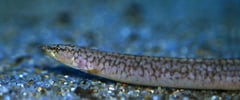
Caecomastacembelus albomaculatus
Mastacembelidae · authority not recorded
Caecomastacembelus albomaculatus is a spiny eel endemic to Lake Tanganyika, where it inhabits rocky areas around the shoreline. Rarely seen in the hobby, it suits a Tanganyikan community of species too large to be considered food, and its hard, alkaline water requirements rule out most other freshwater tanks. The stiffened dorsal rays that give spiny eels their name mean care is needed when handling it.
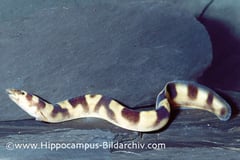
Caecomastacembelus plagiostomus
Mastacembelidae · authority not recorded
Caecomastacembelus plagiostomus is a spiny eel endemic to Lake Tanganyika, found in shallow water over rocky areas around the shoreline. Very rarely seen in the hobby, it suits a Tanganyikan community of species too large to be considered food and is somewhat territorial with conspecifics. It grows to 300 mm SL, and its stiffened dorsal rays call for care when handling it.

Callochromis macropsBig-eyed Mouthbrooder
Cichlidae · authority not recorded
The big-eyed mouthbrooder, Callochromis macrops, is a sand-sifting cichlid endemic to Lake Tanganyika, found in the southern part of the lake. It lives over shallow sandy bottoms near rocks, taking in mouthfuls of sand and sifting out invertebrates through the gills. Several geographical colour forms exist and should not be kept together, as they hybridise freely. Males are particularly belligerent towards one another in captivity, so a small tank suits one male with several females.
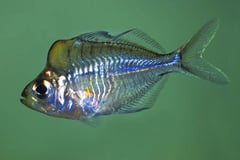
Chanda pulcinellaHumphead Perchlet
Ambassidae · (Kottelat, 2003)
The humphead perchlet, Chanda pulcinella, is a freshwater ambassid endemic to Myanmar, where it inhabits large, fast-flowing, clear streams. Described in 2003, it takes its name from the scaleless hump on its head, formed from an extension of the spine and apparently smaller in females. Artificially dyed specimens have reached the market and should be avoided, since the process is cruel and usually shortens the fish's life considerably.
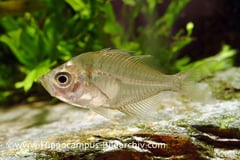
Chanda siamensis
Ambassidae · Fowler, 1937
Chanda siamensis is a small glass fish from Thailand, Laos, Cambodia, Vietnam, Malaysia, Singapore and Indonesia. An occasional import, it is sometimes sold as C. ranga, the Indian glass fish, but lacks patterning behind the eye and has a more elongate body. C. siamensis inhabits lowland rivers and flooded fields and is exclusively a freshwater fish, so it should never be kept under brackish conditions.
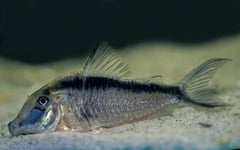
Corydoras narcissusLong-nosed Skunk Cory
Callichthyidae · authority not recorded
The long-nosed skunk cory, Corydoras narcissus, is an armoured catfish that appears to be endemic to the Rio Purus in Brazil. It lives alongside Brochis arcuata and looks very similar at first glance, but has an elongated snout where that of B. arcuata is much more rounded. Large for a Corydoras at around 75 mm SL, it does best with some water flow in the tank.
Corydoras ourastigmaLong-nosed Smudge Spot Cory
Callichthyidae · authority not recorded
The long-nosed smudge spot cory, Corydoras ourastigma, is an armoured catfish from the Rio Purus basin in Brazil. It can be confused with Gastrodermus guapore, Hoplisoma caudimaculatum, H. simile and Brochis spectabilis, but is the only one with an obvious long snout. Its smudged caudal blotch resembles that of H. simile but is grey to black. Nothing is recorded of its habitat.
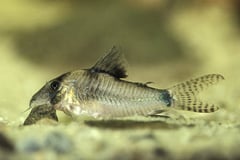
Corydoras septentrionalisNorthern Longnose Cory
Callichthyidae · authority not recorded
The northern longnose cory, Corydoras septentrionalis, is an armoured catfish from the Rio Orinoco in Venezuela and possibly Colombia. It superficially resembles C. simulatus and C. amapaensis. C. amapaensis has a clear caudal fin, where this species has a noticeably barred one. It is found in main river channels and tributaries.

Ctenopoma murieiOcellated Bushfish
Anabantidae · authority not recorded
The ocellated bushfish, Ctenopoma muriei, is one of the smallest members of its genus, recorded from Egypt and Sudan south to Tanzania and Zambia. It lives in sluggish or still waters such as pools, lagoons and swamps, many of them low in dissolved oxygen. Rarely seen in the trade, it will eat only the tiniest fish and suits an African community with Alestiid tetras, dwarf cichlids and small Mochokid catfish.

Cyathopharynx furciferFeatherfin Cichlid
Cichlidae · authority not recorded
The featherfin cichlid, Cyathopharynx furcifer, is a maternal mouthbrooder endemic to Lake Tanganyika, where it lives over scattered rocks and sand. Highly sought after in the hobby but fairly delicate, it needs a lot of space and the highest water quality, and males develop full adult colour only at around 4 inches. Males dig spawning craters up to 60 cm across. The colour forms of the two Cyathopharynx species should not be kept together, as they can hybridise.

Cynotilapia afraDogtooth Cichlid
Cichlidae · authority not recorded
The dogtooth cichlid, Cynotilapia afra, is a Mbuna endemic to Lake Malawi, found around the rocky shoreline. It is easily confused with some Pseudotropheus but has unicuspid teeth, and its black flank bars continue into the dorsal fin. The many colour forms should not be mixed, as they interbreed. Belligerent and very aggressive towards its own species, it is one of the hardier Mbuna and a good choice for the newcomer to these fish.

Cyrtocara mooriiMalawi Blue Dolphin
Cichlidae · authority not recorded
The Malawi blue dolphin, Cyrtocara moorii, is a large, peaceful cichlid endemic to Lake Malawi, found mainly over shallow sandy areas. Formerly named Haplochromis moorii, it shoals in nature and follows substrate-sifting species such as Fossorochromis rostratus to feed on morsels stirred up from the sand. Males reach at least 25 cm, and it should not be kept with boisterous species such as mbuna.
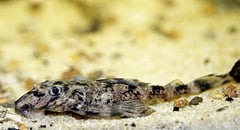
Dekeyseria pictaButterfly Plec
Loricariidae · (Kner, 1854)
The butterfly plec, Dekeyseria picta (L168), is a flattened loricariid catfish from the Rio Negro in Brazil. The Rio Orinoco fish traded as L052 is now included in the same species. Also called the chameleon plec, it changes colour to match the substrate and other surfaces and has a distinctive night-time colouration. It needs well-oxygenated water with plenty of movement.
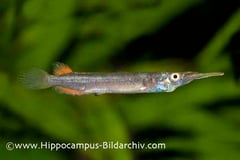
Dermogenys pusillaWrestling Halfbeak
Hemiramphidae · authority not recorded
The wrestling halfbeak, Dermogenys pusilla, is a halfbeak widespread from India and Myanmar east to Vietnam, the Philippines and Indonesia. Males fight by locking jaws, and in some of its native countries it is used as a fighting fish with wagers placed on the outcome. Probably the halfbeak most commonly seen in the trade, it can be delicate when first imported and is flighty, so dense planting around the edges helps protect its mouthparts from the glass.
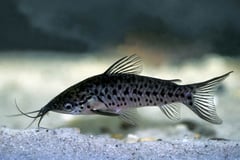
Dianema longibarbisPorthole Catfish
Callichthyidae · authority not recorded
The porthole catfish, Dianema longibarbis, is a peaceful callichthyid catfish from the Amazon basin in Peru and Brazil. It is named for the row of spots running along the lateral line. All specimens in the trade are wild-caught and new imports tend to be delicate and susceptible to disease, but once acclimatised it usually proves very hardy and can live for over 10 years.
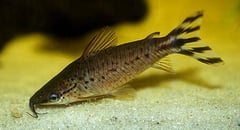
Dianema urostriatumFlagtail Catfish
Callichthyidae · authority not recorded
The flagtail catfish, Dianema urostriatum, is a peaceful callichthyid catfish from parts of the Brazilian Amazon basin. It lives away from the main river channels in slower creeks, tributaries, floodplain lakes and ponds. All specimens in the trade are wild-caught and new imports can be delicate, but once acclimatised it usually proves very hardy and adaptable, and suits the larger community tank.

Dicrossus filamentosusLyretail Checkerboard Cichlid
Cichlidae · authority not recorded
The lyretail checkerboard cichlid, Dicrossus filamentosus, is a cichlid from the Rio Orinoco in Colombia and Venezuela and the Brazilian Rio Negro. Formerly placed in Crenicara, it shares Dicrossus with D. maculatus, which looks similar but lacks the lyretailed caudal fin. Shy by nature, it needs a well-planted, dimly lit tank with plenty of hiding places, and very soft, acidic water to breed.

Dimidiochromis compressicepsMalawi Eye-Biter
Cichlidae · authority not recorded
The Malawi eye-biter, Dimidiochromis compressiceps, is a predatory cichlid endemic to Lake Malawi, where it is widely distributed. An ambush predator, it hides head-down among Vallisneria beds, its laterally compressed body and dark stripe from snout to tail helping to conceal it. Despite its name it mainly hunts small fish, and eye-eating happens infrequently in nature and rarely, if ever, in aquaria with well-fed specimens.
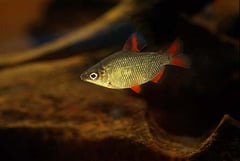
Distichodus affinisSilver Distichodus
Citharinidae · authority not recorded
The silver distichodus, Distichodus affinis, is an active citharinid from the Lower and Central Congo basin. It develops bright red fins as it matures and some specimens a pink sheen on the underside, and these variations may indicate different species. It will eat most greenery, so it suits a tank furnished with smooth rocks and driftwood better than a planted one.
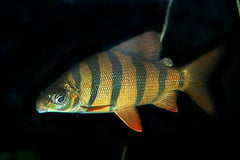
Distichodus sexfasciatusSix-banded Distichodus
Citharinidae · authority not recorded
The six-banded distichodus, Distichodus sexfasciatus, is a large citharinid from Cameroon, the Democratic Republic of Congo and Tanzania. The most common Distichodus in the hobby, it is often sold for the general community tank, which its temperament and size do not suit: it reaches 75 cm, though rarely more than 40 cm in aquaria. Juveniles are orange and black striped with red fins, but much of this colour fades as the fish grows.

Ectodus descampsiiDescamp's Strange-Tooth Cichlid
Cichlidae · authority not recorded
Descamp's strange-tooth cichlid, Ectodus descampsii, is a shy cichlid endemic to Lake Tanganyika, between Moliro and Utinta Bay. It inhabits open water over sand and is gregarious, so a group of at least eight is recommended. An undescribed fish, Ectodus sp. 'north', is sometimes imported under this name and has a smaller adult size and a black dorsal spot towards the front of the fin (in the middle in E. descampsii).
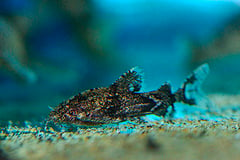
Erethistes maesotensis
Erethistidae · authority not recorded
Erethistes maesotensis is a small erethistid catfish known only from a single tributary of the Salween River on the border of Myanmar and Thailand. It lives in shallow, fast-flowing water over rocks and spends much of its time buried in the substrate or hiding in caves. Its outwardly pointing pectoral-fin denticles lead many experts to place it in Hara, though it is still officially included in Erethistes.
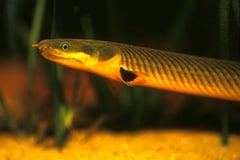
Erpetoichthys calabaricusRopefish
Polypteridae · authority not recorded
The ropefish, Erpetoichthys calabaricus, is a nocturnal polypterid from shallow, heavily vegetated waters in Western Africa. The only member of its genus, it is closely related to Polypterus, and its divided swim bladder serves as an accessory breathing organ, so it can drown if denied atmospheric air. It grows to 90 cm and will eat tankmates it can fit in its mouth.
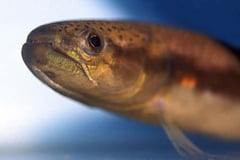
Erythrinus erythrinusRed Wolf Fish
Erythrinidae · authority not recorded
The red wolf fish, Erythrinus erythrinus, is a predatory erythrinid from Peru, French Guiana, Venezuela, Trinidad and Tobago and Brazil. Colour and pattern vary with collection locality, and genetic differences between populations suggest it is a species complex. A modified swim bladder lets it breathe in oxygen-deficient, stagnant water. It is very intolerant of conspecifics, often fighting them to the death, and will strike at nets and siphon tubes with its sharp teeth.
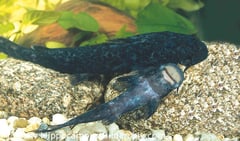
Euchilichthys guentheri
Mochokidae · authority not recorded
Euchilichthys guentheri is a mochokid catfish from the Democratic Republic of Congo, where it inhabits fast-flowing areas of rivers. It is very rare in the hobby. It is told apart from similar Chiloglanis species by its elliptical mouthparts and larger adult size, reaching 19 cm. It needs strong flow and well-oxygenated water, and becomes territorial with conspecifics as it matures.

Fossorochromis rostratus
Cichlidae · authority not recorded
Fossorochromis rostratus is a large, sand-sifting cichlid endemic to Lake Malawi, most common over shallow sandy substrates. When startled it may bury itself, and a sand substrate is essential since gravel may injure it. A very fast, active swimmer, it needs open water and should not be kept with boisterous species such as mbuna. Shoals of Cyrtocara moorii follow feeding groups in the wild to take the morsels they stir up.
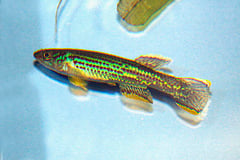
Fundulopanchax marmoratusMarbled Lyretail
Nothobranchiidae · authority not recorded
The marbled lyretail, Fundulopanchax marmoratus, is a rare killifish endemic to Cameroon, found in a single area of coastal rainforest. It inhabits small streams and ponds and occurs only in permanent water, so it is not an annual species. It needs cooler temperatures than most killifishes and is best kept in a species tank.
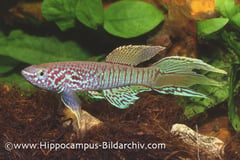
Fundulopanchax sjoestedtiGolden Pheasant
Nothobranchiidae · authority not recorded
The golden pheasant, Fundulopanchax sjoestedti, is a large killifish from Nigeria and Cameroon, reaching 12 cm, found in swampy coastal rainforest. Adult males are admired for their colouration. It was formerly classified as Aphyosemion sjoestedti, and much of the literature still uses that name. Several colour forms exist, including a smaller variety known as 'Dwarf Red'. Males are aggressive towards one another.
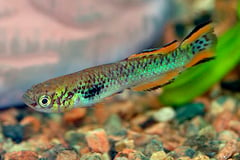
Fundulopanchax walkeri
Nothobranchiidae · authority not recorded
Fundulopanchax walkeri is a predatory killifish from the Ivory Coast and Ghana. It lives in small streams, swamps and ponds in coastal rainforest and forested savanna, and occurs as both an annual and a non-annual fish, so it can breed in permanent and temporary water. It needs cooler water than many killifishes, and will eat any fish that fits in its mouth. Some wild populations are threatened or extinct through rapid human development.
Gastrodermus napoensisNapo Cory
Callichthyidae · authority not recorded
The Napo cory, Gastrodermus napoensis, long known as Corydoras napoensis, is an armoured catfish from the upper Amazon in Peru and Colombia, including the Rio Napo and Rio Nanay. It belongs to the 'elegans group' of similar species with G. elegans, G. bilineatus and G. nanus. Males show a dark marking in the upper dorsal fin, but females are much harder to identify, especially as G. napoensis and G. elegans occur together and are often sold in mixed shipments.
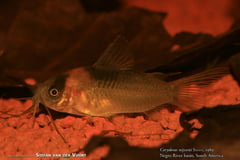
Gastrodermus nijsseniNijssen's Cory
Callichthyidae · authority not recorded
Nijssen's cory, Gastrodermus nijsseni, long known as Corydoras nijsseni, is an armoured catfish endemic to the Rio Negro basin in Brazil, living in acidic blackwater rivers and creeks. It was first described as a subspecies of G. elegans, and its rounded snout recalls that species, though its colour pattern is closer to Hoplisoma adolfoi. It suits a Rio Negro biotope or other softwater community.
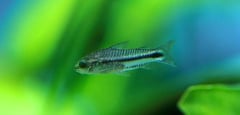
Gastrodermus pygmaeusPygmy Cory
Callichthyidae · authority not recorded
The pygmy cory, Gastrodermus pygmaeus, long known as Corydoras pygmaeus, is one of a handful of tiny Corydoras species and appears to be endemic to the Rio Madeira basin, Brazil. Unlike most of its congeners it swims in midwater. It is most often confused with G. hastatus, which has a dark diamond-shaped spot at the caudal peduncle, where G. pygmaeus has a dark stripe along the entire lateral line. Easily intimidated by larger tankmates, it is best kept in a group of at least six with other tiny species.
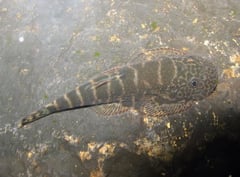
Gastromyzon sp. 'SK04'
Gastromyzontidae · authority not recorded
Gastromyzon sp. 'SK04' is an undescribed hillstream loach from South Kalimantan province, Indonesian Borneo. Based on colour pattern it appears similar to members of the G. lepidogaster group, which also includes G. psiloetron. It has occasionally been maintained by private collectors, and like its congeners it needs clean, well-oxygenated water with strong flow.
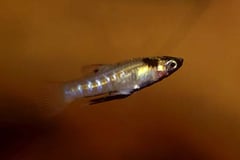
Girardinus metallicusMetallic Girardinus
Poeciliidae · authority not recorded
The metallic girardinus, Girardinus metallicus, is a small livebearer from Cuba. It lives in streams, ponds and ditches where the water is commonly stagnant and often brackish. Introduced to the aquarium trade in the early 20th century, it disappeared soon after and reappeared in a Berlin zoo in 1965. Breeding is very easy provided soft, acidic water is avoided.
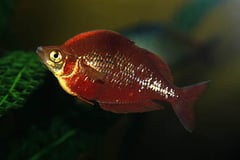
Glossolepis incisusRed Rainbowfish
Melanotaeniidae · authority not recorded
The red rainbowfish, Glossolepis incisus, is a rainbowfish from the Lake Sentani region of northern New Guinea, Indonesia. Also known as the salmon-red or New Guinea rainbowfish, it is usually found in shoals around heavily vegetated areas. Mass-bred fish have far less colour than wild ones. It is quite skittish and does far better in a shoal of at least 6-8.
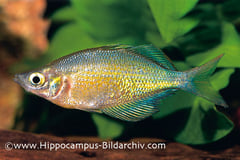
Glossolepis wanamensisLake Wanam Rainbowfish
Melanotaeniidae · authority not recorded
The Lake Wanam rainbowfish, Glossolepis wanamensis, is a rainbowfish endemic to Lake Wanam in Papua New Guinea. It is now considered critically endangered, a decline thought to result from introduced tilapia, Gambusia and carp and a big rise in the number of people living around the lake. A captive breeding programme has been set up, but it has been argued that most fish in the hobby are contaminated by cross-breeding with G. multisquamata.

Gnathochromis permaxillaris
Cichlidae · authority not recorded
Gnathochromis permaxillaris is a deep-water cichlid endemic to Lake Tanganyika, recorded foraging at depths of up to 200 metres. The upper lip of adults is extended to extraordinary proportions, so the mouth faces downwards when opened, and the fish uses it to sift invertebrates from the sand. It is rare in the trade because it is difficult to collect in numbers, it is sensitive to deteriorating water quality, and the colour morphs should not be mixed as they may hybridise.
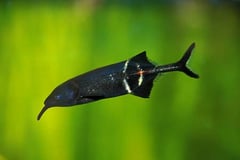
Gnathonemus petersiiElephantnose Fish
Mormyridae · authority not recorded
The elephantnose fish, Gnathonemus petersii, is a mormyrid with a vast African range, recorded in ten countries from Mali and Benin to Zambia. It uses its 'trunk' to find food hidden in the substrate, so it needs a soft substrate, and it needs dim lighting. Like other mormyrids it produces a weak electric field that it uses to navigate, hunt and communicate. It is very sensitive to deteriorating water conditions and to many medications, including salt.
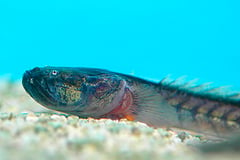
Gobioides broussonnetiiViolet Goby
Gobiidae · authority not recorded
The violet goby, Gobioides broussonnetii, is an estuarine goby from the southern USA, Central America, the Caribbean and northeastern South America. Also sold as the dragon or Peruvian goby, it grows very large (to 62.5 cm), has specialised feeding requirements and needs brackish water, as it does not survive for long in freshwater. The smaller, riverine G. peruanus is often imported under its name and is told apart by its smaller adult size and thicker, more purple body.
Gymnarchus niloticusAba Aba
Gymnarchidae · authority not recorded
The aba aba, Gymnarchus niloticus, is a large predatory fish from much of the northern half of Africa, and the only species in its genus. An extended dorsal fin gives it the alternative name upside-down knifefish, although it is more closely related to the mormyrids, and it uses a weak electrical discharge to navigate and communicate. Growing to 165 cm and extremely aggressive, it is simply not suited to the home aquarium in any respect.

Gymnocorymbus bondiSilver Tetra
Characidae · authority not recorded
The silver tetra, Gymnocorymbus bondi, is a characid from the Rio Orinoco basin in Colombia and Venezuela. It inhabits small tributaries, streams and creeks. Juveniles have reddish unpaired fins that fade as they mature, and the fairly bland adults are not often seen in the hobby. Peaceful and hardy, it is sometimes labelled G. socolofi, a name now considered a junior synonym of G. bondi.

Gymnocorymbus ternetziBlack Widow Tetra
Characidae · authority not recorded
The black widow tetra, Gymnocorymbus ternetzi, is a characid from the Rio Paraguay and Guaporé basins in Brazil, Bolivia and Argentina. All the fish in the trade are captive bred and unfussy about water chemistry and diet. The intense black of juveniles fades as they grow. Long-finned and 'golden' (leucistic) forms exist, the latter often sold as the 'white skirt tetra', and artificially dyed fish also turn up, a stressful process that often shortens their lifespan considerably.
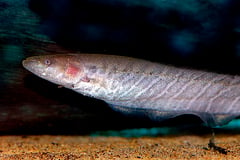
Gymnotus carapoBanded Knifefish
Gymnotidae · authority not recorded
The banded knifefish, Gymnotus carapo, is a gymnotid knifefish recorded across Central and South America, from Mexico to Argentina. Several species once considered G. carapo have been described since 1994, and its massive natural range will likely turn out to be far more restricted. It uses a weak electric field to navigate and communicate, and a modified swimbladder acts as an accessory breathing organ. It grows to 60 cm and is sensitive to many medications, particularly copper.

Haplochromis latifasciatus
Cichlidae · authority not recorded
Haplochromis latifasciatus is a cichlid found only in Lake Kyoga and the adjacent Lake Nawampasa, satellite lakes north of Lake Victoria in Uganda. Critically endangered in nature and possibly extinct in Lake Kyoga, it is quite easily bred in aquaria. It is often sold under the invalid name Astatotilapia latifasciata, or as Haplochromis sp. 'zebra obliquidens' or H. obliquidens, a Victorian species from a different lake. A maternal mouthbrooder, it must not be kept with Victorian Mbipi as they may hybridise.
Hara jerdoniAsian Stone Catfish
Sisoridae · authority not recorded
The Asian stone catfish, Hara jerdoni, is a tiny sisorid catfish from India and Bangladesh, found in slow-moving streams and small rivers. It grows to around 30 mm SL and is told apart from others in the genus by its elongated pectoral spines. It and its congeners also go by the name moth catfish, after their patterning and shape when viewed from above. Very peaceful, it prefers soft substrates and is outcompeted by active bottom-dwelling species.

Hasemania nanaSilvertip Tetra
Characidae · authority not recorded
The silvertip tetra, Hasemania nana, is a characid from the Rio São Francisco basin in Brazil. It inhabits creeks and tributaries away from the main river channels. Hasemania is one of the few characid genera whose members lack an adipose fin. All the fish in the trade are captive bred and unfussy about water chemistry and diet, and it is sometimes sold as the 'copper tetra'.
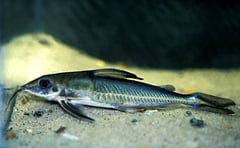
Hassar orestisBlack-top Mouse Catfish
Doradidae · authority not recorded
The black-top mouse catfish, Hassar orestis, is a doradid catfish recorded in Ecuador, Colombia, Venezuela, Guyana, Peru and Brazil. It can be delicate when first imported, and fish without a rounded belly or with sunken eyes are emaciated and seldom survive long. It resembles Nemadoras leporhinus, which has longer first fin rays and a clear dorsal fin with a dark patch at the base. Like other doradids it produces audible sounds, and its pectoral spines tangle easily in nets.
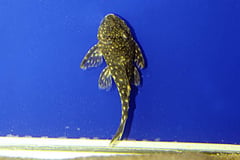
Hemiancistrus guahiborumL106
Loricariidae · authority not recorded
L106, Hemiancistrus guahiborum, is a suckermouth catfish known only from the Rio Orinoco drainage in Venezuela. Also known as the spotted orange seam plec, it lives amongst rocks in flowing water and needs well-oxygenated water with some current. Described in 2005, it may be the same species as the undescribed L122, although the flatter profile of L122 suggests the two are distinct.
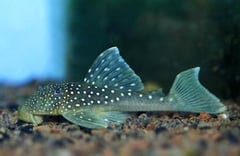
Hemiancistrus sp.Blue Phantom Plec
Loricariidae · authority not recorded
The blue phantom plec (L128) is a suckermouth catfish known only from the northern Rio Orinoco drainage in Venezuela. Its identity is unresolved. It closely resembles Hemiancistrus subviridis, the green phantom plec (L200), and the colour of the two grades from one into the other along the same river system, suggesting colour forms of one species, but this awaits scientific confirmation. Newly imported fish can be delicate, and emaciated fish with sunken eyes do not often survive for long.

Hemichromis bimaculatusJewel Cichlid
Cichlidae · authority not recorded
The jewel cichlid, Hemichromis bimaculatus, is a cichlid from Africa's western coast, between southern Guinea and central Liberia. Regularly seen in the trade and often sold as a community fish, it is not recommended for the beginner or the general community tank, and it becomes very aggressive when spawning. It can be told from H. lifalili by a third black spot, on the caudal peduncle.

Hemichromis lifaliliBlood-Red Jewel Cichlid
Cichlidae · authority not recorded
The blood-red jewel cichlid, Hemichromis lifalili, is a cichlid endemic to the Democratic Republic of Congo. Often confused with H. bimaculatus, it has two black spots on the flanks against that species' three, and its round midlateral marking sits above the lateral line, unlike the oval one of the red form of H. guttatus. It becomes very aggressive when spawning but is fairly placid otherwise, and is not a particularly good species for the community tank or for newcomers to cichlids.
Hemigrammus barrigonaeBarrigona Tetra
Characidae · authority not recorded
The barrigona tetra, Hemigrammus barrigonae, is a small characin from the Rio Meta and Orinoco basins in Colombia and Venezuela. It inhabits slow-moving rivers and tributaries. Not a common species in the hobby, it occasionally shows up as a contaminant among imports of more popular species. Like all Hemigrammus, its taxonomic status is Incertae Sedis, and most experts agree the genus needs a full revision.

Hemigrammus belottiiDash-dot Tetra
Characidae · authority not recorded
The dash-dot tetra, Hemigrammus belottii, is a small characin from the Rio Solimões, Negro and Maroni basins in Brazil and French Guiana. It is not common in the trade, and most specimens come in as contaminants among batches of more popular species. Like all Hemigrammus, its taxonomic status is Incertae Sedis, and most experts agree the genus needs a full revision.
Hemigrammus boesemaniBoesman's Tetra
Characidae · authority not recorded
Boesman's tetra, Hemigrammus boesemani, is a small characin officially recorded from Suriname, French Guiana and Peru. It favours sluggish and still waters. Very rare in the hobby, it was once considered a subspecies of H. micropterus. The recorded range suggests it has been misidentified in at least one of these countries or occurs in others as well.
Hemigrammus cupreusShiny Copper Tetra
Characidae · authority not recorded
The shiny copper tetra, Hemigrammus cupreus, is a small characin known only from the Rio Solimões in Brazil. It lives in the turbid white water of the river itself and in flooded habitats including the lakes known as várzeas, where conditions are far less acidic than in blackwater. Not common in the hobby, it occasionally shows up as a contaminant among imports of more popular species.

Hemigrammus erythrozonusGlowlight Tetra
Characidae · authority not recorded
The glowlight tetra, Hemigrammus erythrozonus, is a small characin known only from the Rio Essequibo in Guyana. Hardy and inexpensive, it is one of the best choices for a newcomer to fishkeeping. All fish in the trade are mass-bred on commercial farms, and a selectively-bred albino form is also sold. In nature it lives in forested tributaries with tannin-stained, often highly acidic water, and it is more colourful in acidic conditions.
Hemigrammus hyanuaryJanuary Tetra
Characidae · authority not recorded
The January tetra, Hemigrammus hyanuary, is a small characin from the Amazon basin in Peru and Brazil. Also known as the costello or green neon tetra, it resembles an elongated head and tail light tetra, H. ocellifer, and is occasionally confused with it. The type specimen came from Lake Hyanuary near Manaus. It inhabits slow-moving rivers, tributaries and floodplain lakes and tends to lose colour in alkaline water.
Hemigrammus levis
Characidae · authority not recorded
Hemigrammus levis is a small characin native to the Brazilian Amazon, found in slow-moving rivers, tributaries and floodplain lakes. A rather rare fish in the UK hobby, it occasionally shows up as a contaminant among imports of more popular species. Like all Hemigrammus, its taxonomic status is Incertae Sedis, and most experts agree the genus needs a full revision.

Hemigrammus rodwayiGolden Tetra
Characidae · authority not recorded
The golden tetra, Hemigrammus rodwayi, is a small characin native to Guyana, Suriname, French Guiana, Peru and Brazil. Its normal colour is a rather dull silvery grey. In some areas wild fish react to a trematode parasite with metallic gold deposits of guanin in the skin, and these were once described as a separate species, H. armstrongi. Captive-bred fish are not exposed to the parasite, so most 'golden tetras' on sale lack the gold colour.

Hemigrammus stictusRed-base Tetra
Characidae · authority not recorded
The red-base tetra, Hemigrammus stictus, is a small characin from Venezuela, Guyana and Brazil. It inhabits slow-moving rivers, tributaries and floodplain lakes. Not often seen for sale, it occasionally shows up as a contaminant among imports of more popular species. Like all Hemigrammus, its taxonomic status is Incertae Sedis, and most experts agree the genus needs a full revision.

Hemigrammus ulreyiBroken-line Tetra
Characidae · authority not recorded
The broken-line tetra, Hemigrammus ulreyi, is a small characin known only from the Brazilian part of the Rio Paraguay basin. Other species are frequently misidentified as H. ulreyi, and the true fish is quite scarce in the hobby. It inhabits slow-moving rivers and tributaries. Like all Hemigrammus, its taxonomic status is Incertae Sedis, and most experts agree the genus needs a full revision.

Hemigrammus unilineatusFeatherfin Tetra
Characidae · authority not recorded
The featherfin tetra, Hemigrammus unilineatus, is a small characin widespread across northern South America, from Venezuela to Peru and Brazil. Despite its abundance in nature it is not commonly seen in the hobby, and usually turns up only as a contaminant among imports of other species. A very peaceful shoaling fish, it inhabits slow-moving rivers, tributaries, oxbow lakes and ditches, some clear and others murky with sediment.
Hemigrammus vorderwinkleri
Characidae · authority not recorded
Hemigrammus vorderwinkleri is a small tetra known only from the Rio Negro in Brazil, where it inhabits blackwater rivers and tributaries. It is most likely to be seen as a contaminant among imports of other species. A very peaceful shoaling fish growing to around 40 mm SL, it suits a blackwater biotope or a heavily planted tank, since fish on sale will almost certainly be wild caught.
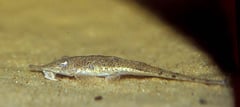
Hemiodontichthys acipenserinusPinocchio Whiptail Catfish
Loricariidae · authority not recorded
The Pinocchio whiptail catfish, Hemiodontichthys acipenserinus, is a loricariid from Guyana, French Guiana, Peru, Bolivia and Brazil. Also known as the knob nosed whiptail, it is hard to confuse with any other Loricariid thanks to its diamond shape seen from above and the enlarged tip of its rostrum. Imports often arrive weak from oxygen deprivation and early losses are high, but once acclimatised it is quite easy to keep over the soft sand in which it partially buries itself.
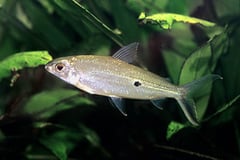
Hemiodus argenteus
Hemiodontidae · authority not recorded
Hemiodus argenteus is a shoaling hemiodontid characin from Venezuela, Guyana, Suriname and Brazil, where it inhabits floodplain rivers and lakes. Like its congeners it can be very skittish when first introduced but usually settles over time, especially in a large group. Very active and growing to around 235 mm SL, it needs a large tank with a well-fitting cover, as it can leap surprising distances.
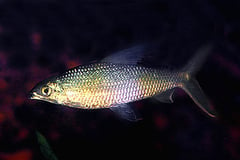
Hemiodus atranalis
Hemiodontidae · authority not recorded
Hemiodus atranalis is a shoaling hemiodontid characin from Guyana, Peru and Brazil, found in floodplain rivers and lakes. Its reported maximum size is only 90 mm, though it probably grows bigger than this. Very active and skittish when first introduced, it usually settles in a large group, and the tank needs a well-fitting cover since it can leap surprising distances.
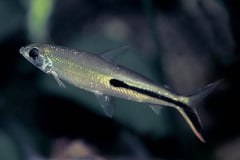
Hemiodus gracilisSlender Hemiodus
Hemiodontidae · authority not recorded
The slender hemiodus, Hemiodus gracilis, is a shoaling characin from Venezuela and Brazil, found in floodplain rivers and lakes. Probably the most often seen member of the genus in the hobby, it is sometimes sold as the red or red-tailed hemiodus. Very active and nervous when first introduced, it settles best in a large group in a spacious tank with a well-fitting cover.
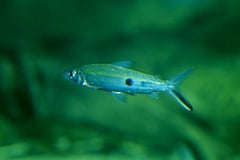
Hemiodus orthonops
Hemiodontidae · authority not recorded
Hemiodus orthonops is a large, shoaling hemiodontid characin from Brazil, Paraguay and Argentina, where it inhabits floodplain rivers and lakes. Growing to around 250 mm SL and very active, it needs a tank of at least 120 cm with a well-fitting cover. Like its congeners it can be nervous when first introduced but usually settles over time, especially in a large group.
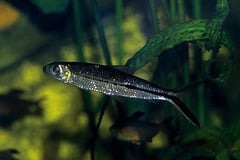
Hemiodus ternetzi
Hemiodontidae · authority not recorded
Hemiodus ternetzi is a shoaling hemiodontid characin known only from the Rio Tocantins basin in Brazil. It can be identified by its black lateral stripe, which extends to behind the eye, and a dorsal fin with no pigmentation. Like other Hemiodus it can be skittish when first introduced but usually settles, especially in a large group.
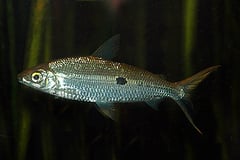
Hemiodus unimaculatus
Hemiodontidae · authority not recorded
Hemiodus unimaculatus is a large, shoaling hemiodontid characin from Guyana, Suriname, French Guiana and Brazil. It inhabits floodplain lakes and fast-moving parts of rivers and grows to around 215 mm SL. Somewhat flighty, it needs a spacious, well-covered tank and a large group to settle, and in nature it is known to spawn during the wet season.
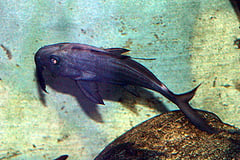
Hemisynodontis membranaceusMoustache Catfish
Mochokidae · authority not recorded
The moustache catfish, Hemisynodontis membranaceus, is a large mochokid widespread in Africa, from Egypt and Sudan to Senegal and Nigeria. Its 'moustache' is a membrane along the maxillary barbels. It feeds mainly on plankton, filtered through its many gill rakers, and often feeds at the surface upside down. Often sold as a spotted juvenile, it can reach 50 cm and becomes territorial with conspecifics as it matures.
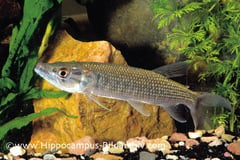
Hepsetus odoeAfrican Pike Characin
Hepsetidae · authority not recorded
The African pike characin, Hepsetus odoe, is a predatory characin widespread in Africa, from Senegal and Guinea to Angola, Namibia and Zimbabwe. The only species in its genus, it is an ambush predator with a fearsome set of teeth that superficially resembles the European pike. Juveniles appear in the trade, but it reaches 70 cm in nature and is strictly for the specialist with a very large aquarium.

Herichthys carpintisPearlscale Cichlid
Cichlidae · (Jordan & Snyder, 1899)
The pearlscale cichlid, Herichthys carpintis, is a large cichlid from northern Mexico, found in lagoons around the mouth of the Panuco drainage. It is often mislabelled as the Texas or green Texas cichlid, though the Texas cichlid is a different species, H. cyanoguttatus. Not difficult to keep or breed, it digs, can be territorial and sometimes downright aggressive, and males may turn on females when spawning.

Herichthys pearsei
Cichlidae · authority not recorded
Herichthys pearsei is a large, almost exclusively vegetarian cichlid from the coastal waters of eastern Mexico and Guatemala. Males reach around 42.5 cm and females around 35 cm, so a fully grown male or pair needs a tank of around 240 cm, and any plants will be eaten. For its size it is quite placid, and suits a community of bigger fish that share its need for hard, alkaline water.

Heros efasciatusSeverum
Cichlidae · authority not recorded
The severum, Heros efasciatus, is a cichlid from the Amazon main channel and the Rio Solimoes, also recorded from the Rio Xingu. One of the most popular and readily available cichlids in the hobby, it is sold in the standard green form and in gold. Many buyers do not realise it grows fairly large, often 20 to 25 cm in aquaria, and it needs a tank of at least 120 cm. Outside spawning it is fairly mild-mannered for its size.

Heros notatusSpotted Severum
Cichlidae · authority not recorded
The spotted severum, Heros notatus, is a cichlid endemic to the Rio Negro basin in Brazil, where it inhabits blackwater rivers and tributaries. Rarely seen, it is occasionally offered by specialist cichlid or South American dealers. Not a particularly aggressive species, though males may squabble with conspecifics, it suits a larger cichlid community, and much smaller fish will almost certainly be eaten.

Herotilapia multispinosaRainbow Cichlid
Cichlidae · authority not recorded
The rainbow cichlid, Herotilapia multispinosa, is a Central American cichlid from eastern Honduras and throughout Nicaragua and Costa Rica. Peaceful by Central American standards, it suits fishkeepers who do not want the more aggressive species, and can live with tetras, barbs and smaller peaceful cichlids. In nature it inhabits turbid lakes, swamps and marshes with soft, muddy substrates, and in the aquarium it typically reaches around 10 cm.
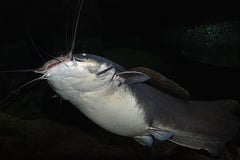
Heterobranchus longifilisVundu
Clariidae · authority not recorded
The vundu, Heterobranchus longifilis, is a clariid catfish widespread throughout Africa and one of the largest freshwater fishes on the continent. Growing to 150 cm, it is highly predatory, must be kept alone, and suits only public aquaria or a hobbyist able to house it properly. Its very long adipose fin separates it from similar members of the genus.
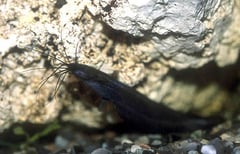
Heteropneustes fossilisLiver Catfish
Clariidae · authority not recorded
The liver catfish, Heteropneustes fossilis, is a catfish from Iran, Pakistan, India, Nepal, Sri Lanka, Bangladesh, Myanmar and the Andaman Islands. Also known as the stinging or fossil catfish, it carries venom sacs at the base of the pectoral spines and its sting is very painful, so it is not recommended for the inexperienced. Exceptionally hardy and long-lived, it can breathe atmospheric air to a certain extent and survives in sluggish, oxygen-deficient swamps and ditches.

Holopristis ocelliferaHead-and-tail light Tetra
Characidae · authority not recorded
The head-and-tail light tetra, Holopristis ocellifera, is a small characin from Guyana, Suriname, French Guiana, Peru and Brazil. Also known as the beacon tetra, it is hardy, inexpensive and one of the best choices for a newcomer to fishkeeping. Wild fish are rarely offered, since it is commercially bred in huge numbers for the trade, and a selectively bred albino form is also available.

Holopristis pulchraPretty Tetra
Characidae · authority not recorded
The pretty tetra, Holopristis pulchra, is a small characin endemic to the Upper Amazon in Peru, found in slow-moving tributaries under forest cover. Also known as the garnet or black wedge tetra, it is hardy, inexpensive and a good choice for the beginner. The vast majority on sale in the UK come from commercial farms in Eastern Europe, and it does well in most general community tanks.
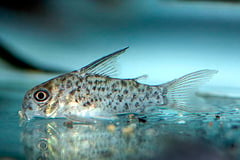
Hoplisoma loretoense
Callichthyidae · authority not recorded
Hoplisoma loretoense, long known as Corydoras loretoensis, is an armoured catfish from the upper Amazon in Peru, growing to around 50 mm SL. The profile singles out its very long dorsal spine. Nothing is recorded of its habitat.
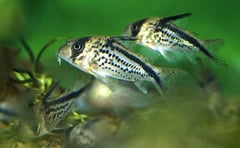
Hoplisoma loxozonum
Callichthyidae · authority not recorded
Hoplisoma loxozonum, long known as Corydoras loxozonus, is an armoured catfish from the Rio Meta basin in Colombia, also referred to by its C-number, C082. Its habitat in the wild is unknown. It prefers slightly lower temperatures than many Corydoras, which matters when choosing tankmates.
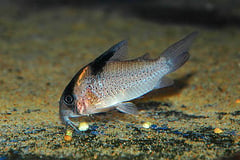
Hoplisoma melanistiumSpotted Cory
Callichthyidae · authority not recorded
The spotted cory, Hoplisoma melanistium, long known as Corydoras melanistius, is an armoured catfish from coastal rivers and tributaries of Guyana, Suriname and French Guiana. It can be told from the similar Brochis delphax by its 12-13 dorsal-fin rays, against usually 7 in B. delphax. Two subspecies once assigned to it are now H. brevirostre and B. ambiacus.
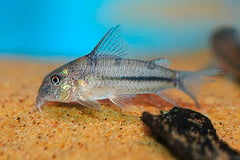
Hoplisoma nattereriNatterer's Cory
Callichthyidae · authority not recorded
Natterer's cory, Hoplisoma nattereri, long known as Corydoras nattereri, is an armoured catfish from coastal zones of southern Brazil between Espírito Santo and Paraná. Also known as the blue cory, it needs slightly cool conditions, in which many commonly available fish fail to thrive.
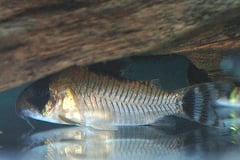
Hoplisoma oiapoquenseFlag-tailed Panda Cory
Callichthyidae · authority not recorded
The flag-tailed panda cory, Hoplisoma oiapoquense, long known as Corydoras oiapoquensis, is an armoured catfish from the upper Rio Oyapock in French Guiana and Brazil. It lives alongside the near-identical Brochis condiscipulus, and the two are often found shoaling together. The only external differences seem to be the longer snout and wider distribution in the Oyapock of B. condiscipulus.
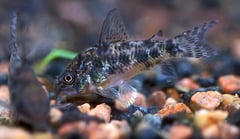
Hoplisoma paleatumPepper Cory
Callichthyidae · authority not recorded
The pepper cory, Hoplisoma paleatum, long known as Corydoras paleatus, is an armoured catfish from southern Brazil, Uruguay, Paraguay and Argentina. Along with the bronze cory it is one of the most commonly found corys in the hobby. Most fish on sale are captive bred for the trade, and wild-caught specimens are much more vividly coloured. In nature it lives in rivers, tributaries and standing waters including pools and small lakes.
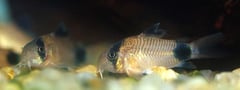
Hoplisoma pandaPanda Cory
Callichthyidae · authority not recorded
The panda cory, Hoplisoma panda, long known as Corydoras panda, is an armoured catfish from the upper Amazon in Peru, named for dark and light markings that recall the giant panda. Wildly expensive when first imported in the late 1970s, it is now mass-produced, and virtually all fish in the trade are farmed. Wild fish live in clear and blackwater streams that cool to around 19 °C when Andean meltwater arrives.
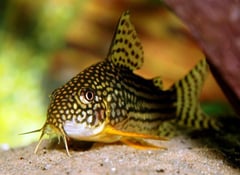
Hoplisoma sterbaiSterba's Cory
Callichthyidae · authority not recorded
Sterba's cory, Hoplisoma sterbai, long known as Corydoras sterbai, is a peaceful armoured catfish from Bolivia and Brazil, marked with light spots on a dark head. Almost all fish in the trade are produced commercially on farms. The head pattern separates it from the similar Brochis haraldschultzi, in which the markings are dark on a light background, and it is generally considered one of the easiest Corydoras to spawn.
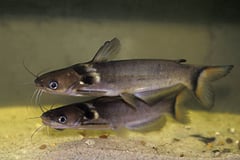
Horabagrus nigricollarisBlack Collared Catfish
Bagridae · authority not recorded
The black collared catfish, Horabagrus nigricollaris, is a bagrid catfish endemic to the Chalakudy River in Kerala, south-western India. The rarer of the two species in the genus in the hobby, it resembles the much larger H. brachysoma. Both are usually sold as juveniles, and in this species the black shoulder marking extends up and over the top of the body, giving the collar that names it.
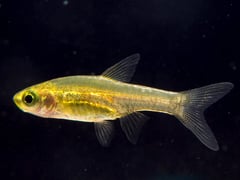
Horadandia atukorali
Cyprinidae · Deraniyagala, 1943
Horadandia atukorali is a miniature cyprinid from Sri Lanka and southern India, where it is restricted to Kerala, Tamil Nadu and Puducherry. Its small adult size evolved through miniaturisation, and it shows a preference for sluggish and still waters such as rice paddies, swamps and weedy ponds. Very peaceful but timid, it does best alone or with other diminutive species in a densely-planted tank.
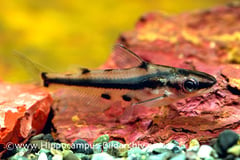
Hyalobagrus flavusShadow Catfish
Bagridae · authority not recorded
The shadow catfish, Hyalobagrus flavus, is a small bagrid catfish from the Batang Hari drainage in Sumatra and the Mentaya basin in Borneo. For many years it has been imported as Pelteobagrus ornatus. Unlike most catfish it is diurnal and spends much of its time swimming in shoals in midwater, and it suits a peaceful community with soft, acidic water.
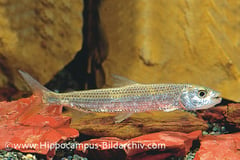
Hydrocynus vittatusAfrican Tiger Fish
Alestidae · authority not recorded
The African tiger fish, Hydrocynus vittatus, is a large predatory alestid found throughout Africa, from Egypt to South Africa. A voracious piscivore with dagger-shaped, interlocking teeth, it hunts in large shoals in the wild and is a popular game fish. Small specimens show up quite frequently in dealers' tanks, but even an aquarium of 300 by 90 cm is too small for an adult.
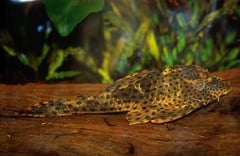
Hypostomus cf. cochliodonSpotted Cochliodon
Loricariidae · authority not recorded
The spotted cochliodon (L050), Hypostomus cf. cochliodon, is an undescribed suckermouth catfish of the Hypostomus cochliodon complex. Like other members of the group it develops a hump-backed profile and spoon-shaped teeth, and eats wood. Its exact distribution is unknown. It grows to around 230 mm SL and is non-territorial enough to keep in a group or with other peaceful loricariids.
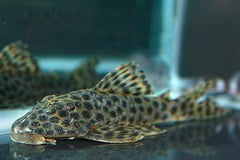
Hypostomus mutucaeLDA10
Loricariidae · authority not recorded
LDA10, Hypostomus mutucae, is a small suckermouth catfish from Mato Grosso, Brazil, with its type specimen collected in the Rio Mutuca. It grows to around 75 mm and is peaceful, and it inhabits flowing, highly oxygenated water over sand scattered with rocks. It is often confused with LDA09 but has smaller spots on the head, where LDA09 has larger spots of uniform size all over.
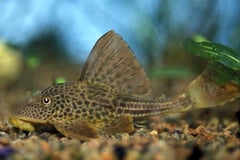
Hypostomus plecostomoidesLDA42
Loricariidae · authority not recorded
Hypostomus plecostomoides (LDA42, LDA38) is a wood-eating suckermouth catfish from the Rio Orinoco drainage in Colombia and Venezuela. A member of the Hypostomus cochliodon complex, it has a hump-backed profile and spoon-shaped teeth. It is very difficult to tell from H. hondae, H. pagei and H. taphorni, and collection locality is often the best guide.

Hypselecara temporalisChocolate Cichlid
Cichlidae · authority not recorded
The chocolate cichlid, Hypselecara temporalis, is a large cichlid from Peru, Colombia, Venezuela and Brazil. It most often inhabits silt-laden, slow-flowing rivers, and has been collected in the Ucayali, Amazonas, Solimões, Amapá and Oyapock. Although it reaches 30 cm, it is quite a placid species and can be kept in a community of large fish in a suitably-sized tank.
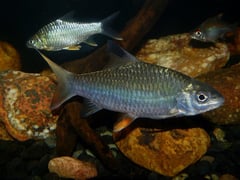
Hypselobarbus jerdoniJerdon's Carp
Cyprinidae · authority not recorded
Jerdon's carp, Hypselobarbus jerdoni, is a large cyprinid endemic to India, recorded from Maharashtra, Karnataka, Kerala and Tamil Nadu. A riverine fish of clear, well-oxygenated, running water, it can reach 46 cm and is very rarely encountered in the trade. Very active and a vigorous feeder, it needs a tank of 240 ∗ 120 ∗ 120 cm or more for a group of adults, and many Indian authors consider it endangered.

Hypsophrys nicaraguensisNicaragua Cichlid
Cichlidae · authority not recorded
The Nicaragua cichlid, Hypsophrys nicaraguensis, is a Central American cichlid from Nicaragua and Costa Rica, found in lakes and slow-moving rivers. Also known as the spilotum or moga, it exists in several colour forms depending on collection locality, and has been hybridised with the convict cichlid, Archocentrus nigrofasciatus. Relatively peaceful for its size but territorial, it is best kept as a mated pair and spawns in caves.
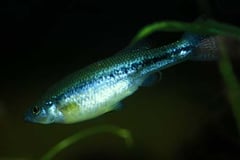
Ilyodon furcidensGoldbreast Goodeid
Goodeidae · authority not recorded
The goldbreast goodeid, Ilyodon furcidens, is a livebearer from Jalisco and Colima in Mexico, found in fast-flowing streams and small rivers. Also called the goldbreast splitfin, it is named for its fork-shaped teeth. Like other goodeids it nourishes its developing young through a trophotaenia, and females must be mated separately for each brood. A peaceful fish, it suits a community whose other species can cope with the lower temperatures it needs.

Inpaichthys kerriPurple Emperor Tetra
Characidae · authority not recorded
The purple emperor tetra, Inpaichthys kerri, is a small characin from the Rio Aripuanã and upper Rio Madeira basins in Brazil. Also sold as the 'blue emperor', 'regal' or 'royal' tetra, it is sometimes confused with the emperor tetra, Nematobrycon palmeri, but can be told apart by its adipose fin (absent in Nematobrycon). It lives in sluggish, tannin-stained forest tributaries and has been spawned regularly in the hobby.
Iodotropheus sprengeraeRusty Cichlid
Cichlidae · authority not recorded
The rusty cichlid, Iodotropheus sprengerae, is a dwarf mbuna endemic to Lake Malawi, around the islands of Boadzulu, Chinyankwazi and Chinyamwezi. One of the least aggressive and smallest mbuna in the hobby, it is easily outcompeted by bigger species and can be kept in smaller tanks. It is sometimes confused with certain populations of Labidochromis vellicans, and as a polygamous maternal mouthbrooder is easily bred.

Julidochromis dickfeldiBrown Julie
Cichlidae · authority not recorded
The brown julie, Julidochromis dickfeldi, is a cave-spawning cichlid endemic to Lake Tanganyika. It inhabits shallow rocky shorelines in the southwest of the lake, between Kapampa and Ndole. There is some speculation over whether it belongs in Julidochromis, since it has a pointed snout, blue edging to the dorsal and anal fins and very dark horizontal stripes. It is aggressive towards conspecifics and should be kept as a pair.

Julidochromis reganiRegan's Julie
Cichlidae · authority not recorded
Regan's julie, Julidochromis regani, is the largest species of Julie, a cichlid endemic to Lake Tanganyika. It reaches 30 cm but rarely grows beyond 15 cm in aquaria, and is the least aggressive member of the genus. Less of a rock dweller than its congeners, it is more often found over sand with scattered rocks, though it still spawns in rocky caves. It may also be seen for sale as the striped or convict julie.

Knodus borkiBlue Tetra
Characidae · authority not recorded
The blue tetra, Knodus borki, is a small characid from Colombia and Brazil, found in rivers, streams and tributaries. Its colour is often so intense that many who first see it for sale assume it has been artificially coloured, though it will not develop its best colours in sparse surroundings. It may nip the fins of conspecifics and long-finned fishes, which a group of 8-10 in a larger tank helps to limit.
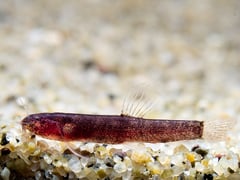
Kottelatlimia katik
Cobitidae · Kottelat & Lim, 1992
Kottelatlimia katik is a miniature cobitid loach from Johor in Peninsular Malaysia and the Batang Hari drainage of Sumatra, reaching 13.5 mm SL. It is considered paedomorphic, keeping juvenile features such as long fins and long nasal barbels into adulthood. It lives in small forest streams associated with blackwater peat swamps, often in leaf litter, and needs a soft sandy substrate and spotless water.

Labeotropheus fuelleborniFuelleborn's Cichlid
Cichlidae · authority not recorded
Fuelleborn's cichlid, Labeotropheus fuelleborni, is an mbuna endemic to Lake Malawi, found in turbulent shallow water around rocky shorelines. An overhanging snout and chisel-shaped teeth let it graze algae from rocks other species cannot reach. It occurs in many colour forms, including orange and orange blotch females, and forms should not be mixed as they may hybridise. It is aggressive and territorial and should not be kept with peacocks or utaka.

Labeotropheus trewavasaeTrewavas' Cichlid
Cichlidae · authority not recorded
Trewavas' cichlid, Labeotropheus trewavasae, is an mbuna endemic to Lake Malawi, living around rocky shorelines and islands with heavy algal growth. It is told from the similar L. fuelleborni by its more slender body and smaller adult size, and has been recorded at greater depths. Over 40 colour forms are recorded in nature, and they should not be mixed in aquaria as they may hybridise. It is very aggressive towards its own kind.

Labidochromis caeruleusCaeruleus
Cichlidae · authority not recorded
Labidochromis caeruleus is a relatively peaceful mbuna from the northern part of Lake Malawi, best known in the hobby for its 'electric yellow' morph. That morph is one of the rarer forms in nature, where the blue and white variety is more widespread, and most fish on sale are tank-bred. It lives among rocks and in beds of Vallisneria. It was originally imported as L. tanganyicae, and should not be mixed with other forms or Labidochromis species as they may hybridise.

Labidochromis sp. "perlmutt"Pearly Labidochromis
Cichlidae · authority not recorded
Labidochromis sp. 'perlmutt' is an mbuna endemic to Lake Malawi, known from Higga Reef and Mbamba Bay, where it lives in deep rocky zones. Discovered in 1995, it takes its name from the German for 'mother of pearl', after the pearly white colouration of adults, and is also sold as Labidochromis sp. 'yellow bar'. The Mbamba Bay Island population closely resembles L. caeruleus and the two hybridise freely, so they should not be kept together.
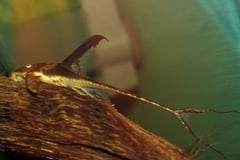
Lamontichthys llanero
Loricariidae · authority not recorded
Lamontichthys llanero is a suckermouth catfish from the Orinoco basin in Venezuela. It lives among rocky substrates and driftwood snags in shallow, flowing water, and needs well-oxygenated water with plenty of movement. Unaggressive and peaceful with conspecifics, it is rarely seen in the hobby.

Lamprologus congoensisCongo Lamprologus
Cichlidae · authority not recorded
The Congo lamprologus, Lamprologus congoensis, is a cichlid from fast-moving stretches of the Congo River in the Republic of Congo and DR Congo. It resembles Steatocranus species in shape and lifestyle, with a streamlined body, strong pectoral fins and a much-reduced swimbladder that makes it less buoyant. Aggressive and territorial, it should not be kept with other cichlids. It spawns polygamously in caves, and males develop a prominent nuchal hump.
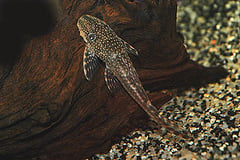
Lasiancistrus tentaculatusL092
Loricariidae · authority not recorded
Lasiancistrus tentaculatus (L092, L194) is a wood-eating suckermouth catfish from Colombia and Venezuela. The only primarily wood-eating Lasiancistrus, it will not do well without wood as a food source, and lives among driftwood snags in rivers. Mature males develop a few Ancistrus-like tentacles around the mouth, the only species in the genus to do so. Sunken eyes and a belly that is not rounded are classic signs of emaciation in newly imported fish.
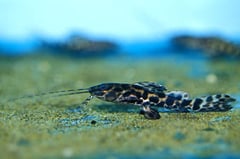
Leiarius longibarbisMarbled Pim
Pimelodidae · authority not recorded
The marbled pim, Leiarius longibarbis, is a large pimelodid catfish from the Rio Orinoco, Rio Essequibo and Amazon basins. It grows to around 80 cm and can live for well over 20 years, and whether it should be considered an aquarium subject at all is debatable. Much of the literature still lists it as L. marmoratus, a name treated as a junior synonym since a reclassification in 2003.
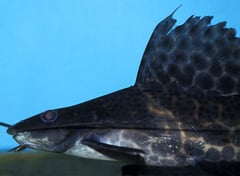
Leiarius pictusSailfin Pim
Pimelodidae · authority not recorded
The sailfin pim, Leiarius pictus, is a large pimelodid catfish from the Rio Orinoco basin in Colombia and Venezuela and the Amazon in Peru and Brazil. Also known as the painted, saddle or marbled sailfin catfish, it reaches around 60 cm and can live for well over 20 years. Juveniles are often sold without adequate information on their long-term care, and a fully-grown fish needs a tank in the region of 240 by 90 by 120 cm.
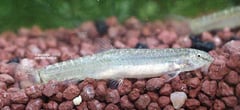
Lepidocephalichthys cf. irrorataLoktak Loach
Cobitidae · Hora, 1921
The Loktak loach, Lepidocephalichthys irrorata, is a small cobitid from north-eastern India and Bangladesh. Hora described it as widely distributed in lakes and streams of the Manipur Valley, and some of his specimens came from Loktak Lake. It grows to only 29 mm SL, has large, exposed scales on top of the head, and is occasionally exported as bycatch among other species.
Lepidosiren paradoxaSouth American Lungfish
Lepidosirenidae · authority not recorded
The South American lungfish, Lepidosiren paradoxa, is found across the Amazon, Rio Paraguay and lower Paraná basins. The only lungfish known from South America, it is an obligatory air breather and survives the dry season by aestivating in a mucous cocoon inside a burrow in the mud. It can reach 125 cm and live for well over 20 years, so whether it should be considered an aquarium subject at all is debatable.
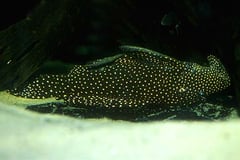
Leporacanthicus galaxiasGalaxy Plec
Loricariidae · authority not recorded
The galaxy plec, Leporacanthicus galaxias (L029), is a suckermouth catfish from the Amazon, Tocantins and other river basins in Brazil. Also sold as the vampire or tusken plec, it lives in rapids and other fast-flowing waters. Four similar undescribed variants, L007, L240, L241 and L294, are known as L. cf. galaxias and are best referred to by their L numbers.
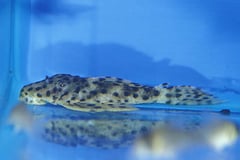
Leporacanthicus heterodonGolden Vampire Plec
Loricariidae · authority not recorded
The golden vampire plec, Leporacanthicus heterodon, is a suckermouth catfish from the Rio Xingu basin in Brazil. It lives in rapids and other fast-flowing waters. The 'vampire' name refers to the two large teeth in the upper jaw shared by the genus, probably used to grip prey such as snails.
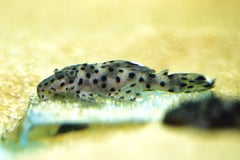
Leporacanthicus joselimaiSultan Plec
Loricariidae · authority not recorded
The sultan plec, Leporacanthicus joselimai (L264), is a suckermouth catfish from the Rio Tapajós in Brazil. It lives in rapids and other fast-flowing waters among rocks and driftwood snags. Young fish have white fin tips that fade with growth and often disappear completely. Territorial with conspecifics, particularly males, it has been bred in the hobby as a cave spawner.
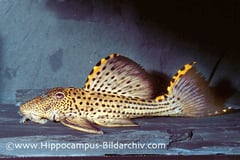
Leporacanthicus triactisThree Beacon Plec
Loricariidae · authority not recorded
The three beacon plec, Leporacanthicus triactis (L091), is a suckermouth catfish from the upper Orinoco basin in Colombia and Venezuela. Several colour forms are available with varying amounts of orange in the fins, some sold as 'dragon fin' or 'tiger fin', and the colour is retained as the fish matures. It lives in rapids and is territorial with conspecifics, particularly males.

Lestradea perspicax
Cichlidae · authority not recorded
Lestradea perspicax is a cichlid endemic to the northern end of Lake Tanganyika, where it inhabits shallow water over sandy substrates. There is some confusion over the taxonomy of this species and its congener L. stappersi, which was originally regarded as a subspecies of perspicax and is now considered distinct. Very peaceful, and a maternal mouthbrooder in nature, it is not often seen in the hobby.
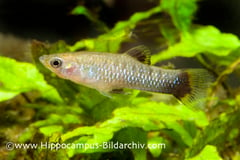
Limia melanogasterBlack-bellied Limia
Poeciliidae · authority not recorded
The black-bellied limia, Limia melanogaster, is a small livebearer endemic to Jamaica, where it usually lives in small streams. Originally placed in Limia, it was later treated as a member of Poecilia and has since been returned to Limia, but much of the literature still refers to it as Poecilia. Peaceful and easy to breed, it is not often seen for sale in the hobby.
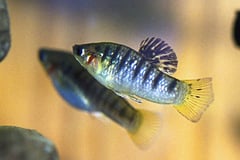
Limia nigrofasciataHump-backed Limia
Poeciliidae · authority not recorded
The hump-backed limia, Limia nigrofasciata, is a livebearer from Haiti and the Dominican Republic, found in shallow, heavily vegetated water. It usually swims in large shoals and also occurs in brackish conditions at several locations. Adult males develop a characteristic hump along the spine, caused by deposition of fatty tissue, and the species breeds very easily provided soft, acidic water is avoided.
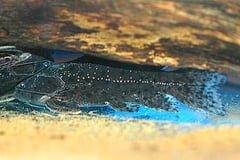
Liosomadoras morrowiFalse Jaguar Catfish
Auchenipteridae · authority not recorded
The false jaguar catfish, Liosomadoras morrowi, is an auchenipterid catfish from the Río Ucayali basin in Peru. It is often confused with its congener L. oncinus, from which it differs in its duller patterning. Nocturnal, peaceful and shy, it will eat small fish during the hours of darkness, and fertilisation is internal, with the male's extended anal fin used in a similar way to a livebearer's gonopodium.
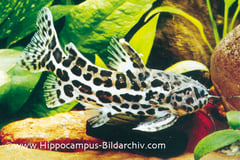
Liosomadoras oncinusJaguar Catfish
Auchenipteridae · authority not recorded
The jaguar catfish, Liosomadoras oncinus, is an auchenipterid catfish from the Ucayali, Amazonas and Negro river basins in South America. Often confused with L. morrowi, it has brighter patterning and grows larger, to around 250 mm SL. Formerly placed in the Doradidae because of its opercular spines, it is nocturnal and generally peaceful but eats small fish after dark. Its water requirements depend on where it was collected.
Lophiobagrus cyclurusAfrican Bullhead
Claroteidae · authority not recorded
The African bullhead, Lophiobagrus cyclurus, is a small claroteid catfish endemic to Lake Tanganyika. It hides among rocks by day and forages after dark, and it lives in most communities of Tanganyikan catfish and cichlids, though very small fish will be eaten. It is rumoured to secrete a poisonous mucus when stressed that can kill other fish in the aquarium, which is one reason to house it in as large a tank as possible.

Lugubria lugubrisAtabo Red Pike Cichlid
Cichlidae · (Heckel, 1840)
The Atabo red pike cichlid, Lugubria lugubris, is a large pike cichlid from rivers in Suriname, Guyana and Brazil. Colourful when small, it quickly grows into an aggressive adult of up to 40 cm and will eat any fish small enough to be considered food. Pairs are difficult to form because males become increasingly aggressive as they mature, and prospective mates are often killed.

Lugubria strigataStriped Pike Cichlid
Cichlidae · (Günther, 1862)
The striped pike cichlid, Lugubria strigata, is a large pike cichlid from the lower Amazon basin in Brazil, away from the main river itself. One of the more commonly available pike cichlids in the UK, it is often bought by fishkeepers unaware that it grows to around 40 cm. It can be aggressive, especially towards conspecifics, and is reported to be susceptible to hole in the head disease.

Lugubria tigrinaTiger Pike Cichlid
Cichlidae · (Ploeg, Jégu & Ferreira, 1991)
The tiger pike cichlid, Lugubria tigrina, is a pike cichlid known only from the Rio Trombetas in the Brazilian Amazon. It is rarely seen in the UK hobby, and males carry the prominent black spots and stripes behind the common name. Growing to around 30 cm, it can be aggressive towards conspecifics and will eat any fish small enough to be considered food.
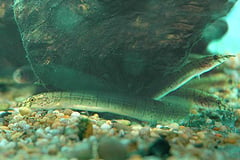
Macrognathus zebrinusZebra Spiny Eel
Mastacembelidae · authority not recorded
The zebra spiny eel, Macrognathus zebrinus, is a spiny eel from Myanmar, found in rivers and swamps with large amounts of aquatic vegetation. It was previously included in the closely related genus Mastacembelus. The sharp dorsal rays that give spiny eels their name can easily puncture human skin. Peaceful with fish it cannot swallow, it tends to be territorial with its own kind and grows to 460 mm, although usually smaller in aquaria.

Makunaima pittieriDiamond Tetra
Characidae · authority not recorded
The diamond tetra, Makunaima pittieri, is a characid endemic to Lake Valencia and surrounding waters in Venezuela. It is usually sold as a fairly bland, silvery juvenile, and given time and a good diet develops into an adult that sparkles like a diamond. It is found in shallow, vegetated parts of the lake and slow-moving tributaries, but most fish in the trade are mass-bred on commercial farms in Eastern Europe or the Far East.
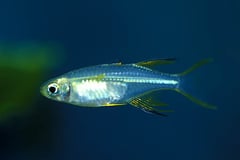
Marosatherina ladigesiCelebes Rainbowfish
Telmatherinidae · authority not recorded
The Celebes rainbowfish, Marosatherina ladigesi, is a rainbowfish from the island of Sulawesi (formerly Celebes) in Indonesia. For many years it was included in Telmatherina, and it is the only species in Marosatherina. Overfishing for the aquarium trade has left it listed as vulnerable by the IUCN, but it is now mass-produced on farms in the Far East and Eastern Europe. It needs pristine, medium to hard alkaline water and is very sensitive to rapidly changing conditions.
Mastacembelus armatusTyre-Track Eel
Mastacembelidae · authority not recorded
The tyre-track eel, Mastacembelus armatus, is a spiny eel from India, Thailand and Sumatra, also known as the white-spotted spiny eel. Growing to around 91 cm, it hides during the day and often buries itself, so it needs sand, plenty of hiding places and a close-fitting hood. It eats live fish in the wild, and tankmates should be too large to be considered prey.
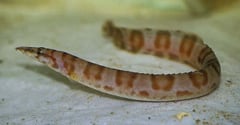
Mastacembelus ellipsiferTanganyikan Spiny Eel
Mastacembelidae · authority not recorded
The Tanganyikan spiny eel, Mastacembelus ellipsifer, is a spiny eel endemic to Lake Tanganyika. It is found around the shores, most often where the rocks give way to sandier substrates, and spends much of its time burrowed in the substrate, so the aquarium needs a layer of sand. Nocturnal and predatory, it is best kept in a Tanganyikan community with species too large to be considered food.

Maylandia callainosCobalt Blue Zebra
Cichlidae · authority not recorded
The cobalt blue zebra, Maylandia callainos, is an mbuna endemic to the north of Lake Malawi. Formerly Pseudotropheus callainos and Metriaclima callainos, it is still named as one of these by many sources and has been sold as Pseudotropheus zebra 'pearly'. It is very easily confused with similar species such as M. estherae and M. benetos. Aggressive and territorial, it can be combined with other mbuna but not with peaceful species such as peacocks or utaka.

Maylandia greshakeiRed Top Ice Blue Zebra
Cichlidae · authority not recorded
The red top ice blue zebra, Maylandia greshakei, is an mbuna endemic to Lake Malawi, found only around Makokola in the southeast of the lake. It inhabits the upper parts of rocky reefs next to open water, leaving the reef to feed on phytoplankton. Formerly Pseudotropheus greshakei and Metriaclima greshakei, it is still named as either of these by many sources. Aggressive and territorial, it can be combined with other mbuna but not with peaceful species such as peacocks or utaka.
Maylandia zebraZebra Mbuna
Cichlidae · authority not recorded
The zebra mbuna, Maylandia zebra, is a cichlid endemic to Lake Malawi, where it inhabits rocky zones around shores, reefs and islands. One of the more aggressive mbuna, it is not a fish for a general community aquarium. It should be kept in a Malawi tank at around three females to each male.
Mchenga flavimanus
Cichlidae · authority not recorded
Mchenga flavimanus is a peaceful utaka cichlid endemic to Lake Malawi, known from Nkhata Bay and the islands of Chitande, Mbowe and Kande. It shoals in large numbers in open water over sand and isolated boulders at 5 to 20 metres, feeding on zooplankton. Still listed as a Copadichromis in much of the literature, it suits a peaceful Lake Malawi community, but should not be kept with mbuna or with other Mchenga or Copadichromis, since they can hybridise.

Megalamphodus rosaceusRosy Tetra
Characidae · (Durbin, 1909)
The rosy tetra, Megalamphodus rosaceus, is a small characid from Guyana, Suriname and Brazil, in river systems including the Essequibo and Corantijn. It is so similar to Megalamphodus bentosi that it was once considered a subspecies of it, and is most easily told apart by lacking the dark marking just behind the operculum. The vast majority of fish in the trade are mass bred on commercial farms.
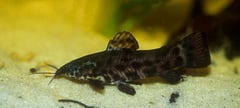
Megalechis thoracataSpotted Hoplo
Callichthyidae · authority not recorded
The spotted hoplo, Megalechis thoracata, is a callichthyid catfish widespread across northern South America, living primarily in still waters. Still widely referred to as Hoplosternum thoracatum, it can breathe atmospheric air, absorbing the oxygen through the intestine, and this lets it endure poor conditions in the wild. It is also eaten as a food fish in parts of South America.

Melanochromis auratusGolden Mbuna
Cichlidae · authority not recorded
The golden mbuna, Melanochromis auratus, is a cichlid endemic to Lake Malawi, common down the western coast and along the southern end of the lake. One of the most aggressive and territorial mbuna, it is not recommended for the beginner. Mature males turn dark, unlike the golden females and juveniles, and older females often darken until they superficially resemble males. Other Melanochromis should not be kept with it, as they may hybridise.

Melanochromis chipokae
Cichlidae · authority not recorded
Melanochromis chipokae is an mbuna endemic to Lake Malawi, found only around Chindunga Rocks, a reef just off the island of Chipoka. One of the predatory 'pike auratus' group, it eats fry as well as crustaceans and algae. Females and juvenile males are easily confused with M. auratus, but have a more pointed mouth and a fully striped caudal fin. Arguably the most aggressive mbuna, it is not recommended for the beginner.

Melanochromis cyaneorhabdos
Cichlidae · authority not recorded
Melanochromis cyaneorhabdos is an mbuna endemic to Lake Malawi, known from one locality on the northeastern shore of Likoma Island. Formerly known as M. 'maingano', it is sometimes incorrectly sold as 'electric blue' johanni. Dominant males are bluish overall, where the similar M. johanni has more black patterning. Aggressive and territorial, it should not be kept with other Melanochromis, as they may hybridise.

Melanochromis johanni
Cichlidae · authority not recorded
Melanochromis johanni is an mbuna endemic to Lake Malawi, found in shallow rocky coastal areas around Masinje Rocks and Cape Ngombo. Males are blue-black with bright blue striping and females orange. The blacker dominant males separate it from the bluer M. cyaneorhabdos, and it is sometimes sold as 'electric blue johanni'. Less aggressive than most Melanochromis, it can be housed with similarly-sized mbuna.

Melanochromis lepidiadaptes
Cichlidae · authority not recorded
Melanochromis lepidiadaptes is an mbuna endemic to Lake Malawi, found only in a limited area around Makanjila Point on the eastern side. Originally sold as M. fuscus and then M. sp. 'lepidophage', it apparently feeds almost solely on the scales of other species in nature, though not other mbuna. Relatively peaceful for a Melanochromis, it suits a Lake Malawi aquarium with cichlids of similar size and disposition.
Melanotaenia affinisNew Guinea Rainbowfish
Melanotaeniidae · authority not recorded
The New Guinea rainbowfish, Melanotaenia affinis, is a rainbowfish from Papua New Guinea. It was one of the first rainbowfish species to be imported for the hobby in any numbers. Three geographical variants are found in the hobby: the widespread 'standard' form, the 'Pagwi' form from a tributary of the Sepik River, and the 'Bluewater Creek' form known from a single location near Madang. They look superficially similar and differ only in small details of colour and patterning.
Melanotaenia australisWestern rainbowfish
Melanotaeniidae · authority not recorded
The western rainbowfish, Melanotaenia australis, is a rainbowfish from Australia and probably the commonest rainbowfish species there. Once classified in the M. splendida complex, it has since proved genetically distinct from that group, with two clear lineages within it. Colour and patterning vary widely by locality, and the different morphs should not be mixed in the aquarium because they hybridise freely. Juveniles are much drabber than adults, and full colour can take over 12 months to develop.
Melanotaenia boesemaniBoeseman's rainbowfish
Melanotaeniidae · authority not recorded
Boeseman's rainbowfish, Melanotaenia boesemani, is a rainbowfish from Indonesia, known only from the Ajamaru lakes and nearby Lakes Hain and Aitinjo. One of the most popular rainbowfish in the hobby, it is almost always sold as farmed stock from the Far East and Eastern Europe. The species is rare in nature and on the IUCN red list, and collection of breeding stock for the trade has had a massively detrimental effect on it. The drab juveniles usually offered for sale can take over 12 months to colour up.
Melanotaenia fluviatilisAustralian Rainbowfish
Melanotaeniidae · authority not recorded
The Australian rainbowfish, Melanotaenia fluviatilis, is a rainbowfish from Queensland and New South Wales, Australia. Also known as the Murray River or crimson-spotted rainbowfish, it is easily confused with the very similar M. duboulayi, with which it was once grouped as a single species. Its range extends further south than any other rainbowfish, and it can withstand relatively cool temperatures, though it becomes less active and loses colour if kept that cold.
Melanotaenia gracilisSlender Rainbowfish
Melanotaeniidae · authority not recorded
The slender rainbowfish, Melanotaenia gracilis, is a small rainbowfish from the Drysdale and Carson Rivers in the Kimberley, north-western Australia. It is uncommonly seen in the hobby because it comes from such a remote area, and the IUCN lists it as at risk. Unlike many members of the genus, it lives in sparse, rocky, slow-moving stretches of river and in isolated pools during the dry season.
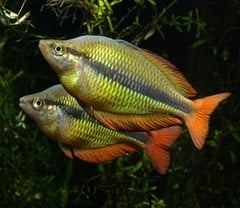
Melanotaenia herbertaxelrodiLake Tebera Rainbowfish
Melanotaeniidae · authority not recorded
The Lake Tebera rainbowfish, Melanotaenia herbertaxelrodi, is a rainbowfish endemic to the Lake Tebera basin in the Central Highlands of New Guinea. It inhabits clear, heavily vegetated water in the lake and its surrounding streams, and is probably at risk from overfishing. Mature fish are among the more colourful rainbowfish, and they show their best colours in a heavily planted tank with high water quality.
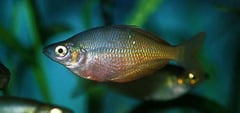
Melanotaenia irianjayaIrian Jaya Rainbowfish
Melanotaeniidae · authority not recorded
The Irian Jaya rainbowfish, Melanotaenia irianjaya, is a rainbowfish from Indonesia, recorded only around Bintuni Bay in Irian Jaya. It can be identified by the longer middle rays in the dorsal and anal fins, a feature usually associated with the closely related genus Glossolepis. It is not often seen in the hobby. In nature it lives in slow and fast-flowing rainforest streams with little aquatic vegetation, using submerged logs and branches for cover.
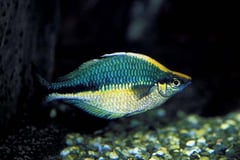
Melanotaenia lacustrisLake Kutubu Rainbowfish
Melanotaeniidae · authority not recorded
The Lake Kutubu rainbowfish, Melanotaenia lacustris, is a rainbowfish endemic to Lake Kutubu and the River Soro in Papua New Guinea. The lake is threatened by overfishing, much of it for the aquarium trade, and by oil development, and the species has 'vulnerable' status on the IUCN red list. Juveniles are much drabber than the blue adults and are usually sold as 'blue' rainbowfish or similar. Full colour can take over 12 months to develop.
Melanotaenia maccullochiDwarf Rainbowfish
Melanotaeniidae · authority not recorded
The dwarf rainbowfish, Melanotaenia maccullochi, is a small rainbowfish from Papua New Guinea and Australia. Several geographical variants are available, differing in colour, patterning and sometimes size, and they should not be mixed in aquaria because they may hybridise. Some are so distinct that they may turn out to be different species. It is found in a wide range of habitats, from clear streams to turbid, tannin-stained ponds.
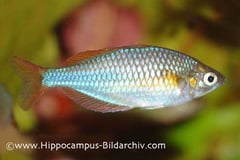
Melanotaenia praecoxNeon Dwarf Rainbowfish
Melanotaeniidae · authority not recorded
The neon dwarf rainbowfish, Melanotaenia praecox, is a small rainbowfish endemic to the Mamberamo river system in New Guinea, Indonesia. It inhabits swiftly flowing tributaries of the main river and the surrounding swamps and marshes. Peaceful and small enough for many community aquaria, it shows its best colours in a heavily planted tank with floating plants to diffuse the light.
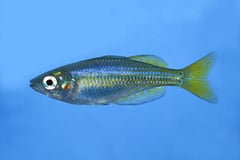
Melanotaenia splendida inornataCheckered Rainbowfish
Melanotaeniidae · authority not recorded
The checkered rainbowfish, Melanotaenia splendida inornata, is one of four described subspecies of M. splendida and comes from Australia. The subspecies differ mainly in colour, pattern and fin counts, though these also vary by locality, and the different forms should not be mixed in the aquarium because they may hybridise. Juveniles are much drabber than adults, and full colour can take over 12 months to develop.
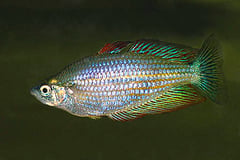
Melanotaenia splendida splendidaEastern Rainbowfish
Melanotaeniidae · authority not recorded
The eastern rainbowfish, Melanotaenia splendida splendida, is one of four described subspecies of M. splendida and comes from Australia. It varies widely in colour and patterning by locality, and fish are often sold with a place name added to the species name. The different forms and subspecies should not be mixed in the aquarium because they may hybridise. Full colour can take over 12 months to develop.
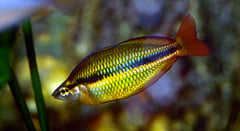
Melanotaenia trifasciataBanded Rainbowfish
Melanotaeniidae · authority not recorded
The banded rainbowfish, Melanotaenia trifasciata, is a rainbowfish from Australia, most commonly seen in flowing streams and tributaries. Colour and patterning vary widely by locality, and the morphs are often sold with the collection locality added to the scientific name. They should never be mixed in the aquarium because they hybridise freely. Several species are thought to be involved, and a reclassification will probably follow.
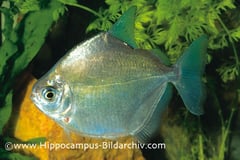
Metynnis argenteus
Serrasalmidae · authority not recorded
Metynnis argenteus is a silver dollar, a relative of the piranhas probably endemic to the Rio Tapajós drainage in Brazil. It is very similar to M. hypsauchen, and both are sold in the hobby as 'silver dollar'. The two are virtually identical in appearance and care, but M. hypsauchen has a black blotch above and behind each eye. An avid plant-eater, it is best kept in a group of at least five and may eat much smaller fish.
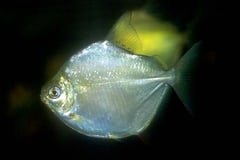
Metynnis hypsauchenSilver Dollar
Serrasalmidae · authority not recorded
The silver dollar, Metynnis hypsauchen, is a relative of the piranhas with a patchy distribution in Guyana, Brazil, Peru and Bolivia. Sometimes called the plain metynnis, it is sold under the same name as the very similar M. argenteus and differs in the black blotch above and behind each eye. A striped form is not a distinct species. An avid plant-eater, it is best kept in a group of at least five.

Microctenopoma fasciolatumBanded ctenopoma
Anabantidae · authority not recorded
The banded ctenopoma, Microctenopoma fasciolatum, is an anabantoid from the Congo basin and a handful of rivers in Cameroon. In nature it is found in clear water with plenty of surface and overhanging vegetation. Less shy than M. ansorgei, it is still slow-moving and easily out-competed by boisterous species. Males are territorial. A bubblenester, it has been bred in captivity.
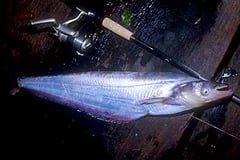
Micronema bleekeriBleeker's Sheatfish
Siluridae · authority not recorded
Bleeker's sheatfish (Micronema bleekeri) is a large silurid catfish from Thailand, Cambodia, Laos and Vietnam. An irregular import, it is often confused with some of its congeners. At up to 60 cm it needs a lot of open swimming space, powerful filtration and a heavy, tightly fitting cover, and it will eat any smaller fish it can fit in its mouth.
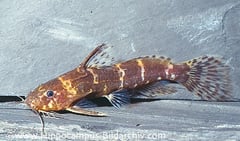
Microsynodontis batesiiDwarf Synodontis
Mochokidae · authority not recorded
The dwarf synodontis, Microsynodontis batesii, is a small catfish from the Congo and Ogowe basins in DR Congo, Gabon and Cameroon. The largest Microsynodontis, it is sometimes mislabelled as Synodontis sp. 'Nyong'. Young fish are sold with a spotted or reticulated pattern that breaks up into the characteristic barring as they grow, and new imports are often delicate. At least some of its recorded occurrences may be different species.
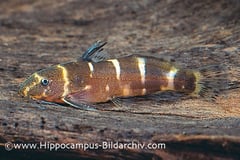
Microsynodontis polliPygmy Synodontis
Mochokidae · authority not recorded
The pygmy synodontis, Microsynodontis polli, is a small catfish from the upper Niger basin in Liberia and Guinea, growing to around 40 mm SL. It is sometimes sold mislabelled as Synodontis sp. 'Nyong' or M. batesii but lacks the distinct body barring of that species. New imports are often delicate, and it is quite shy, so it should not be kept with aggressive or very vigorous fish.

Mimagoniates microlepisBlue Tetra
Characidae · authority not recorded
The blue tetra, Mimagoniates microlepis, is a characid from southeastern Brazil, found from southern Bahia to northern Rio Grande do Sul. Not to be confused with Knodus borki, also sold as 'blue tetra', it is much scarcer in the hobby, less boisterous and lacks that species' tendency to nip fins. It inhabits flowing clear-water streams and small rivers of coastal floodplains, and is a predominantly surface-dwelling fish.
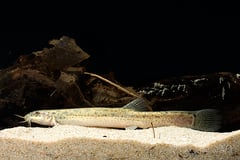
Misgurnus anguillicaudatusOriental Weather Loach
Cobitidae · authority not recorded
The oriental weather loach, Misgurnus anguillicaudatus, is a loach native to Siberia, Korea, Japan, China and northern Vietnam. Known in the United States as the 'dojo loach', it is one of the most ubiquitously available species in the hobby, and years of mass-production have made health and morphological issues common. Exceptionally hardy and adaptable, it is established as an alien species around the globe, and its adult size of up to 280 mm should be considered prohibitive.

Moenkhausia cerosCeros Tetra
Characidae · authority not recorded
The ceros tetra, Moenkhausia ceros, is a small characid from the Amazon basin in Peru and Brazil. Rare in the UK hobby, it occasionally shows up as a contaminant among imports of more popular species. It inhabits slow-moving rivers, tributaries and floodplain lakes. Moenkhausia is used as a catch-all for many small characins, and most experts agree the genus needs a full revision.
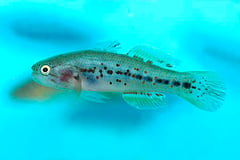
Mogurnda adspersaSouthern Purple Spotted Gudgeon
Eleotridae · authority not recorded
The southern purple spotted gudgeon, Mogurnda adspersa, is an Australian gudgeon considered endangered across its native range. Commercially farmed fish reach the hobby. It looks very similar to the commoner northern purple spotted gudgeon, M. mogurnda, but has only 30-36 lateral line scales (37-48 in M. mogurnda) and more red spotting in the second dorsal fin. Territorial but not particularly boisterous, it will probably eat any tankmate it can fit in its mouth.
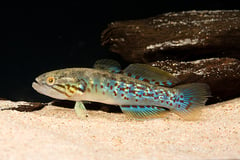
Mogurnda mogurndaNorthern Purple Spotted Gudgeon
Eleotridae · authority not recorded
The northern purple spotted gudgeon, Mogurnda mogurnda, is a gudgeon from Australia and Papua New Guinea. Tolerant of a wide range of water conditions, hardy and easily bred, it suits the beginner, and it can survive low oxygen in habitats from forest streams to desert boreholes. It is territorial and known to nip fins, so should not be kept with very delicate or long-finned species. It is easily confused with the rarer southern purple spotted gudgeon, M. adspersa.
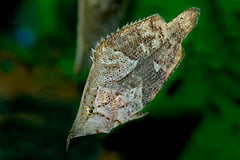
Monocirrhus polyacanthusSouth American Leaf Fish
Polycentridae · authority not recorded
The South American leaf fish, Monocirrhus polyacanthus, is a predator from Brazil, Peru, Venezuela, Colombia and Bolivia that mimics a dead leaf. It stalks prey head-down, appearing to drift like a leaf, and can swallow prey almost as big as itself. Flighty and very sensitive to deteriorating water quality, it is difficult to maintain and not a species for the beginner, and soft, acidic water is essential.
Monopterus albusSwamp Eel
Synbranchidae · authority not recorded
The swamp eel, Monopterus albus, is very widespread, found from India and China to Japan, Indonesia, the Philippines and Australia. Not a true eel, it has a single gill slit and an accessory breathing organ, and during dry spells it burrows into wet earth. Growing to around 100 cm, nocturnal and piscivorous, it is best kept singly, and the tank must have an extremely tightly-fitting, heavy cover.
Mylochromis melanonotusHaplochromis Yellow-black Line
Cichlidae · authority not recorded
Known in the trade as 'Haplochromis yellow-black line', Mylochromis melanonotus is a predatory cichlid endemic to Lake Malawi. Rarely imported, it caused confusion because some individuals have a shovel-like lower jaw. Ad Konings found wild populations with and without it, and Platygnathochromis and M. semipalatus are now regarded as synonyms. A sandy substrate is essential, and it will eat small fish.
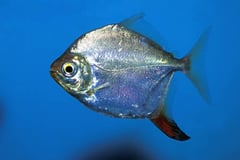
Myloplus rubripinnisRedhook
Serrasalmidae · authority not recorded
The redhook, Myloplus rubripinnis, is a relative of the silver dollars from much of northern South America, including the Amazon and Orinoco. Commonly sold as a silver dollar, it can be told apart by its black-trimmed, red anal fin and grows much larger, to around 25 cm. Given a large enough aquarium, correct feeding and good water quality it should not pose many problems. It is still widely referred to as Myleus rubripinnis.
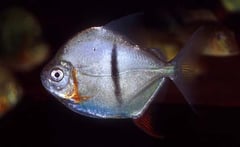
Myloplus schomburgkiiBlack-barred Myleus
Serrasalmidae · (Jardine, 1841)
The black-barred myleus, Myleus schomburgkii, is a close relative of the redhook from parts of Venezuela, Peru and Brazil. The black vertical bar on the flanks distinguishes it, and it is a smaller adult fish, though it is sometimes offered for sale as a redhook. Also called the black-ear pacu and disc pacu, it should be kept in groups of at least five, and a tight-fitting lid is a good idea as it moves extremely quickly when startled.
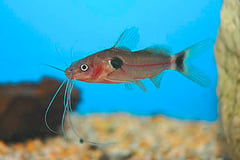
Mystus bimaculatusTwo Spot Mystus
Bagridae · authority not recorded
The two spot mystus, Mystus bimaculatus, is a small catfish found only on the island of Sumatra in Indonesia. It inhabits peat swamps, and its natural habitat is in danger of destruction by human activity. Very peaceful with even the smallest fish, it is more outgoing in a small group of its own kind. Commercial breeders have bred it only by hormone injection.
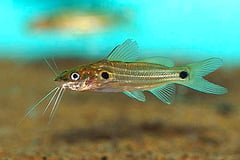
Mystus bleekeriDay's Mystus
Bagridae · authority not recorded
Day's mystus, Mystus bleekeri, is a bagrid catfish from India, Pakistan, Nepal, Bangladesh, Bhutan, Myanmar and Indonesia. It superficially resembles the more common M. vittatus but grows larger, to around 155 mm, and has a much longer adipose fin. Peaceful and gregarious, it suits communities of larger fish, though adults will probably eat small fish, and it is more outgoing in a small group.
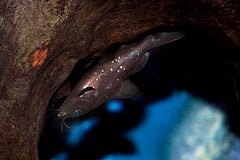
Mystus leucophasisAsian Upside Down Catfish
Bagridae · authority not recorded
The Asian upside down catfish, Mystus leucophasis, is a bagrid catfish from rivers in Myanmar that spends most of its time swimming inverted. Often sold at only a couple of inches, it is confused with the much smaller Synodontis nigriventris but is a uniform black without countershading. It grows to around 300 mm, will eat smaller fish, is usually intolerant of its own kind and is unsuitable for the general community tank.
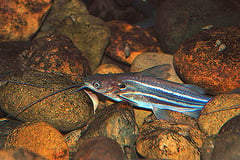
Mystus mysticetus
Bagridae · authority not recorded
Mystus mysticetus is a peaceful bagrid catfish from rivers of Laos, Thailand and Cambodia. It migrates into flooded forest in the wet season and is apparently often seen living and feeding in large shoals with its congener M. multiradiatus. The only Mystus with laterally positioned eyes, it makes a good bottom dweller for communities of larger peaceful fish, though it will probably eat small fish when adult.
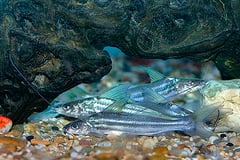
Mystus rhegma
Bagridae · authority not recorded
Mystus rhegma is a peaceful bagrid catfish from Laos, Thailand and Cambodia, where it inhabits rivers and flooded areas including fields. An irregular import, little is known about its natural behaviour. Gregarious, it makes a good bottom dweller for communities of larger peaceful fish, though it will probably eat small fish when adult.
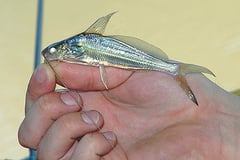
Mystus singaringan
Bagridae · authority not recorded
Mystus singaringan is a large bagrid catfish from Cambodia, Thailand, Vietnam, Laos, Malaysia and Indonesia. Not often seen in the hobby, it grows to around 300 mm and is used as a food fish in many of its native countries. It can be territorial and aggressive, eats smaller fish and is usually intolerant of its own kind, so it suits a tank of bigger fish such as larger barbs and large cichlids.

Nannacara anomalaGolden Dwarf Cichlid
Cichlidae · authority not recorded
The golden dwarf cichlid, Nannacara anomala, ranges from the Rio Aruka in Guyana to the lower Rio Marowijne in Suriname. It is often found in flooded grassland in low-lying coastal areas, but most fish in the trade are mass-produced on farms in the Far East or Eastern Europe. Hardy and easy to breed, it is regarded as an excellent beginner's cichlid, though a female guarding fry can be very aggressive.

Nannacara taeniaStriped Dwarf Cichlid
Cichlidae · authority not recorded
The striped dwarf cichlid, Nannacara taenia, is known only from part of the Rio Tocantins basin close to Belém in Pará state, Brazil. A fairly shy fish of small, densely planted streams, it tends towards a drab brown and is rarely seen in shops, so it is more often obtained through specialist cichlid dealers or amateur enthusiasts. The female guards the eggs in a small cave while the male guards the wider territory.
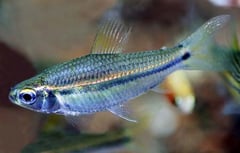
Nannaethiops unitaeniatusOne-lined African Characin
Citharinidae · authority not recorded
The one-lined African characin, Nannaethiops unitaeniatus, is a small citharinid from Cameroon, Nigeria, Gabon and both Congo republics. A shy, peaceful fish of streams, small rivers, lakes and ponds, it should be kept in a shoal. Not often seen for sale, it is often confused with similar-looking members of the genus Neolebias, and mature males are smaller, slimmer and more brightly coloured than females.
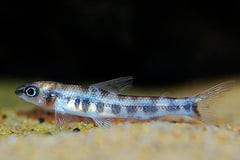
Nannocharax brevisAfrican Darter Characin
Citharinidae · authority not recorded
The African darter characin, Nannocharax brevis, is a citharinid endemic to parts of the River Congo basin in the Democratic Republic of Congo. Nannocharax are notoriously tricky to identify, and more than two species may be sold under the names N. brevis and N. fasciatus. They look superficially very similar to the South American darter characins of the genus Characidium, and this species probably inhabits swiftly-flowing rivers and streams.
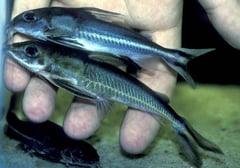
Nemadoras leporhinusMouse Catfish
Doradidae · authority not recorded
The mouse catfish, Nemadoras leporhinus, is a doradid catfish recorded from Venezuela, Guyana and Brazil. Rare in the hobby, it sometimes shows up as bycatch among Hassar or Hemidoras species and is most often confused with Hemidoras stenopeltis. N. leporhinus has a clear dorsal fin with a dark patch at the base and a more rounded snout. It is shy and nocturnal.
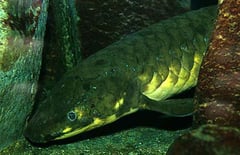
Neoceratodus forsteriAustralian Lungfish
Ceratodontidae · authority not recorded
The Australian lungfish, Neoceratodus forsteri, is endemic to parts of Australia, where it lives in pools, swamps and other still or sluggish waters. It has a single lung and must reach atmospheric air, but it cannot survive completely dry conditions for long. It is very hardy and protected by CITES. Lungfish are unpredictable with tankmates, and it is best kept singly and alone.

Neolamprologus callipterus
Cichlidae · authority not recorded
Neolamprologus callipterus is a shell-brooding cichlid endemic to Lake Tanganyika, in which males grow many times larger than females. Males must be large enough to carry snail shells and females small enough to fit inside them, and in nature the nests of large males can measure several metres across. Males are territorial and aggressive, and the species is not very popular in the hobby because of its relatively drab colouration and aggressive nature.

Neolamprologus fasciatusBarred Lamprologus
Cichlidae · authority not recorded
The barred lamprologus, Neolamprologus fasciatus, is a predatory cichlid endemic to Lake Tanganyika, living mainly in rocky areas. Its laterally compressed body lets it enter crevices in the rockwork to prey on invertebrates, eggs, fry and small fish. It is sometimes confused with juvenile Altolamprologus but has a blue-green iris and a more elongate body.

Neolamprologus lemairiiLemaire's Lamprologus
Cichlidae · authority not recorded
Lemaire's lamprologus, Neolamprologus lemairii, is a piscivorous cichlid endemic to Lake Tanganyika, growing to around 25 cm. An ambush predator, it lies motionless on the substrate so that its mottled pattern makes it appear dead to the smaller fish that come to investigate. It is unsuited to the general aquarium and should be kept alone, with tankmates too large to be considered food. In nature it spawns in caves.

Neolamprologus tretocephalusFive-barred Lamprologus
Cichlidae · authority not recorded
The five-barred lamprologus, Neolamprologus tretocephalus, is an aggressive cichlid endemic to Lake Tanganyika. It lives in relatively shallow water over rocky areas and intermediate zones with scattered rocks. Five vertical bars on the flanks, against six in N. sexfasciatus, separate the two species. Its aggression, particularly when breeding, rules it out of the general Tanganyikan community.
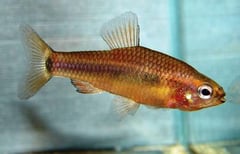
Neolebias ansorgiiAnsorge's Neolebias
Citharinidae · authority not recorded
Ansorge's neolebias, Neolebias ansorgii, is a small distichodontid from Cameroon, Democratic Republic of Congo, Nigeria, Gabon and Benin. It inhabits marshes and small, heavily vegetated ponds and creeks, and does not thrive in a brightly lit setup. Rarely offered for sale, it often looks fairly plain in dealers' tanks but colours up in the correct conditions. A very shy fish, it is ideally kept in a species setup.
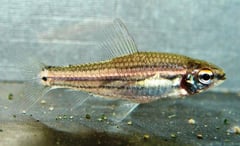
Neolebias trilineatusThree-lined Neolebias
Citharinidae · authority not recorded
The three-lined neolebias, Neolebias trilineatus, is a small distichodontid from the Democratic Republic of Congo. A very shy shoaling fish, it needs a densely planted tank with floating cover and soft, acidic, stained water. Rarely seen in the trade, it often looks quite bland in dealers' tanks but colours up in the correct environment.
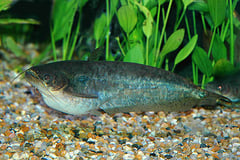
Ompok bimaculatusButter Catfish
Siluridae · authority not recorded
The butter catfish, Ompok bimaculatus, is a widespread silurid catfish recorded from Afghanistan and Pakistan east to China and Indonesia. Also known as the two spot glass catfish, it very likely contains a number of separate species, given the clear morphological differences between populations. It grows to 45 cm, needs a very large tank and will eat any smaller fish it can fit in its mouth.
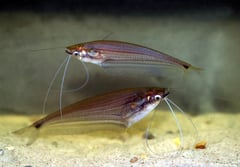
Ompok eugeneiatusBorneo Glass Catfish
Siluridae · authority not recorded
The Borneo glass catfish, Ompok eugeneiatus, is a silurid catfish from flowing waters in Brunei, Thailand, Cambodia, Malaysia and Indonesia. Not often encountered in the hobby, it is a schooling catfish for a community of medium to large peaceful fish, though it will eat any smaller fish it can fit in its mouth. It needs open swimming space, some current and clean, well-oxygenated water.

Ophthalmotilapia boops
Cichlidae · authority not recorded
Ophthalmotilapia boops is a mouthbrooding cichlid endemic to Lake Tanganyika, found only along the southern Tanzanian coastline. It inhabits rocky drop-offs and slopes. A relatively boisterous species needing a lot of space for its size, it becomes withdrawn unless it is the dominant species in the tank, and males are aggressive towards each other. It was the first species placed in the genus Ophthalmotilapia.

Ophthalmotilapia nasuta
Cichlidae · authority not recorded
Ophthalmotilapia nasuta is a mouthbrooding cichlid endemic to Lake Tanganyika, found on its northwestern, southwestern and southern coasts. A fleshy, proboscis-like growth extending beyond the upper lip, more prominent in males, separates it from the rest of the genus. Several geographical morphs exist, including 'Kachese', 'Mpimbwe', 'Cape Tembwe' and 'Chamba', and these should not be mixed as they hybridise freely.

Ophthalmotilapia ventralis
Cichlidae · authority not recorded
Ophthalmotilapia ventralis is a mouthbrooding cichlid endemic to Lake Tanganyika, found around most of the lake's coastline. It exists in well over 20 colour morphs, which hybridise freely and should not be mixed. In nature only the largest dominant males build nests, holding territories that may measure several metres across, while subdominant males and females shoal together.

Oreochromis mossambicusMozambique Mouthbrooder
Cichlidae · authority not recorded
The Mozambique mouthbrooder, Oreochromis mossambicus, is a cichlid native to the East African coast and one of the most invasive fish in the world. Farmed for food across the globe, it now has escaped populations in over 90 countries. Known in the trade as the 'Mossie', it reaches 39 cm, breeds readily in large broods and is not recommended to most hobbyists. The brightly coloured forms seen in aquaria are selectively bred, and some are crosses with other Oreochromis.

Oreochromis niloticus niloticusNile Tilapia
Cichlidae · authority not recorded
The Nile tilapia, Oreochromis niloticus niloticus, is a cichlid with a very wide natural range in Africa, from Senegal east to Egypt and Uganda. Bred in huge numbers as a food fish, it has been introduced to over 70 other countries and is one of the most invasive fish species in the world. It reaches 60 cm, though usually around 35 cm, breeds readily, is very messy and does not make a good aquarium subject.

Oreochromis tanganicaeTanganyikan Tilapia
Cichlidae · authority not recorded
The Tanganyikan tilapia, Oreochromis tanganicae, is a large cichlid endemic to Lake Tanganyika, where it inhabits river mouths and shorelines. It is often seen in shoals in nature and appears to feed primarily on phytoplankton. Reaching 42 cm, it is not seen very often in the hobby.

Orthochromis stormsi
Cichlidae · authority not recorded
Orthochromis stormsi is a cichlid from fast-moving, well-oxygenated stretches of the Congo River in the Democratic Republic of Congo. Its swimbladder is much reduced, so it is less likely to be swept away by the current, and in the aquarium it spends most of its time on the substrate, moving in a characteristic 'hopping' fashion. It was previously classified as Schwetzochromis stormsi and is still named as such by many sources.

Osphronemus exodonElephant Ear Gourami
Osphronemidae · authority not recorded
The elephant ear gourami, Osphronemus exodon, is a large gourami from Thailand, Laos and Cambodia. Its greatly enlarged teeth, with an extra set in concentric bands on the outer lips, stay visible when the mouth is closed and are used to pick fruit from overhanging branches. Reaching 60 cm, it inhabits still or slow-moving areas of large rivers and enters flooded forest in the rainy season.

Osphronemus goramyGiant Gourami
Osphronemidae · authority not recorded
The giant gourami, Osphronemus goramy, is a large gourami from Borneo, Java, Sumatra, Thailand, Indo-china and the Malay Peninsula. Reaching 70 cm and living for over 20 years, it is often sold as a juvenile with no information on its adult size. It is cultured for food on a large scale, a golden variety exists in aquaria, and dyed fish are produced by injecting colour under the skin.

Osphronemus laticlaviusGiant Red Tail Gourami
Osphronemidae · authority not recorded
The giant red tail gourami, Osphronemus laticlavius, is a large gourami from Indonesia and Malaysia, described to science in the early 1990s. Adults develop bright red fin edges with filamentous extensions and a body colour between blue-green and almost black. It reaches 50 cm and probably inhabits slow-moving rivers and other sluggish or stagnant water.
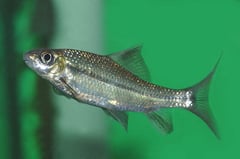
Osteochilus nashii
Cyprinidae · authority not recorded
Osteochilus nashii is a cyprinid endemic to India, where it appears restricted to Karnataka and Kerala in the southwest. Predominantly a riverine fish, it lives in clear, well-oxygenated running water and hill streams over boulders, bedrock and smaller stones. Reaching around 18 cm, it is very scarce in the trade and most likely to turn up as a contaminant among imports of other Indian species.
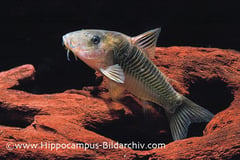
Osteogaster melanotaeniaGreen-gold Cory
Callichthyidae · authority not recorded
The green-gold cory, Osteogaster melanotaenia, long known as Corydoras melanotaenia, is an armoured catfish from the Rio Meta basin in Colombia. It lives in small tributaries, creeks, flooded forest and sand banks. Also known as the 'elongate bronze cory', it resembles C. aeneus at first glance, but is more elongate and has a golden-yellow tinge to the fins.

Otopharynx lithobatesSulphur-headed Hap
Cichlidae · authority not recorded
The sulphur-headed hap, Otopharynx lithobates, is a cichlid endemic to Lake Malawi, where it lives among caves and crevices in rocky areas. A true rock dweller, it is hardly ever seen in open water, even in aquaria. In breeding males the three flank spots are masked by neon blue patterning and the dorsal fin and top of the head turn deep yellow-orange. It has been sold in the trade as 'Aristochromis sp. red top'.
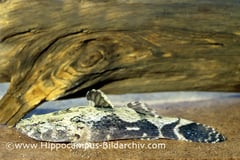
Oxyeleotris marmorataMarbled Goby
Butidae · authority not recorded
The marbled goby, Oxyeleotris marmorata, is one of the largest gobies in the world, found in Southeast Asia from Thailand to the Philippines. It lives in rivers, ponds, swamps and flooded forests, mainly in fresh water but also in brackish environments, and grows to 65 cm. A nocturnal ambush predator, it is territorial with its own kind and will eat any fish it can fit in its mouth, so it is best kept alone. It is also a popular food fish in some of its native countries.
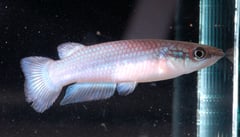
Pachypanchax omalonotusPowder-blue Panchax
Aplocheilidae · Duméril, 1861
The powder-blue panchax, Pachypanchax omalonotus, is a killifish from Nosy Be and the adjacent Sambirano River system in northwestern Madagascar. Many fish in the hobby identified as P. omalonotus are in fact P. arnoulti, as are those in much older aquarium literature, and a degree of hybridisation has undoubtedly occurred. Metallic gold spots on the flanks separate it from that species, and males are polymorphic, with yellow, red and blue morphs in different populations.
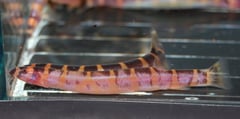
Pangio sp. 'PAN01'
Cobitidae · authority not recorded
Pangio sp. 'PAN01' is an unidentified kuhli loach, possibly from Borneo, assigned to the P. kuhlii-oblonga group with a degree of certainty. The imported fish shown in the profile do not correspond to any described Pangio. Some carry a pinkish to purplish pigmentation that has also been reported in P. superba and appears to be shared by some Bornean Pangio populations.
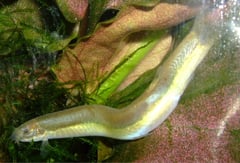
Pangio sp. 'PAN02'
Cobitidae · authority not recorded
Pangio sp. 'PAN02' is an unidentified kuhli loach of unknown origin that can be assigned to the P. kuhlii-oblonga group with a degree of certainty. It is apparently exported as a contaminant among shipments of a uniformly brown fish, and unpublished genetic analyses suggest the two might be variants of the same species. Its dark upper and white lower body suggest it may be related to P. alcoides.
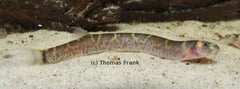
Pangio sp. 'PAN03'
Cobitidae · authority not recorded
Pangio sp. 'PAN03' is an unidentified kuhli loach that appears to be native to the Barito River basin in Indonesian Borneo. It belongs to the P. kuhlii-oblonga group and has been misidentified and traded as P. alternans, a different-looking species. Like its congeners it needs a soft, sandy substrate, since it digs and spends some of its time buried.
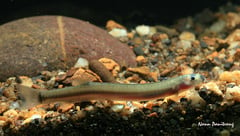
Pangio sp. 'PAN04'Panda Loach
Cobitidae · authority not recorded
The panda loach, Pangio sp. 'PAN04', is an unidentified kuhli loach apparently native to the Thai portion of the Mekong River basin. Traded since the mid-00s, it comes in two similar forms. One has a darker body, dark pectoral fins and barbels and a blue sheen on the head, while the other is paler with better-defined head markings, hyaline pectoral fins and colourless barbels.
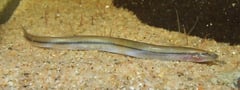
Pangio sp. 'PAN05'
Cobitidae · authority not recorded
Pangio sp. 'PAN05' appears to be an undescribed eel loach in the P. anguillaris group, and where it comes from is unclear. It is regularly imported and traded as 'eel loach', usually alongside P. anguillaris, and like other members of the group has a worm-like, usually patternless, greyish body and a high vertebral count.
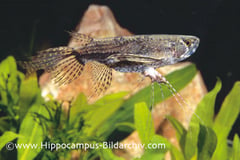
Pantodon buchholziAfrican Butterfly Fish
Pantodontidae · authority not recorded
The African butterfly fish, Pantodon buchholzi, is a surface-dwelling osteoglossiform from still and slow waters in West and Central Africa. The only member of its genus and family, it takes its name from the large pectoral fins, which make it look like a dead leaf at the surface and power leaps of several metres. It is quite inactive when not feeding, will eat any fish it can fit in its mouth, and needs a tightly fitting cover.
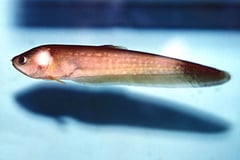
Papyrocranus aferArowana Knifefish
Notopteridae · authority not recorded
The arowana knifefish, Papyrocranus afer, is a notopterid knifefish widespread over much of western and central Africa, from Senegal to Sudan. Its anal and caudal fins are fused into one long, undulating fin. Infrequently imported, it grows to 80 cm and becomes increasingly territorial as it matures, so it is recommended only to the experienced fishkeeper and best kept as a single specimen.
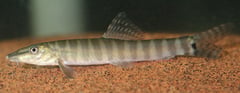
Parabotia fasciata
Botiidae · Dabry de Thiersant, 1872
Parabotia fasciata is a botiid loach from China, described from the Yangtze and also recorded from much of the Pearl River watershed. It is rarely seen in the trade and usually arrives only as bycatch among shipments of Sinibotia, particularly S. robusta. A single dark spot at the caudal-fin base separates it from the similar P. bimaculata, and numerous species from several genera are considered synonymous with it.
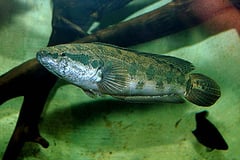
Parachanna obscuraAfrican snakehead
Channidae · authority not recorded
The African snakehead, Parachanna obscura, is widespread in West Africa from Senegal to Cameroon and ranges inland across the continent to Sudan. The most commonly seen African Parachanna, it is hard to tell apart from the rarely imported P. insignis. It will eat any fish less than two thirds its size and is best kept alone. Both parents guard the eggs among surface vegetation, and the female is said to feed the fry with infertile eggs.

Paracheirodon innesiNeon Tetra
Characidae · Myers, 1936
The neon tetra, Paracheirodon innesi, is a small characid from the Amazon basin in Colombia, Brazil and Peru, found in acidic forest streams. Years of commercial breeding have weakened the ornamental strain, and defects and ill-health are widespread, so stock needs choosing with care. Neons are also susceptible to 'neon tetra disease', a microsporidian infection that is virtually untreatable once advanced.

Parachromis managuensisJaguar Cichlid
Cichlidae · authority not recorded
The jaguar cichlid, Parachromis managuensis, is a large predatory cichlid from eastern Central America, from Honduras through Nicaragua to Costa Rica. Almost exclusively carnivorous, it will see smaller fish as food and is always territorial. A large aquarium is required, and a single spawn from large adults can produce 3000 fry.
Parachromis motaguensisFalse Yellowjacket Cichlid
Cichlidae · authority not recorded
The false yellowjacket cichlid, Parachromis motaguensis, is a large predatory cichlid from Guatemala, El Salvador and Honduras. It occurs in lakes and larger streams, most often in the central flowing parts of rivers. Aggressive towards its own and other species, it treats anything that fits in its mouth as food, and a breeding pair will hurt any other fish in the tank, even significantly bigger ones.

Paracyprichromis brieni
Cichlidae · authority not recorded
Paracyprichromis brieni is a deep-water cichlid endemic to Lake Tanganyika, where it is quite widespread. Males hold territories under rocky overhangs and are often seen hanging upside down beneath them, while females stay in open water above the rocks. It is easily confused with P. nigripinnis, its only congener, but has smaller eyes and a slimmer, more elongate body, and it quickly loses its best colouration under bright lighting or with boisterous tankmates.
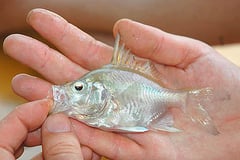
Parambassis wolffiiDuskyfin Glass Fish
Ambassidae · authority not recorded
The duskyfin glass fish, Parambassis wolffii, is a large, predatory ambassid from Thailand, Laos, Cambodia, Vietnam and Indonesia. It inhabits slow-moving and standing waters, including floodplains, and is very common in its native countries, where it is used as a food fish. It grows to around 20 cm, though not usually in aquaria, and eats any small tankmates.

Paratilapia polleni
Cichlidae · authority not recorded
Paratilapia polleni is a large cichlid endemic to Madagascar, widespread on the island and known to many natives as 'marakely', meaning 'black fish'. Like most Madagascan cichlids it is highly endangered in the wild through habitat destruction and competition from introduced species. Large- and small-spotted forms exist whose identity is unconfirmed, and they should never be mixed in aquaria since they hybridise freely.

Paretroplus damii
Cichlidae · authority not recorded
Paretroplus damii is a cichlid endemic to northwestern Madagascar, around Lake Pambilao. Moderately aggressive and growing to around 30 cm, it is best kept in groups with similarly sized cichlids of similar temperament. It digs, so plants need to be used with care.
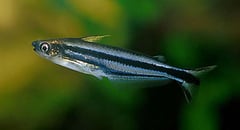
Pareutropius buffeiThree Striped African Glass Catfish
Schilbeidae · authority not recorded
The three striped African glass catfish, Pareutropius buffei, is a midwater, diurnal catfish from Nigeria, Niger, Benin, Mali and Guinea. It is very often sold as 'Debauwi catfish', but the closely related P. debauwi is seldom imported. P. buffei has three lateral stripes to that species' one, black spots in the caudal fin and a clear leading edge to the adipose fin, though young fish of the two are hard to tell apart.

Parosphromenus alfredi
Osphronemidae · Kottelat & Ng, 2005
Parosphromenus alfredi is a liquorice gourami endemic to a small part of eastern Johor, Peninsular Malaysia, around Kota Tinggi, Mawai and Desaru. A stenotypic inhabitant of peat swamp forests and blackwater streams, it has lost a great deal of its habitat and is considered in grave danger of extinction. It is most similar to P. phoenicurus, which has a rhombic caudal fin, and P. tweediei, which lacks blue markings in the unpaired fins.

Petrochromis famula
Cichlidae · authority not recorded
Petrochromis famula is a cichlid endemic to Lake Tanganyika, found only in the northern part of the lake in shallow water over rocky bottoms. Its highly specialised mouthparts form a rasping 'plate' for scraping algae from rock, so the diet in captivity should be high in fibre and low in protein. Like others in the genus it has a nasty reputation, though aggression is directed primarily towards conspecifics.
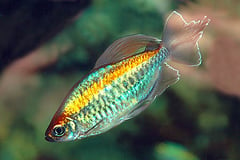
Phenacogrammus interruptusCongo Tetra
Alestidae · authority not recorded
The Congo tetra, Phenacogrammus interruptus, is a tetra from parts of the River Congo drainage in the Democratic Republic of Congo. Wild populations are endemic there, but most fish in the trade are bred commercially in the Far East and Eastern Europe. Usually sold as a drab, greyish juvenile, it colours up as it matures, and males develop extended caudal filaments and a greatly extended dorsal fin. It is sensitive to water quality and easily frightened when not kept in numbers.

Piabucus dentatusPiabuco Tetra
Characidae · authority not recorded
The piabuco tetra, Piabucus dentatus, is a large tetra from coastal waters of northern South America, from Venezuela to the mouth of the Amazon. A pelagic species of estuaries and floodplain streams, it is often found in turbid, silt-laden water and sometimes in brackish conditions, and reaches 13 cm SL. Oddly for a tetra it will also eat red, filamentous 'black brush' algae. All three species in the genus are rarely seen in the hobby.
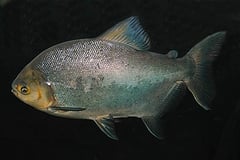
Piaractus brachypomusRed-bellied Pacu
Serrasalmidae · authority not recorded
The red-bellied pacu, Piaractus brachypomus, is a serrasalmid from the Orinoco and Amazon basins in Colombia, Venezuela, Peru, Bolivia and Brazil. Known as the pirapitinga in its native countries, it is one of the largest scaled fishes in the Amazon basin, with wild fish recorded to 88 cm. Juveniles mimic the red-bellied piranha and are sold small as 'vegetarian piranha', and releases by aquarists have left populations in the USA and elsewhere.
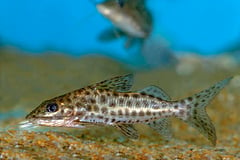
Pimelodus maculatusSpotted Pim
Pimelodidae · authority not recorded
The spotted pim, Pimelodus maculatus, is a pimelodid catfish from the Rio Paraná and Rio São Francisco basins in Brazil and Argentina. Active and shoaling, it grows to 18 cm and is a predator that will eat smaller fish, so it suits only roomy tanks with tough, active tankmates. Like other pims it is scaleless and sensitive to many medications, and the mucus on its rigid fin spines can cause a painful sting.
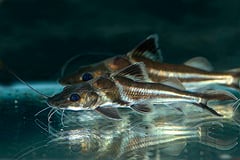
Pimelodus ornatusOrnate Pim
Pimelodidae · authority not recorded
The ornate pim, Pimelodus ornatus, is a pimelodid catfish recorded in major river systems from Colombia and Venezuela south to Paraguay and Argentina. One of the more sought-after pims imported with any regularity, it grows to 28 cm and is a predator that will eat smaller fish. It is scaleless, sensitive to many medications and often in poor shape when first imported, and its rigid fin spines can cause a painful sting.
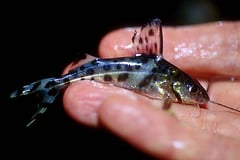
Pimelodus pictusPictus Cat
Pimelodidae · authority not recorded
The pictus cat, Pimelodus pictus, is a small pimelodid catfish from the Rio Orinoco and Amazon basins in Colombia, Venezuela, Peru and Brazil. The most popular member of the genus in the hobby, it is often sold as a bottom dweller for communities of small fish, though it is a predator that will eat neons, guppies and similarly-sized species. Colombian fish are peppered with tiny dark spots, while the Peruvian form has much larger spots on the body.

Placidochromis electraDeepwater Hap
Cichlidae · authority not recorded
The deepwater hap, Placidochromis electra, is a cichlid endemic to Lake Malawi, living over sandy bottoms usually below 7 metres. In nature it feeds on invertebrates stirred up by digging substrate feeders such as Taeniolethrinops praeorbitalis. The common name dates from when it was thought to live only in much deeper water. A very gentle species, it is unsuited to a mbuna community, and its colour forms should not be kept together as they may hybridise.

Placidochromis milomoSuper VC 10 Hap
Cichlidae · authority not recorded
The Super VC 10 hap, Placidochromis milomo, is a cichlid endemic to Lake Malawi, found in the southern part of the lake and at Nkhata Bay. Wild fish have massively enlarged lips for scraping algae and invertebrates from rocks, but these usually recede in the aquarium and do not develop at all in tank-bred fish. Relatively peaceful, it does well with larger Malawians but not mbuna, and only one male should be kept unless the tank is very large.
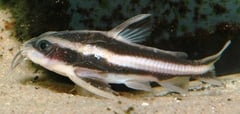
Platydoras armatulusHumbug Catfish
Doradidae · authority not recorded
The humbug catfish, Platydoras armatulus, is a doradid catfish ranging from the Rio Orinoco basin to the Amazon, Tocantins and Parnaíba basins. Also sold as the striped dora, striped raphael or striped talking catfish, it is hardy, but its secretive nature, adult size and habit of eating smaller tankmates suit it only to communities of larger fish. It produces audible sounds by grinding its pectoral spines in their sockets or by resonating the swimbladder.
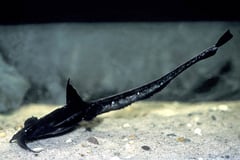
Platystacus cotylephorusBanded Banjo Catfish
Aspredinidae · authority not recorded
The banded banjo catfish, Platystacus cotylephorus, is an aspredinid catfish from estuarine and coastal waters of northern South America and Trinidad. Largely inactive and secretive, it is camouflaged to resemble a dead leaf and emerges only after dark, often lying buried in muddy substrates of fresh or brackish mangroves. During the spawning season females develop fleshy stalks called cotylephores on the belly, to which the eggs are attached until they hatch.
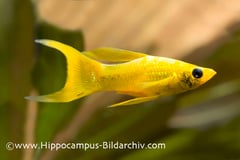
Poecilia latipinnaSailfin Molly
Poeciliidae · Lesueur, 1821
The sailfin molly, Poecilia latipinna, is a livebearer native to southern North America and Mexico, from Carolina to Veracruz. Bred into many colour morphs and crossed with P. sphenops, it can live perfectly well in fresh water provided it is not soft or acidic. Dark rectangular spots in the dorsal fin separate it from the similar P. velifera, and introduced populations in many countries often outcompete native species.
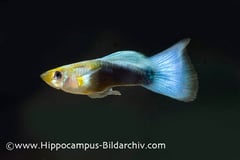
Poecilia reticulataGuppy
Poeciliidae · Peters, 1859
The guppy, Poecilia reticulata, is a livebearer native to northeastern South America and the southern Caribbean, including Venezuela and Trinidad. One of the most popular aquarium fish in the world, it is available in many aquarium-bred varieties with elongated finnage, while the wild form is seldom seen for sale. Many commercially bred guppies are weakened by inbreeding and over-production, and introduced or feral populations exist in around fifty other countries.
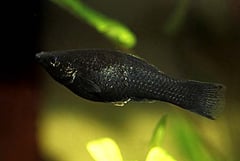
Poecilia sphenopsShort-finned Molly/Black Molly
Poeciliidae · Valenciennes, 1846
The short-finned molly, Poecilia sphenops, is a livebearer whose native range runs north from Venezuela and Colombia to Mexico. Many colour morphs exist, including the black molly, and years of inbreeding and over-production have left many of them weak and prone to disease. All the morphs do better in slightly brackish conditions and are much more prone to disease in fresh water that is not hard and alkaline.
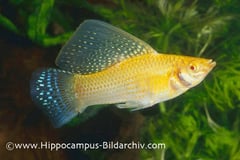
Poecilia veliferaGiant Sailfin Molly
Poeciliidae · Regan, 1914
The giant sailfin molly, Poecilia velifera, is a livebearer endemic to southeastern Mexico, with introduced populations in several other countries. Young fish are hard to tell from P. latipinna, and the only reliable method is to count the dorsal-fin rays: 18-19 in this species against 14. More difficult to maintain than others in the genus, it needs hard, alkaline water of high quality for males to develop the full sail-like dorsal fin.
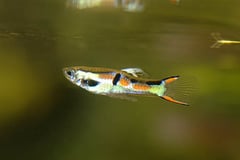
Poecilia wingeiEndler's Livebearer
Poeciliidae · Poeser, Kempkes & Isbrucker, 2005
Endler's livebearer, Poecilia wingei, is a small livebearer from the Campoma and Buena Vista lagoons in northeastern Venezuela. It hybridises with the guppy, P. reticulata, to produce fertile offspring, but Schories et al. (2009) confirmed it as a valid species. The fish are thought to be extinct at Laguna de Patos, the type locality, after the lake became polluted, and much of the species' natural variability has been lost through inbreeding in the hobby.
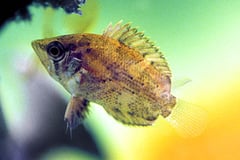
Polycentropsis abbreviataAfrican Leaf Fish
Polycentridae · authority not recorded
The African leaf fish, Polycentropsis abbreviata, is a predatory leaf fish from Nigeria, Benin, Cameroon and Gabon. Camouflaged to mimic a dead leaf, it stalks prey in a head-down stance and can swallow prey almost as big as itself. It is flighty and very sensitive to deteriorations in water quality, needs soft, acidic water and often accepts only live food. It is not recommended for the beginner.
Polypterus bichir bichirNile Bichir
Polypteridae · authority not recorded
The Nile bichir, Polypterus bichir bichir, is a large bichir recorded from Egypt, Kenya, Ethiopia and Chad west to Nigeria, Ghana and Guinea-Bissau. It grows to 72 cm, though rarely that large in aquaria, and belongs to the 'lower-jawed' group of Polypterus. It is one of the subspecies of the P. bichir complex, will eat any tankmate it can fit in its mouth, and needs a tight-fitting cover as an excellent escape artist.
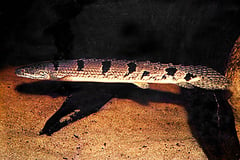
Polypterus delheziArmoured Bichir
Polypteridae · authority not recorded
The armoured bichir, Polypterus delhezi, is a bichir from the Democratic Republic of Congo, found in lakes, streams and flooded areas. Also known as the banded bichir, it is hardy and nocturnal with very poor vision, and relies on its sense of smell to find food. Like other bichirs it can drown if denied access to atmospheric air, and it will eat any tankmate small enough to fit in its mouth.
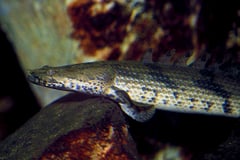
Polypterus endlicheri endlicheriSaddled Bichir
Polypteridae · authority not recorded
The saddled bichir, Polypterus endlicheri endlicheri, is a nocturnal bichir recorded from ten African countries including Cameroon, Nigeria and Sudan. It lives in rivers and marshy areas and is occasionally found in brackish water around mangroves. One of the 'lower-jawed' tribe of Polypterus, it can reach 75 cm, though rarely in captivity, and a fully grown fish needs a very large aquarium. Like other bichirs it breathes atmospheric air and can drown if denied access to it.
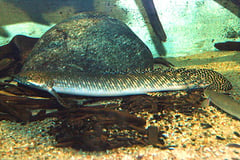
Polypterus ornatapinnisOrnate Bichir
Polypteridae · authority not recorded
The ornate bichir, Polypterus ornatapinnis, is a nocturnal bichir from Cameroon, the Democratic Republic of Congo, Burundi, Angola and Tanzania. It is found in rivers, ponds, marshes and lakes, including Tanganyika. The largest of the 'upper-jawed' polypterids, it reaches 60 cm, though usually less in aquaria, and will eat any tankmate small enough to fit in its mouth.
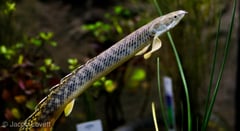
Polypterus palmas palmasMarbled Bichir
Polypteridae · authority not recorded
The marbled bichir, Polypterus palmas palmas, is a small bichir from Ghana, Cameroon, the Democratic Republic of Congo and four other countries. One of the more peaceful and active Polypterus, it reaches 32.5 cm and is recommended as a beginner's bichir. Three subspecies make up the P. palmas complex, and most fish sold as P. palmas are in fact P. palmas polli, though aquarium care for all of them is identical.
Polypterus retropinnisWest African Bichir
Polypteridae · authority not recorded
The West African bichir, Polypterus retropinnis, is a nocturnal bichir widely distributed throughout Western Africa. It inhabits marshes, swamps, flooded areas and small rivers, and is also known as the speckled bichir. Imported infrequently, it has an unsettled classification: its former subspecies P. retropinnis lowei is now a synonym of P. palmas palmas, and there is some discussion as to whether P. retropinnis belongs in the P. palmas complex too.
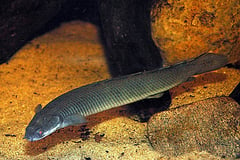
Polypterus senegalus senegalusSenegal Bichir
Polypteridae · authority not recorded
The Senegal bichir, Polypterus senegalus senegalus, is the most widespread bichir, found in 26 African countries including Egypt and Senegal. It is usually found in shallow, slow-moving swamps, marshes and freshwater lagoons. One of the more peaceful and active Polypterus, it reaches 50 cm, is recommended for beginners with these fish, and has lived for over 30 years in aquaria.
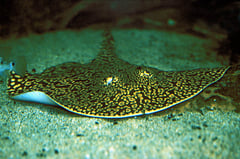
Potamotrygon falkneriLarge Spot Stingray
Potamotrygonidae · authority not recorded
The large spot stingray (P53), Potamotrygon falkneri, is a freshwater stingray from the Paraná and Paraguay basins in Brazil, Paraguay and Argentina. A large female can reach about 52 cm across the disc. It is imported irregularly and is usually expensive when available. Like all rays it carries a venomous sting on the tail, and the venom causes intense pain and tissue necrosis.
Potamotrygon hystrixPorcupine Stingray
Potamotrygonidae · authority not recorded
The porcupine stingray (P06), Potamotrygon hystrix, is a freshwater stingray from the Rio Paraná and Rio Paraguay basins in Argentina and Brazil. Usually around 35 cm across the disc, it is recommended as a good beginners' ray. Fish sold as hystrix are almost always Peruvian and mislabelled: P. humerosa, P. yepezi and a P. motoro variant known as P. sp. 'Peru' have all been sold under the name, and all grow considerably larger.
Potamotrygon leopoldiPolka Dot Stingray
Potamotrygonidae · Castex & Castello, 1970
The polka dot stingray, Potamotrygon leopoldi, is a freshwater stingray known only from the Rio Xingu basin and Rio Fresco in central Brazil. A large female reaches 70 cm across the disc, and males tend to be smaller. A rare form with ring-shaped spots is known as 'eclipse'. P. henlei is very similar and is told apart by spots on the underside of the disc that P. leopoldi is supposed to lack.
Potamotrygon motoroMotoro Stingray
Potamotrygonidae · authority not recorded
The motoro stingray, Potamotrygon motoro, is a freshwater stingray ranging across Colombia, Peru, Bolivia, Brazil, Paraguay, Uruguay and Argentina. It reaches about 50 cm across the disc. The patterning is highly variable, with some variants given P-numbers and others sold as 'blue', 'orange', 'black' or 'marbled'. Males are among the most violent when spawning and can seriously injure females.
Potamotrygon orbignyiSmooth-back Stingray
Potamotrygonidae · authority not recorded
The smooth-back stingray (P11), Potamotrygon orbignyi, is a freshwater stingray from Venezuela, Guyana, Suriname, French Guiana, Brazil and Bolivia. Often labelled 'teacup ray' by dealers, it is tricky to identify when young and most resembles P. humerosa. The skin tells them apart: rough in P. humerosa and noticeably smooth in P. orbignyi. Most reach 35 to 37.5 cm across the disc, but females from the Amazon basin grow larger and do not mature until about 44 cm.
Potamotrygon schroederiFlower Ray
Potamotrygonidae · authority not recorded
The flower ray, Potamotrygon schroederi, is a freshwater stingray from the Orinoco (Rio Apure) and Amazon (Rio Negro) basins in Brazil and Venezuela. A large female can exceed 50 cm across the disc, and the long caudal fin takes it well over 90 cm nose to tail. Another fish sold as 'flower ray' is a potentially undescribed species from Peru, known to ray enthusiasts as 'Peru flower' or P40.
Potamotrygon scobinaMosaic Stingray
Potamotrygonidae · authority not recorded
The mosaic stingray, Potamotrygon scobina, is a freshwater stingray found only in the middle and lower Amazon drainage in Brazil. Most captive fish stay below 35 cm across the disc, and it is usually recommended as a good beginners' ray. Other rays, almost always Peruvian, are often mislabelled as scobina. Apparently only the real P. scobina has five rows of spines on the tail.
Potamotrygon sp. "itaituba"P14
Potamotrygonidae · authority not recorded
P14, Potamotrygon sp. 'Itaituba', is a freshwater stingray collected from the Rio Tapajos in Brazil. It is unclear whether it is a geographical variant of P. leopoldi or a distinct species. It is smaller, at around 40 cm across the disc, and its light spots are smaller, denser around the edge of the disc and extend to the underside. The name comes from Itaituba, the city the rays are sent to before being shipped on to Santarém.

Prionobrama filigeraGlass Bloodfin Tetra
Characidae · authority not recorded
The glass bloodfin tetra, Prionobrama filigera, is a characid recorded from the Amazon drainage in Ecuador, Colombia, Peru, Bolivia and Brazil. It is told from the other bloodfin tetra, Aphyocharax anisitsi, by its more elongate body and the lack of red in the anal and ventral fins. An active, pelagic species of the upper water layers, it grows to around 6 cm and should be kept in groups of at least six to eight.

Pristella maxillarisX-ray Tetra
Characidae · Ulrey, 1894
The X-ray tetra, Pristella maxillaris, is a small characid native to coastal waters of Venezuela, Guyana, Suriname, French Guiana and northern Brazil. In the dry season it lives in clearwater streams, moving into flooded savannah to spawn when the rains come. Peaceful, hardy and inexpensive, it is commercially bred in huge numbers, and a semi-albino 'golden' strain exists. The only species in the genus, it appears in older literature as Pristella riddlei.
Pristolepis marginataMalabar Leaffish
Pristolepididae · authority not recorded
The Malabar leaffish, Pristolepis marginata, is a nandid endemic to the Western Ghats of Kerala, India, and is also known as the common catopra. Unlike many other nandids it inhabits flowing water, from fast-moving streams and rivers to some whitewater areas. It reaches 15 cm, will swallow any tankmate small enough to eat and can be a little belligerent, so it is best kept with similarly sized or larger fish that also suit flowing water.

Procatopus nototaeniaLarge-finned Lampeye
Poeciliidae · authority not recorded
The large-finned lampeye, Procatopus nototaenia, is a killifish thought to be endemic to the Lobi and Kienke river basins in southwestern Cameroon. It lives in shady forest streams with clear, moderately flowing water. Several colour forms are known by collection locality, among them 'Kribi', 'Edea' and 'Kopongo', and should never be mixed. The males carry the differences in colour and finnage, their dorsal, anal and caudal fins lengthening as they mature.

Protomelas fenestratusFenestratus
Cichlidae · authority not recorded
Known as the fenestratus, Protomelas fenestratus is a cichlid endemic to Lake Malawi, found in the northern and southwestern parts of the lake. It inhabits rocky shorelines and the sandy zones beyond them, feeding by blowing sediment from rocks and taking what it uncovers. A gentle species unsuited to the boisterous mbuna community, it should not be kept with P. taeniolatus or Protomelas sp. 'steveni taiwan reef', as they may hybridise.

Protomelas pleurotaenia
Cichlidae · authority not recorded
Protomelas pleurotaenia is a cichlid endemic to Lake Malawi, known from Nkhata Bay and Monkey Bay, where it lives in vegetation between rock and sand. It feeds by blowing at the top layer of the substrate, usually sand, and eating the invertebrates it uncovers. Rare in the hobby, it is gentle and unsuited to the mbuna community, though it becomes territorial when breeding.

Protomelas sp. steveni "Taiwan reef"
Cichlidae · authority not recorded
Protomelas sp. 'steveni taiwan reef' is an undescribed cichlid endemic to Lake Malawi, found at Taiwan Reef, Higga Reef and Mbamba Bay Island. Often sold as a subspecies of P. fenestratus, it is thought to be distinct, and adult males are told from P. fenestratus and P. taeniolatus by their bright red anal fin. Males hold territories on flat rock deeper than 20 metres, and in nature these can measure 5 or 6 feet across.

Protomelas taeniolatus
Cichlidae · authority not recorded
Protomelas taeniolatus is a cichlid endemic to Lake Malawi, where it is widespread over rocky areas of shallow, clear water. Very similar to P. fenestratus, it is one of the more popular Protomelas, and its colour forms include 'Red Empress', 'Super Red Empress' and 'Blue Fire'. Some of these may be reclassified as distinct species, as they reach different maximum sizes. Tougher than its congeners, it can even be kept with mbuna.
Protopterus dolloiSlender Lungfish
Protopteridae · authority not recorded
The slender lungfish, Protopterus dolloi, is a lungfish from Gabon, Angola, the Central African Republic and both Congo republics. It inhabits floodplains, rivers, swamps and backwaters, and survives the dry season in a mucus cocoon, though it aestivates more rarely than P. annectens annectens. It reaches 130 cm, lives for over 20 years and is best kept singly, since it can suddenly turn on tankmates.

Pseudocrenilabrus nicholsi
Cichlidae · authority not recorded
Pseudocrenilabrus nicholsi is a small mouth-brooding cichlid from the Democratic Republic of Congo, found in ponds, creeks and drainage ditches. Rarely seen in the hobby, it is a pugnacious little fish, and males are very aggressive towards one another, so a single male is best kept with several females. Some males develop long extensions to the ventral fins.

Pseudocrenilabrus philanderSouthern Mouth-Brooder
Cichlidae · authority not recorded
The southern mouth-brooder, Pseudocrenilabrus philander, is a cichlid found in eleven countries from the Democratic Republic of Congo to South Africa. It lives in streams, lakes, ponds and sinkholes, and some populations exist in slightly brackish conditions. Three subspecies are recognised, but as many as 11 distinct populations may exist and these should not be mixed in aquaria. Not often seen in the hobby, it appears to travel badly and losses are common.

Pseudotropheus demasoni
Cichlidae · authority not recorded
Pseudotropheus demasoni is a dwarf mbuna endemic to Lake Malawi, where it occurs around Pombo Rocks off the Tanzanian coast. It hugs rock surfaces more than most mbuna and is often seen swimming on its side or upside down as it explores caves and crevices. One of the most aggressive and territorial mbuna, it will attack fish several times its own size and is not recommended for the beginner.

Pseudotropheus elongatusElongate Mbuna
Cichlidae · authority not recorded
The elongate mbuna, Pseudotropheus elongatus, is a slender cichlid endemic to Lake Malawi, found in Mbamba Bay and Nkata Bay. Over 30 different forms occur in the lake and they hybridise freely, so they should not be mixed in the aquarium. In nature females defend territories containing 'gardens' of algae. One of the most aggressive and territorial mbuna, it is not recommended for the beginner.

Pseudotropheus estheraeRed Zebra
Cichlidae · authority not recorded
The red zebra, Pseudotropheus estherae, is a mbuna endemic to Lake Malawi, found along the Mozambique and Malawi coasts from Metangula to Gome. Only described as a distinct species in 1995, it was previously regarded as a morph of Maylandia zebra, and its genus is still debated. Some males are blue and females orange, though orange and OB males occur depending on locality. Not especially aggressive for a mbuna, it will hybridise, so colour forms should never be kept together.

Pseudotropheus fainzilberiGoldbreast Zebra
Cichlidae · authority not recorded
The goldbreast zebra, Pseudotropheus fainzilberi, is a large mbuna endemic to Lake Malawi, on the north-eastern coast from Chirwa Island to Usisya. Its genus is debated, and it has been grouped in both Maylandia and Metriaclima. It has more rows of teeth than others in the genus, with the bicuspid rows extending further back into the mouth. Growing to around 175 mm and one of the most aggressive and territorial mbuna, it is not a good species for the beginner.

Pseudotropheus flavus
Cichlidae · authority not recorded
Pseudotropheus flavus is a mbuna endemic to Lake Malawi, recorded only at Chinyankwazi Island and Chinyamwezi Reef. Not especially aggressive for a mbuna, it suits the general mbuna community, but it should not be kept with any member of the P. elongatus complex: the species interbreed and their males clash heavily. Males are far more colourful than females.
Pseudotropheus lombardoiKennyi
Cichlidae · authority not recorded
Known in the hobby as the kennyi, Pseudotropheus lombardoi is a mbuna endemic to Lake Malawi, confined to the Mbenji Islands and Nkhomo Reef. In a reverse of the usual mbuna pattern, dominant males are yellow and females blue, though subdominant males often turn blue and brooding females can turn yellow. One of the most aggressive and territorial mbuna, it is not recommended for the novice, and commercially produced fish tend to be of lower quality than wild ones.

Pseudotropheus socolofiPowder Blue Cichlid
Cichlidae · authority not recorded
The powder blue cichlid, Pseudotropheus socolofi, is a mbuna endemic to Lake Malawi, found along the Mozambique coast between Cobue and Tumbi Point. Also known as 'Eduard's mbuna' and 'Pindani', it is one of the most popular Rift Lake cichlids and somewhat peaceful for a mbuna. Both sexes share the same powder blue colouration, which makes it hard to sex. Most fish on sale are tank-bred, and an albino form exists in aquaria.

Pseudotropheus tropheops tropheops
Cichlidae · authority not recorded
Pseudotropheus tropheops tropheops is a mbuna endemic to Lake Malawi, where it occurs between the Maleri Islands and Chinyamwezi Rocks. One of three subspecies, it has many colour forms, and none of the subspecies or their morphs should be mixed in aquaria since they hybridise. It browses at a characteristic angle of around 45°, and is relatively peaceable but able to stand up for itself in most mbuna communities.

Pterophyllum "scalare"Angelfish
Cichlidae · authority not recorded
The angelfish, Pterophyllum scalare, is a cichlid from the Amazon, Essequibo, Oyapock and other rivers of northern South America. Adults reach 15 cm in body length and 20 cm or more in height, so it needs a tall tank. Almost all fish on sale are mass-produced, in black, gold and koi strains as well as the standard silver, and while generally peaceful it may eat small fish such as tetras.

Pungu maclareni
Cichlidae · authority not recorded
Pungu maclareni is a maternally mouthbrooding cichlid endemic to Lake Barombi Mbo, a small volcanic crater lake in Cameroon. Enlarged jaw muscles and small teeth allow it to tear chunks from freshwater sponges, its characteristic diet. It is considered critically endangered because of its tiny range, habitat destruction, introduced species and overfishing, and is correspondingly rare in the hobby.

Reganochromis calliurus
Cichlidae · authority not recorded
Reganochromis calliurus is a cichlid endemic to Lake Tanganyika, where it usually swims at 60 metres depth or more over sand or mud. Its deep-water lifestyle makes it difficult to collect, and it is rarely seen in the hobby. A peaceful biparental mouthbrooder, it should be kept in pairs and not with boisterous species such as mbuna.
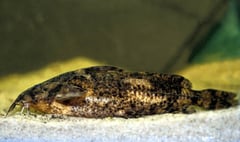
Rhinodoras boehlkeiFog Talking Catfish
Doradidae · authority not recorded
The fog talking catfish, Rhinodoras boehlkei, is a doradid catfish from the upper Amazon basin in eastern Ecuador and Peru. It is usually found sheltering among roots or sunken logs in flowing rivers and tributaries. Shy and nocturnal, it is totally unaggressive but will eat smaller fish, so tankmates need to be too big to be considered food.
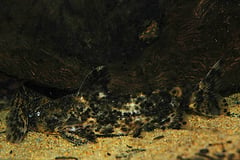
Rhinodoras dorbygnyi
Doradidae · authority not recorded
Rhinodoras dorbygnyi is a talking catfish from the Rio Paraná basin in Bolivia, Paraguay, Uruguay, Argentina and Brazil. It shelters among roots or submerged vegetation in slow-moving and standing waters. Shy and nocturnal, it grows to at least 30 cm and will eat smaller fish, although it is otherwise totally unaggressive.
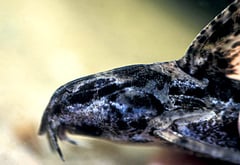
Rhynchodoras woodsiParrot Doradid
Doradidae · authority not recorded
The parrot doradid, Rhynchodoras woodsi, is a doradid catfish that appears to be endemic to the Rio Marañon basin, Ecuador. Rare in the hobby, it takes its name from its inquisitive feeding habits and a bony growth extending from the upper mouthparts, whose use is not known. Very peaceful and tolerant of conspecifics, it does not compete well for food with other bottom dwellers.
Rineloricaria eigenmanniCommon Whiptail Catfish
Loricariidae · authority not recorded
The common whiptail catfish, Rineloricaria eigenmanni, is a peaceful loricariid from Colombia and Venezuela, found among leaf litter over sand. One of the most common species sold as 'whiptail catfish', it breeds quite easily and suits a newcomer to catfish breeding. It is often mixed up with other species: in R. eigenmanni the black bars on the caudal peduncle continue right around the fish, and the fins are barred.
Rineloricaria fallaxWhiptail Catfish
Loricariidae · authority not recorded
Rineloricaria fallax is a whiptail catfish from the upper Rupununi and Branco river basins in Guyana and Brazil. One of the most common species sold as 'whiptail catfish', it breeds quite easily and suits a newcomer to catfish breeding. It lives among leaf litter over sand in shallow, flowing water, and is very peaceful but easily out-competed for food.
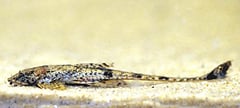
Rineloricaria morrowi
Loricariidae · authority not recorded
Rineloricaria morrowi is a loricariid catfish from the Ucayali River basin, Peru, found among leaf litter over sandy substrates. It is seen less often than some others in the genus. Briefly placed in the resurrected genus Hemiloricaria in 2002, it was returned to Rineloricaria within a year, but the old name is still used quite often.
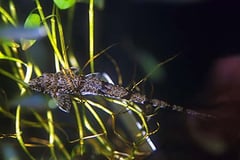
Rineloricaria parvaWhiptail Catfish
Loricariidae · authority not recorded
Rineloricaria parva is a whiptail catfish from Brazil, Paraguay and Argentina, found among leaf litter over sandy substrates. Commonly sold as a 'whiptail catfish', it is difficult to identify: the true R. parva has dark bands across the top of the body only and filaments on the top and bottom of the caudal fin. Some fish seen for sale may be hybrids with other species.
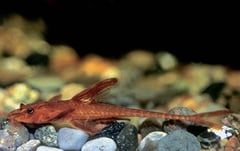
Rineloricaria sp.Red Lizard Catfish
Loricariidae · authority not recorded
The red lizard catfish (Rineloricaria sp., L010a) is a red whiptail catfish of unclear origin, and all fish seen for sale appear to be tank-bred. Some believe it derives from a wild fish, possibly from Paraguay, while others suggest a selectively-bred form of R. lanceolata or a hybrid with it. Very peaceful, it breeds quite easily in suitable conditions.
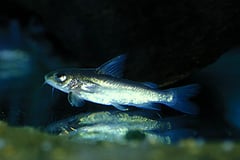
Rita kuturneeDeccan Rita
Bagridae · authority not recorded
The Deccan rita, Rita kuturnee, is a bagrid catfish from large river systems in India, growing to around 260 mm SL. Rita species are not often seen in the hobby. Relatively peaceful, it suits communities of larger species such as the bigger barbs, sturdy cichlids and loricariids, although smaller fish will be eaten.
Sandelia bainsiiEastern Cape Rocky
Anabantidae · authority not recorded
The Eastern Cape rocky, Sandelia bainsii, is an anabantoid endemic to a handful of river systems in the southeastern Cape, South Africa. Listed as endangered by the IUCN since 1994, it occurs in short sections of only half a dozen rivers. A conservation project begun in 1991 at the Blaauwkrantz Nature Reserve has released captive-bred fish at several sites. Sandelia spp. have a less well-developed labyrinth organ than their relatives.
Sandelia capensisCape kurper
Anabantidae · authority not recorded
The Cape kurper, Sandelia capensis, is an anabantoid endemic to the Cape Province, South Africa, found in the middle to lower reaches of many rivers. Its habitats are being destroyed and its numbers declining through introduced predators, damming, pollution and climatic changes. Genetic studies have revealed at least two, possibly several, deep lineages, and these would appear to indicate multiple species.

Sarotherodon melanotheron melanotheronBlack Chin Tilapia
Cichlidae · authority not recorded
The black chin tilapia, Sarotherodon melanotheron melanotheron, is a salt-tolerant cichlid from coastal western Africa. Its main habitat is estuarine water, especially mangrove areas. One of five subspecies of S. melanotheron, it is a paternal mouthbrooder. It has been introduced for aquaculture, and thriving populations exist in parts of Asia, Europe and the USA.
Saxatilia proteusProteus Pike Cichlid
Cichlidae · (Cope, 1872)
The Proteus pike cichlid, Saxatilia proteus, is one of the smaller pike cichlids, known from Ecuador, Peru and Brazil. It is occasionally offered for sale and more than makes up for its size in aggression, especially towards conspecifics. It will eat any fish small enough to be considered food, so suits a tank of larger cichlids or a species-only set-up.

Sciaenochromis fryeriElectric Blue Hap
Cichlidae · authority not recorded
The electric blue hap, Sciaenochromis fryeri, is a non-mbuna cichlid endemic to Lake Malawi, found along rocky shorelines and the sandy zones beyond. It was previously imported and classified as Sciaenochromis ahli, and is still named as such in much of the literature. Males of every morph are blue and differ only in the fins, and the morphs should not be mixed because they will hybridise. Highly piscivorous in nature, it should not be kept with mbuna.
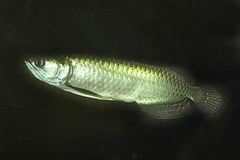
Scleropages jardiniiAustralian Arowana
Osteoglossidae · authority not recorded
The Australian arowana, Scleropages jardinii, is an osteoglossid from still and slow-moving waters in Australia, Papua New Guinea and Indonesia. Known in Australia as the gulf saratoga or northern-spotted barramundi, it has smaller scales, a bronze base colour and duller patterning than the Asian species. It is widely considered the most aggressive arowana in aquaria, and some individuals will not tolerate any tankmates.
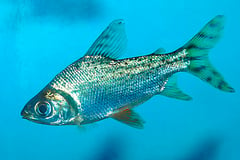
Semaprochilodus insignisFlagtail Prochilodus
Prochilodontidae · authority not recorded
The flagtail prochilodus, Semaprochilodus insignis, is a large shoaling characin from Ecuador, Peru, Colombia, Guyana and Brazil. Known with some congeners as the jaraqui in Brazil, it migrates over large distances in huge shoals and feeds on organic detritus, using one of its two stomachs, filled with mud, to aid digestion. It is aggressive towards its own kind in small numbers but can be kept in groups of six or more in larger tanks.
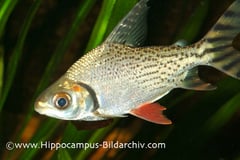
Semaprochilodus taeniurusFlagtail Characin
Prochilodontidae · authority not recorded
The flagtail characin, Semaprochilodus taeniurus, is a large shoaling fish from the central Amazon basin in Brazil, growing to around 30 cm. Also sold as the silver prochilodus or fei feng, it migrates twice a year in huge shoals, moving into white waters to spawn at the start of the wet season and feeding mostly in the floodplains. It is aggressive towards its own kind in small numbers but can be kept in groups of six or more in larger tanks.
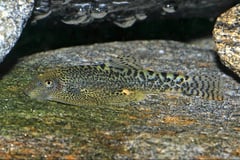
Sewellia sp. 'SEW04'
Gastromyzontidae · authority not recorded
Sewellia sp. 'SEW04' is a hillstream loach thought to originate in Hue province, central Vietnam, and may be undescribed. It has been imported among shipments of S. sp. 'SEW02' and S. sp. 'SEW03' and does not appear to correspond to any known member of the genus.
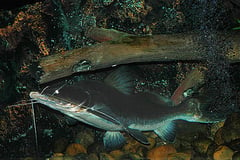
Sperata aorIndian Shovelnose Catfish
Bagridae · authority not recorded
The Indian shovelnose catfish, Sperata aor, is a large bagrid catfish from India, Pakistan, Nepal, Bangladesh and Myanmar. Named for its flattened, extended head, it is sometimes seen in dealers' tanks, but its enormous adult size makes it totally unsuited to aquarium life. It will eat any fish it can fit in its mouth and is territorial with its own kind.

Steatocranus casuariusBlockhead Cichlid
Cichlidae · authority not recorded
The blockhead cichlid, Steatocranus casuarius, is a rheophilic cichlid from the Lower Congo River and its tributaries, Democratic Republic of Congo. Its swimbladder is modified to reduce buoyancy, and in the aquarium it spends most of its time resting on the substrate or in caves, moving with short 'hopping' motions. A monogamous cave spawner, it should be kept in pairs, and both parents guard the fry for up to three months.
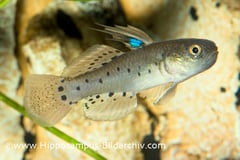
Stigmatogobius sadanundioKnight Goby
Gobiidae · authority not recorded
The knight goby, Stigmatogobius sadanundio, is a widely distributed goby recorded from Pakistan and India through to Indonesia and Fiji. It inhabits estuarine zones but is more often found in fresh than brackish water, and is by far the most common Stigmatogobius in the hobby. It will eat anything that fits in its mouth and is territorial towards conspecifics, so tankmates are medium-sized hardwater or brackish species using other levels of the aquarium.

Stomatepia pindu
Cichlidae · authority not recorded
Stomatepia pindu is a cichlid endemic to Lake Barombi Mbo, a small volcanic crater lake in Cameroon. Its tiny range, water removal for the nearby town of Kumba, deforestation, introduced species and overfishing mean it is considered critically endangered, and it is correspondingly rare in the hobby. It can change colour rapidly, turning pure black when in good condition and particularly when spawning.
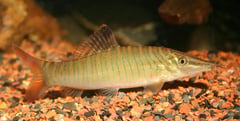
Syncrossus hymenophysaGreen Tiger Loach
Botiidae · Bleeker, 1852
The green tiger loach, Syncrossus hymenophysa, is a botiid loach from Sumatra and Borneo, and the Pahang and Perak systems of Peninsular Malaysia. It may already have disappeared from Peninsular Malaysia, where only one confirmed specimen has been documented since 1955. Often associated with submerged branches, roots and logs, it is sometimes confused with S. helodes but has a dark spot in the dorsal fin and 12-15 body bars with bluish borders.
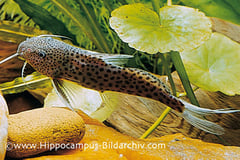
Synodontis acanthomiasBlack-spotted Synodontis
Mochokidae · authority not recorded
The black-spotted synodontis, Synodontis acanthomias, is a squeaker catfish from Cameroon and the Democratic Republic of Congo. Seen less frequently in the trade, it ranks alongside S. schall as one of the more aggressive members of the genus and is particularly pugnacious towards conspecifics and other Synodontis. Very hardy and growing to around 30 cm, it makes a good tankmate for large, aggressive cichlids.
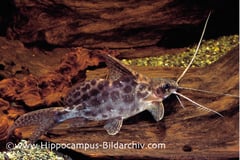
Synodontis albertiHigh-fin Synodontis
Mochokidae · authority not recorded
The high-fin synodontis, Synodontis alberti, is a squeaker catfish from the Democratic Republic of Congo, Cameroon and the Republic of Congo. Its barbels are the longest of any Synodontis, and its very large eyes reflect its nocturnal habits. Also known as the bigeye squeaker and Albert's synodontis, it is hardy, prefers cooler conditions than other members of the genus and is peaceful with tankmates over 2" long.
Synodontis albolineataMustard Synodontis
Mochokidae · authority not recorded
The mustard synodontis, Synodontis albolineata, is a small squeaker catfish endemic to the Majinga river system in Gabon. Also known as the mustard squeaker, it is imported infrequently but sometimes turns up in mixed boxes of Synodontis from exporters. It reaches around 10 cm and is peaceful with most species, though territorial towards its own kind in smaller systems.
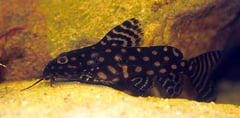
Synodontis angelicusPolka Dot Synodontis
Mochokidae · Schilthuis, 1891
The polka dot synodontis, Synodontis angelicus, is a squeaker catfish from the Democratic Republic of Congo, Cameroon and the Republic of Congo. Very nocturnal and long-lived, it can survive for over 20 years, and its spots vary from white to yellow on a grey to black base depending on locality. It becomes increasingly territorial as it matures, and adults are often completely intolerant of other bottom dwellers, especially other Synodontis.
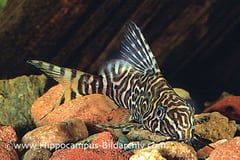
Synodontis aterrima
Mochokidae · authority not recorded
Synodontis aterrima is a peaceful Synodontis catfish found only in the Democratic Republic of Congo. Infrequently offered for sale, it grows to 115 mm SL and suits a medium-sized community aquarium that is dimly lit and has plenty of hiding places. Territorial, it can be kept with others of its own kind if each fish has a refuge.
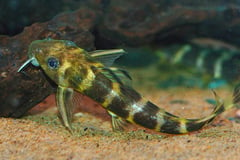
Synodontis brichardiBrichard's Synodontis
Mochokidae · authority not recorded
Brichard's Synodontis, Synodontis brichardi, is a catfish from the Democratic Republic of Congo and Republic of Congo. It inhabits rapids and highly oxygenated pools below waterfalls and will not thrive in aquaria with low water movement. In a biotope aquarium it moves in and out of areas of high and low current, rasping at algae on rocks. It is much more diurnal than many Synodontis, and its colours intensify with age.
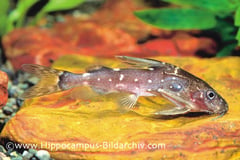
Synodontis contractusBig-nosed Upside-down Catfish
Mochokidae · Vinciguerra, 1928
The big-nosed upside-down catfish, Synodontis contractus, is a small Synodontis from the Democratic Republic of Congo and Republic of Congo. Often confused with S. nigriventris, it is easily told apart by its larger eyes and broad mouth and head, and it spends most of its time swimming inverted. It should be kept in groups of at least three or four, and can be delicate and prone to disease when first imported.
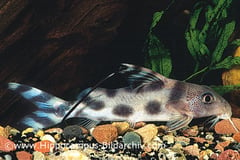
Synodontis decorusClown Synodontis
Mochokidae · Boulenger, 1899
The clown Synodontis, Synodontis decorus, is a large catfish from the Democratic Republic of Congo, Cameroon and the Republic of Congo. The first ray of its dorsal fin is greatly extended, and it has filamentous maxillary barbels, a feature shared with only two other members of the genus. Growing to 300 mm SL, it is secretive and nocturnal, and too large for the general community, though peaceful with fish it cannot swallow.
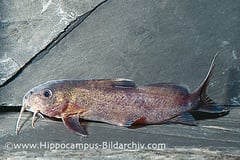
Synodontis dhonti
Mochokidae · authority not recorded
Synodontis dhonti is a large Synodontis catfish endemic to Lake Tanganyika, where it lives in deep water down to at least 100 metres. Its deep-water habitat and solitary lifestyle make collection difficult, so it is rarely seen for sale. Juveniles may be confused with other Tanganyikan Synos but lose their spotted patterning as they mature. It grows to 400 mm SL, though usually much smaller in aquaria, and is territorial with its own kind.
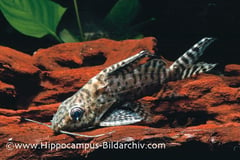
Synodontis eupterusFeatherfin Synodontis
Mochokidae · Boulenger, 1901
The featherfin Synodontis, Synodontis euptera, is a catfish from Nigeria, Cameroon, Mali, Ghana, Sudan, Chad and Niger. Juveniles are often sold as Synodontis 'Network' for their reticulated pattern, with no hint of an adult size of up to 300 mm SL. The pattern breaks up into simple spots with age as the long extensions of the 'feathered' dorsal fin develop. It can live for over 15 years in the aquarium.
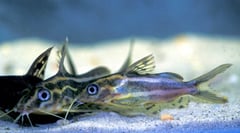
Synodontis flavitaeniataPyjama Synodontis
Mochokidae · authority not recorded
The pyjama Synodontis, Synodontis flavitaeniata, is a catfish endemic to the Malebo Pool area of the River Congo in the Democratic Republic of Congo. Its patterning and colouration vary considerably, but it is difficult to misidentify. Also known as the orange striped squeaker, it has filamentous maxillary barbels like only two other members of the genus, and it is more sensitive to deteriorating water quality than many Synodontis.
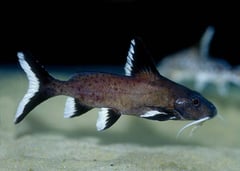
Synodontis granulosa
Mochokidae · authority not recorded
Synodontis granulosa is a large Synodontis catfish endemic to the northern end of Lake Tanganyika, in Burundi and Tanzania. Its deep-water habitat, limited range and solitary lifestyle make collection difficult, so it is rarely seen for sale. It is territorial with its own kind and can be very aggressive in smaller aquaria, though settled fish often become tame enough to feed from the hand. Captive-bred fish from Eastern Europe have been reported to be hybrids.
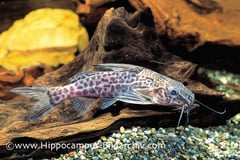
Synodontis greshoffi
Mochokidae · authority not recorded
Synodontis greshoffi is a Synodontis catfish from the Democratic Republic of Congo and Cameroon, growing to around 200 mm SL. Infrequently imported, it is occasionally confused with S. schoutedeni, which it superficially resembles. It becomes slightly territorial as it matures but can be kept in a small group if each fish has a refuge, and its adult size makes it unsuitable for the general community.
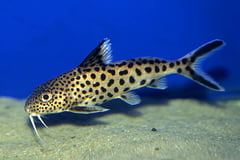
Synodontis multipunctataCuckoo Synodontis
Mochokidae · authority not recorded
The cuckoo Synodontis, Synodontis multipunctata, is a Synodontis catfish endemic to Lake Tanganyika, where it swims in large shoals. One of the only fish known to practise brood parasitism, it lays its eggs among those of a mouthbrooding cichlid, and the young catfish devour the host's eggs. It is bred quite often in aquaria, with cichlids from Lake Malawi or Victoria as hosts, and should be kept in a group of four or more.
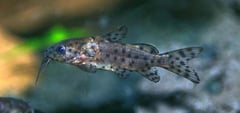
Synodontis nigritaFalse Upside-down Catfish
Mochokidae · authority not recorded
The false upside-down catfish, Synodontis nigrita, is a widespread Synodontis recorded from eleven African countries, among them Nigeria and Mali. Often sold as the upside-down catfish, it inverts far less often than the true one, S. nigriventris, and grows far larger, so adults returned by owners are a common sight in shops. It is also confused with the similar but smaller S. robbianus, from which its greyish base colour separates it.
Synodontis njassaeLake Malawi Synodontis
Mochokidae · authority not recorded
The Lake Malawi Synodontis, Synodontis njassae, is the only Synodontis catfish in Lake Malawi, to which it is endemic. Both large- and small-spotted morphs are available in the trade. A fairly vigorous species, it suits a community of hard water Lake Malawi cichlids but not shy species, and it will fight with other Synodontis but is not aggressive towards its own kind.
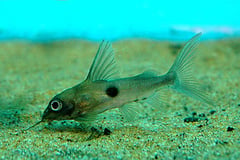
Synodontis notatusOne-spot Synodontis
Mochokidae · Vaillant, 1893
The one-spot Synodontis, Synodontis notata, is a large Synodontis catfish from the Democratic Republic of Congo and the Republic of Congo. Regional variants carry three, six or twelve spots or none, some sold under the invalid name S. ocellata, and similar species such as S. nummifer are often imported with it and all sold as notata. More active by day than many Synos, it is aggressive towards its own species, so only one should be kept unless the tank is very large.
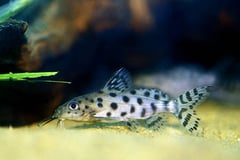
Synodontis ocelliferOcellated Synodontis
Mochokidae · authority not recorded
The ocellated Synodontis, Synodontis ocellifer, is a catfish from Nigeria, Gambia, Chad, Cameroon, Senegal, Mali, Ghana, Niger and Guinea. Often confused with similar Synodontis, it is distinguished by its very long adipose fin. One of the hardiest Synos available, it becomes slightly territorial as it matures, and many hybrids of it have been appearing on the market.
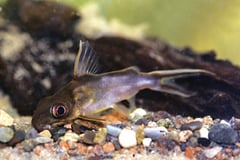
Synodontis pleuropsBig Eyed Synodontis
Mochokidae · authority not recorded
The big eyed Synodontis, Synodontis pleurops, is a Synodontis catfish from the Democratic Republic of Congo and Cameroon. Very large eyes and a downturned mouth suited to grazing algae make it hard to confuse with other species, though colouration and patterning vary considerably with locality. Very nocturnal, it is rarely seen unless the aquarium is dimly lit, and it keeps close to driftwood, rocks and broad plant leaves.
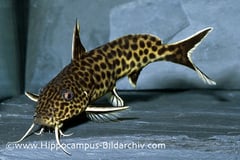
Synodontis polliPoll's Synodontis
Mochokidae · authority not recorded
Poll's Synodontis, Synodontis polli, is a Synodontis catfish endemic to Lake Tanganyika, where it lives in large schools at 30 to 125 metres. It inhabits muddy bottoms and is not comfortable in well-lit conditions without hiding places. Superficially similar to S. petricola, it has larger body spots and a longer head, and it is occasionally mis-identified in the trade as S. angelicus, S. petricola or Synodontis sp.
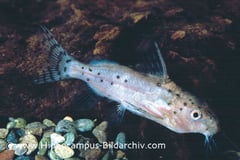
Synodontis robbianus
Mochokidae · authority not recorded
Synodontis robbianus is a Synodontis catfish found only in Nigeria, in the Lower Niger and Cross rivers. It is often confused with the similar but larger S. nigrita, from which its brownish base colour separates it, and it resembles several other Synos when juvenile. A hardy, adaptable species suited to a newcomer to Synodontis, it is not often seen for sale.
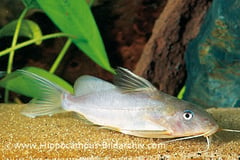
Synodontis schall
Mochokidae · authority not recorded
Synodontis schall is a large, predatory Synodontis catfish recorded from seventeen African countries, among them Nigeria, Egypt and Kenya. Regarded as the 'bad boy' of the genus in aquarium circles, it grows to 375 mm SL, is randomly aggressive and will eat smaller fish, so it should be kept only with tankmates that can stand their own ground. It is an important food fish in some of its native countries.
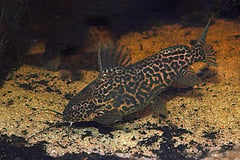
Synodontis schoutedeniVermiculated Synodontis
Mochokidae · authority not recorded
The vermiculated Synodontis, Synodontis schoutedeni, is a peaceful Synodontis catfish found only in the Democratic Republic of Congo. Its colour and patterning vary considerably, and the vermiculated pattern seems to intensify with age in well-kept fish. Of moderate adult size, it seems very susceptible to bloating, so feeding of dried foods is best kept to a minimum.
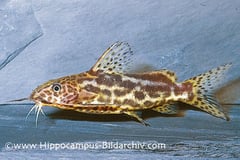
Synodontis waterloti
Mochokidae · authority not recorded
Synodontis waterloti is a Synodontis catfish from Guinea, Liberia, Ivory Coast, Guinea-Bissau, Sierra Leone and Ghana. Uncommonly imported, it has distinctive serrated edges to the pectoral fins and shows its strongest colouration over a light substrate. It becomes slightly territorial as it matures, and its adult size of 185 mm SL makes it unsuitable for the general community.

Taeniacara candidi
Cichlidae · authority not recorded
Taeniacara candidi is a dwarf cichlid from Brazil, ranging from the lower Rio Negro along the Amazon as far as the Rio Tapajós. It needs very specific water parameters and is seen as a challenge even by experienced keepers, commonly sitting at the bottom of the tank for a day or more after a water change. Said to be one of the most aggressive dwarf cichlids, it has a slimmer body than most Apistogramma, and the female guards the fry very aggressively.
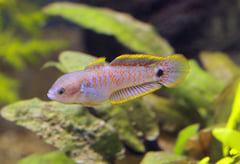
Tateurndina ocellicaudaPeacock Goby
Eleotridae · authority not recorded
The peacock goby, Tateurndina ocellicauda, is a small sleeper from Papua New Guinea, found in lowland rainforest streams, ponds and rivers. The name is misleading, as it belongs to the Eleotridae, the sleepers or gudgeons, which lack the fused pectoral fins of true gobies. A little territorial with its own kind, it suits communities of small, peaceful fish, and it spawns in caves and is easily bred under the right conditions.

Telmatochromis vittatus
Cichlidae · authority not recorded
Telmatochromis vittatus is a lamprologine cichlid endemic to Lake Tanganyika, found in open water near rocky areas at 5 to 20 metres. Similar in lifestyle to Julidochromis species, it suits the smaller Tanganyikan community. It is told from T. brichardi and T. bifrenatus by its larger size, smaller eyes and more rounded nose, and should be kept as a pair because it is aggressive towards conspecifics.
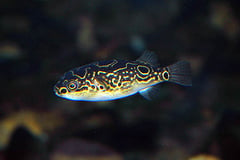
Tetraodon biocellatusFigure Eight Puffer
Tetraodontidae · authority not recorded
The figure eight puffer, Tetraodon biocellatus, is a small puffer from Cambodia, Malaysia and Indonesia. It lives in rivers and coastal waters, most often in freshwater but frequently in brackish conditions. Very sensitive to deteriorating water quality, it tends to live longer with a little marine salt added. It nips the fins of slow-moving or long-finned fish, and single specimens usually live longer in captivity than groups.
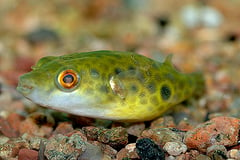
Tetraodon cochinchinensisFang's Puffer
Tetraodontidae · authority not recorded
Fang's puffer, Tetraodon cochinchinensis, is a freshwater puffer from Thailand, Cambodia, Laos and Vietnam. It belongs to the 'target' puffer group, whose members share a range and look very similar, and is told from them by a clear red spot towards the rear of the body. An aggressive and intolerant fish, it should be kept alone.
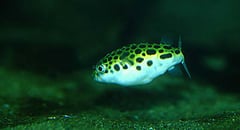
Tetraodon fluviatilisGreen Puffer
Tetraodontidae · authority not recorded
The green puffer, Tetraodon fluviatilis, is a widespread puffer from South and Southeast Asia, found in slow-moving rivers and estuaries. It is often confused with T. nigroviridis and T. schoutedeni but has a more slender, streamlined shape. Though often sold in freshwater, it is a true brackish species and needs a specific gravity of around 1.005 to 1.010 to survive long term.
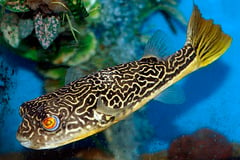
Tetraodon mbuGiant Puffer
Tetraodontidae · authority not recorded
The giant puffer, Tetraodon mbu, is a freshwater pufferfish from rivers and lakes in Central and East Africa, including Lake Tanganyika. Among the most aggressive puffers available, it can reach 75 cm and should be kept alone in a tank of around 240 by 90 by 90 cm. A molluscivore in nature, it needs snails and unshelled shellfish regularly to keep its continuously growing teeth worn down.
Tetraodon miurusCongo Puffer
Tetraodontidae · authority not recorded
The Congo puffer, Tetraodon miurus, is a predatory puffer from large rivers in the Republic of Congo and the Democratic Republic of Congo. A true ambush predator, it spends most of its time buried in the substrate, so a deep bed of sand is essential. It will eat any fish it can fit in its mouth, takes chunks from larger ones, and is not really safe with anything else.
Tetraodon nigroviridisGreen Spotted Puffer
Tetraodontidae · authority not recorded
The green spotted puffer, Tetraodon nigroviridis, is a widespread puffer from South and Southeast Asia, found in both brackish and fresh water. It is often confused with T. fluviatilis and T. schoutedeni. Although often sold as a community fish, it nips slow-moving or long-finned tankmates and some individuals become spiteful with age.
Tetraodon palembangensisHumpback Puffer
Tetraodontidae · authority not recorded
The humpback puffer, Tetraodon palembangensis, is a predatory puffer from Thailand, Laos, Malaysia and Indonesia. An ambush predator, it is very inactive and some specimens move only when food is offered, so it is seen in the trade infrequently and suits the true enthusiast. It is unsuitable for the community tank, though several can share a large tank with plenty of hiding places.

Tilapia guinasana
Cichlidae · authority not recorded
Tilapia guinasana is a cichlid endemic to Lake Guinas, a deep sinkhole lake in Namibia, and is considered critically endangered. Groundwater extraction for agriculture is reducing the lake's water. With no natural predators there, the fish exist in many distinct colour forms, and captive breeding is encouraged, with the lines kept pure. In nature it grazes algae from the rocky walls of the lake.
Toxotes chatareusLargescale Archerfish
Toxotidae · authority not recorded
The largescale archerfish, Toxotes chatareus, is an archerfish recorded from Pakistan and India through Southeast Asia to northern Australia. Its main habitats are brackish mangrove swamps and estuaries, and a brackish setup is recommended. Like its relatives, it shoots jets of water at insects on overhanging vegetation. It reaches 40 cm and is less often offered for sale than T. jaculatrix.
Toxotes jaculatrixBanded Archerfish
Toxotidae · authority not recorded
The banded archerfish, Toxotes jaculatrix, is an archerfish recorded from India through Southeast Asia to the Pacific islands and northern Australia. The most commonly available archerfish, it is sometimes sold as T. jaculator. It shoots jets of water at insects on overhanging vegetation. Its main habitats are brackish mangrove swamps and estuaries, and it is believed to migrate to full seawater to breed.
Trachelyichthys decaradiatus
Auchenipteridae · authority not recorded
Trachelyichthys decaradiatus is a small auchenipterid catfish known only from the Rupununi River in Guyana. It is very similar to T. exilis but has the eye set further back and a broader, shorter humeral process, and neither is seen very often in the hobby. Unlike most auchenipterids it usually feeds by day, and it is peaceful and does best in a group.
Trachelyichthys exilisPygmy Driftwood Catfish
Auchenipteridae · authority not recorded
The pygmy driftwood catfish, Trachelyichthys exilis, is a small auchenipterid catfish from the Nanay river basin in Peru. It is very similar to T. decaradiatus but has the eye set further forward and a longer, thinner humeral process. Unlike most auchenipterids it usually feeds by day. It is totally unaggressive towards conspecifics and does best in a group.
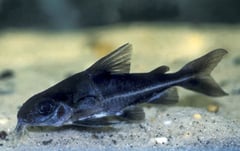
Trachydoras steindachneri
Doradidae · authority not recorded
Trachydoras steindachneri is a doradid catfish from the Amazon basin in Ecuador, Colombia, Peru, Bolivia and Brazil. Rare in the hobby, it is seldom offered for sale. Primarily nocturnal, it is a bottom feeder that suits a peaceful community with tetras, barbs and dwarf cichlids.

Tramitichromis intermedius
Cichlidae · authority not recorded
Tramitichromis intermedius is a sand-dwelling cichlid endemic to Lake Malawi, widespread in the south of the lake. It sifts sediment-rich sand or mud for food, so a soft sandy substrate is essential. Species like this can be delicate, and small, regular water changes are a necessity. The genus differs from Lethrinops only in part of the lower jaw dentition, and this species is likely to be moved to another genus.

Trematocranus placodonSnail-Crusher Hap
Cichlidae · authority not recorded
The snail-crusher hap, Trematocranus placodon, is a large cichlid endemic to Lake Malawi, where it inhabits shallow water. A molluscivore, it feeds mainly on snails, crushing their shells with specially developed pharyngeal teeth. It suits the larger Malawian community but is not often seen for sale. Males are territorial and aggressive towards one another.

Trichogaster labiosaThick-lipped Gourami
Osphronemidae · authority not recorded
The thick-lipped gourami, Trichogaster labiosa, is a labyrinth fish known only from southern Myanmar, found in shady, weedy rivers and ponds. Easy to keep and peaceful, it is one of the best gouramis for a community tank. A gold or 'sunset' strain has been selectively bred for the trade. It should not be kept with the banded gourami because the two can hybridise freely.

Trichopodus leeriiPearl Gourami
Osphronemidae · authority not recorded
The pearl gourami, Trichopodus leerii, is a labyrinth fish from Thailand, Malaysia, Borneo and Sumatra, where it inhabits lowland swamps. One of the most peaceful gouramis, it is hardy and fairly long-lived, surviving 8 years or more in the aquarium. Wild fish are rare in the hobby, and most on sale are mass-produced in the Far East and Eastern Europe.

Trichopodus microlepisMoonlight Gourami
Osphronemidae · authority not recorded
The moonlight gourami, Trichopodus microlepis, is a labyrinth fish from Vietnam, Cambodia and Thailand. It inhabits lowland ponds, bogs and swamps where vegetation grows densely, and its modified ventral fins are considerably longer than in other gouramis. It is often used as a food fish in its native countries, and most fish on sale are mass-produced.

Trichopodus pectoralisSnakeskin Gourami
Osphronemidae · authority not recorded
The snakeskin gourami, Trichopodus pectoralis, is a large labyrinth fish from the Mekong and Chao Phraya drainages of Indochina and Myanmar. Growing to 30 cm, it is farmed as a food fish, and feral populations are established in several countries as a result. A very peaceful species for the larger community tank, it can produce 'cracking' noises during breeding or territorial exchanges.

Trichopodus trichopterusThree-spot Gourami
Osphronemidae · authority not recorded
The three-spot gourami, Trichopodus trichopterus, is a labyrinth fish found mostly in the Mekong basin of Southeast Asia and southern China. The natural form is blue-grey with three spots, but gold, opaline, cosby, marbled and silver forms bred for the trade are seen far more often. One of the hardiest fish in the trade, it is recommended for community tanks with reservations, since some individuals become very spiteful as they mature.

Triportheus angulatusDusky Narrow Hatchetfish
Characidae · authority not recorded
The dusky narrow hatchetfish, Triportheus angulatus, is a characin from Ecuador, Venezuela, Peru, Brazil, Bolivia and Argentina. Common in many native habitats, where it is known as sardina, it is not often seen in the hobby. Very strong pectoral muscles let it leap several metres from the water to catch flying insects, and it should always be kept in a group.

Tyrannochromis macrostomaBig-Mouth Hap
Cichlidae · authority not recorded
The big-mouth hap, Tyrannochromis macrostoma, is a large predatory cichlid endemic to Lake Malawi, living in shallow rocky areas. An ambush predator, it often attacks prey while swimming upside-down, and its reverse countershading (a belly darker than its back) is thought to make it harder to spot. Mbuna are its natural diet, and juveniles are easily confused with T. nigriventer.

Vieja argenteaSilver Cichlid
Cichlidae · authority not recorded
The silver cichlid, Vieja argentea, is a large Central American cichlid that appears to be endemic to the River Usumacinta drainage in Mexico. Also called the white cichlid, it is aggressive, especially towards conspecifics. It may be kept with other tough Central American cichlids if enough rock and bogwood forms territories for all, but there is no guarantee of success.

Vieja fenestrata
Cichlidae · authority not recorded
Vieja fenestrata is a large cichlid endemic to Mexico, occurring in and between the rivers Papaloapán and Chachalacas. It predominantly inhabits clear lakes with sandy or muddy substrates and beds of aquatic plants. Not all that common in the UK hobby, it is often confused with the more commonly available V. synspila, and is moderately aggressive.

Vieja maculicaudaBlackbelt Cichlid
Cichlidae · authority not recorded
The blackbelt cichlid, Vieja maculicauda, is a large cichlid found from the Usumacinta basin in Guatemala south to the River Chagres in Panama. It takes its name from the vertical black stripe around its flank and from its toughness. It lives in slow-moving rivers and lakes, sometimes in brackish or even marine conditions, and should only be kept with similarly aggressive fish of similar size.
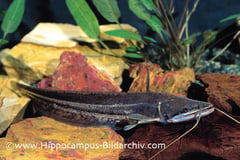
Wallago attuHelicopter Catfish
Siluridae · authority not recorded
The helicopter catfish, Wallago attu, is a giant predatory catfish found through much of Asia, from Afghanistan and Pakistan to Indonesia. It can reach 240 cm, and its mouth is filled with needle-sharp, backward-pointing teeth. It will bite aggressively when fed or handled, and the profile treats it as a genuinely dangerous fish that is clearly not an aquarium species.
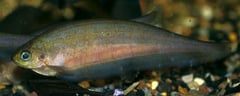
Xenomystus nigriAfrican Knifefish
Notopteridae · authority not recorded
The African knifefish, Xenomystus nigri, is a notopterid recorded from numerous African rivers, including the Nile, Congo and Niger systems. Its swim bladder acts as an accessory breathing organ, and it rises to the surface periodically to gulp air, often with a bell-like sound. Often confused with the far more aggressive Asian knifefish, Notopterus notopterus, it lacks the dorsal fin present in its Asian relative. A scaleless species, it is very sensitive to medications.
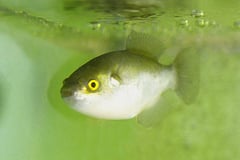
Xenopterus naritusGolden Puffer
Tetraodontidae · authority not recorded
The golden puffer, Xenopterus naritus, is a pufferfish from estuarine rivers in China, Myanmar, Thailand, Vietnam and Indonesia. Much of the available information describes it as a freshwater species, but it appears to be estuarine, and all museum specimens were collected in brackish or marine conditions, so it needs marine salt in aquaria. An aggressive, intolerant fish, it requires its own aquarium and can easily bite chunks from other fish.

Xenotilapia flavipinnisYellow Sand Cichlid
Cichlidae · authority not recorded
The yellow sand cichlid, Xenotilapia flavipinnis, is a bi-parental mouthbrooder endemic to Lake Tanganyika, where groups swim over sandy substrates. In nature the pair bond lasts only for the breeding season. In aquaria it can last much longer, with the pair remaining in their territory and defending it even when not spawning. A gentle substrate-sifter, it needs sand, a group of 6-10 and peaceful Tanganyikan tankmates, and it is very sensitive to deteriorating water conditions.
Xenotilapia melanogenysBlack-Chinned Xenotilapia
Cichlidae · authority not recorded
The black-chinned xenotilapia, Xenotilapia melanogenys, is a cichlid endemic to Lake Tanganyika, where it lives in huge shoals over sandy substrates. Much of the literature still places it in the genus Enatiopus. The shoals in nature appear to be fixed, with an individual remaining in the same group for life. A skittish fish, it may react very nervously to rapid movements outside the tank and should not be kept with boisterous fish such as mbuna.

Xenotilapia simaBig-Eyed Xenotilapia
Cichlidae · authority not recorded
The big-eyed xenotilapia, Xenotilapia sima, is a cichlid endemic to Lake Tanganyika, where it is found in large groups over sandy substrates. Rarely seen in the hobby, it feeds like the South American Geophagus species, sifting sand through its gills for invertebrates, so a sand substrate is essential. A peaceful and skittish maternal mouthbrooder, it should be kept in a group of 6-10 with peaceful Tanganyikan species and never with mbuna.
Xenotoca eiseniRedtail Goodeid
Goodeidae · authority not recorded
The redtail goodeid, Xenotoca eiseni, is a livebearer from Mexico, found in habitats from clear mountain streams to polluted roadside ditches. Very hardy and adaptable, it is less popular in the hobby than it once was, probably because of its often aggressive nature. Some specimens attack and kill other fish, catfish in particular, so a species tank is best. As in other goodeids, the developing young are nourished by a structure known as the trophotaenia.
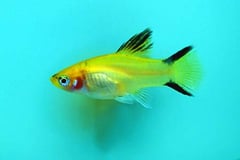
Xiphophorus maculatusPlaty
Poeciliidae · Gunther, 1866
The platy, Xiphophorus maculatus, is a livebearer from the Atlantic coastal plain of Mexico, Guatemala, Belize and Nicaragua. Wild fish are almost never seen in the hobby, where dozens of selectively bred varieties are available, some produced by crossing with other Xiphophorus species. Many commercially bred platies are not very hardy because of inbreeding and over-production. Very peaceful, it suits the beginner as long as the water is moderately hard or harder.
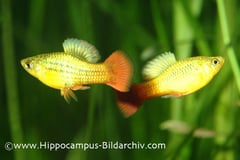
Xiphophorus variatusVariable Platy
Poeciliidae · Meek, 1904
The variable platy, Xiphophorus variatus, is a livebearer native to the Atlantic slope of Mexico, with feral populations in several other countries. Most on sale are mass-produced in the Far East and Eastern Europe, and many commercially bred platies are not very hardy because of inbreeding. Wild fish are slimmer than X. maculatus with a slightly longer dorsal fin, and should be kept from crossbreeding with domestic forms. It lives in shallow, heavily vegetated streams, ponds, swamps and ditches.
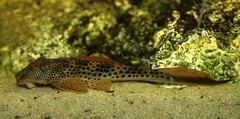
Aphanotorulus emarginatusRed Fin Thresher Plec
Loricariidae · (Valenciennes, 1840)
The red fin thresher plec, Aphanotorulus emarginatus, is a suckermouth catfish from the Amazon region of Brazil, Ecuador, Peru and Bolivia. Many geographical variants exist, four of them assigned L-numbers (L011, L035, L108 and L116), and all share the elongated caudal fin that gives the fish its common name. Often sold at 3-4" as Hypostomus cf. emarginata, it grows to around 40 cm and needs a spacious tank with well-oxygenated, flowing water.
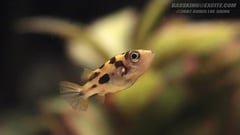
Carinotetraodon travancoricusDwarf Puffer
Tetraodontidae · authority not recorded
The dwarf puffer, Carinotetraodon travancoricus, is a tiny freshwater puffer endemic to the state of Kerala in southern India. Also known as the Malabar puffer and probably the smallest species of puffer, it usually inhabits sluggish, heavily vegetated inland waters. A popular import, it is often sold without the information needed for its long-term care, and tends to nip the fins of slow-moving or long-finned fish.
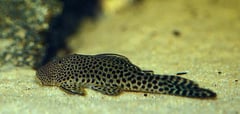
Chaetostoma sp.Spotted Bulldog Plec
Loricariidae · authority not recorded
The spotted bulldog plec, Chaetostoma sp. 'L187a', is a rubbernose plec from fast-flowing mountain streams in Colombia. One of the more commonly seen Chaetostoma, its true identity is uncertain and it is sometimes misidentified in shops. It needs clear, cool, well-oxygenated water with plenty of movement, and it is territorial with its own kind unless each fish has a rock of its own.

Ctenopoma kingsleyaeTailspot Ctenopoma
Anabantidae · authority not recorded
The tailspot ctenopoma, Ctenopoma kingsleyae, is an anabantoid with an enormous range, recorded from Mauritania and Senegal to Gabon and the DR Congo. One of the more aggressive members of the genus, it can be particularly nasty towards conspecifics and will eat small fish. It is named after the explorer Mary Kingsley, and there are reports of specimens surviving in aquaria for over 30 years.

Ctenopoma weeksiiMottled Bushfish
Anabantidae · authority not recorded
The mottled bushfish, Ctenopoma weeksii, is an anabantoid from the River Congo drainage in the Republic of Congo and Democratic Republic of Congo. It lives in sluggish, often hypoxic waters, usually among the thickest marginal vegetation. A predator of small fish but otherwise retiring, it can be kept in a group if all the fish are added at the same time.
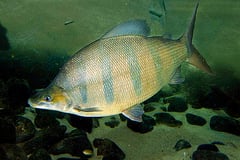
Distichodus lusossoLong-nosed Distichodus
Citharinidae · authority not recorded
The long-nosed distichodus, Distichodus lusosso, is a citharinid from rivers in Cameroon, the Republic of Congo and Democratic Republic of Congo. One of only a handful of Distichodus seen with any regularity in the hobby, it loses much of its juvenile colour and patterning as it matures. It resembles D. sexfasciatus but has a narrow, pointed head, and some specimens become very spiteful with age.
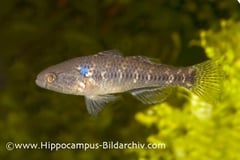
Dormitator lebretonisClay Goby
Eleotridae · authority not recorded
The clay goby, Dormitator lebretonis, is an eleotrid from coastal Western Africa, where it lives in estuaries, lagoons and mangroves. Mainly found in brackish water, it makes a peaceful addition to the brackish or hardwater community of medium-sized fish, though it will eat anything that fits in its mouth. Adults develop a pattern of reds and blues, and it was formerly placed in the defunct genus Batanga.
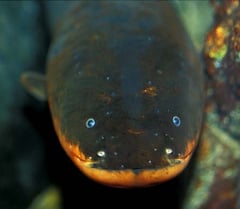
Electrophorus electricusElectric Eel
Gymnotidae · authority not recorded
The electric eel, Electrophorus electricus, is a nocturnal predator from Venezuela, Guyana, Suriname, French Guiana, Peru and Brazil. Up to 80% of its body holds electricity-producing organs: a weak field lets it navigate and locate prey despite very poor eyesight, and bursts of over 600 volts stun prey and can disable a human. It grows to 250 cm and is best kept singly and alone.
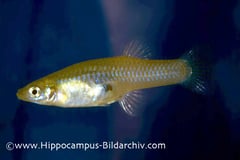
Gambusia affinisWestern Mosquitofish
Poeciliidae · authority not recorded
The western mosquitofish, Gambusia affinis, is a livebearer native to Mexico and the southern USA. It has been introduced to over 60 countries to control mosquitoes, often with detrimental effects, since it also preys on small crustaceans and the eggs and young of other fishes. It was long thought to be the same species as G. holbrooki. Hyper-competitive and a notorious fin nipper, it is best kept in a species tank.

Gymnogeophagus balzaniiParaguay Eartheater
Cichlidae · authority not recorded
The Paraguay eartheater, Gymnogeophagus balzanii, is a cichlid from the Rio Paraná basin in Brazil, Paraguay and Argentina, and the Rio Uruguay. It is found away from the main river channels in sluggish tributaries and creeks. A sand-sifting, delayed maternal mouthbrooder, it is recommended only to the specialist able to give it the specific conditions it needs, and males can be very intolerant of other cichlids. Colour forms vary with locality.
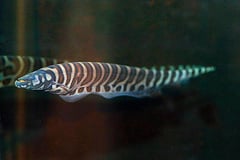
Gymnotus pedanopterusZebra Knifefish
Gymnotidae · authority not recorded
The zebra knifefish, Gymnotus pedanopterus, is a gymnotid knifefish from Peru and Brazil, one of over 20 Gymnotus species described since 1994. It grows to at least 28 cm and inhabits sluggish or still, turbid waters. Like other gymnotids it produces a weak electric field that it uses to navigate and communicate, and it is sensitive to many aquarium medications, particularly those containing copper.

Hemichromis elongatusFive Star General
Cichlidae · authority not recorded
The five star general, Hemichromis elongatus, is a highly aggressive cichlid recorded from Guinea, Cameroon, Angola, Namibia, Botswana and Zimbabwe. The common name comes from the row of five dark markings along its flanks. A piscivore, it eats any fish it can fit into its mouth, does not tolerate conspecifics outside a pair and is best kept in a species tank. The patchy recorded range suggests it has been misidentified in places or occurs in more countries.
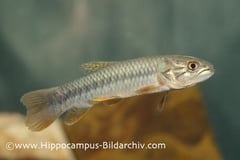
Hoplerythrinus unitaeniatusGold Wolf Fish
Erythrinidae · authority not recorded
The gold wolf fish, Hoplerythrinus unitaeniatus, is a predatory erythrinid widespread throughout much of South America. Also known as the golden trahira, it inhabits small tributaries, swamps, marshes and forest lake margins, and can breathe air using a modified swim bladder. The only member of its genus to appear in the trade with any regularity, it is really a fish for the specialist and is intolerant of conspecifics.
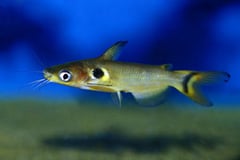
Horabagrus brachysomaSun Catfish
Bagridae · authority not recorded
The sun catfish, Horabagrus brachysoma, is a large bagrid catfish endemic to the state of Kerala in south-western India. Also sold as the bullseye, solar, eclipse or golden red-tailed catfish, it is often marketed as a general community fish, but at 45 cm it suits only communities of other large fish. The smaller H. nigricollaris is similar, and the two can be told apart by the black shoulder marking, a vaguely circular blotch in this species.
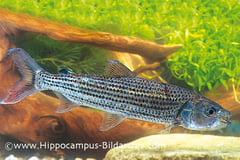
Hydrocynus goliathGiant Tigerfish
Alestidae · authority not recorded
The giant tigerfish, Hydrocynus goliath, is a huge predatory alestid from large rivers and lakes of Tanzania and the Democratic Republic of Congo. A voracious piscivore with dagger-shaped, interlocking teeth, it is one of the world's most infamous game fish. Small specimens are becoming easier to acquire, but its enormous adult size and the danger of maintaining it make it totally unsuited to aquarium life.
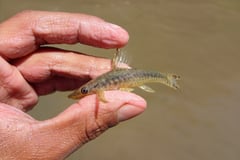
Hypoptopoma incognitum
Loricariidae · authority not recorded
Hypoptopoma incognitum is a loricariid catfish described from the Río Itenez, northeastern Bolivia, and the most widespread member of its genus. It has been recorded through much of the central and lower Amazon basin, the rio Tocantins, and some minor rivers draining straight into the Atlantic in northeastern Brazil.
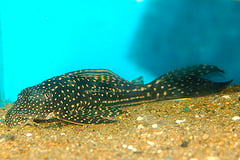
Hypostomus reganiGiant White Spot Plec
Loricariidae · authority not recorded
The giant white spot plec, Hypostomus regani, is a large suckermouth catfish from Brazil, Paraguay, Uruguay and Argentina. It is very hardy and grows to around 400 mm SL. Peaceful with most tankmates, it is territorial with similarly-sized bottom dwellers, especially its own kind, so a very large tank is needed to keep other large catfish with it.

Julidochromis marlieriMarlier's Julie
Cichlidae · authority not recorded
Marlier's julie, Julidochromis marlieri, is a rock-dwelling cichlid endemic to Lake Tanganyika, also sold as the chequered julie. It swims hugging the rock surfaces at any angle, and is found in fairly deep water along rocky shorelines. Adults are very belligerent towards one another, so unless the tank is huge it should be kept as a pair. Several geographical morphs are available, and no two species or morphs of Julidochromis should be kept together as they may hybridise.

Julidochromis ornatusGolden Julie
Cichlidae · authority not recorded
The golden julie, Julidochromis ornatus, is a cave-spawning cichlid endemic to Lake Tanganyika, found mainly in the north of the lake. One of the most common Julie species in aquaria, it may also be sold as the yellow or ornate julie. Most specimens available are tank bred and lack the bright colouration of wild fish. Several geographical morphs and an albino aquarium sport exist, and none should be kept with other Julidochromis as they may hybridise.
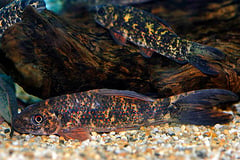
Labeo cyclorhynchusHarlequin Shark
Cyprinidae · authority not recorded
The harlequin shark, Labeo cyclorhynchus, is a cyprinid from the middle and lower Congo basin and the Ogooué drainage in Gabon. The patterning of young fish fades with age and adults are much darker. It becomes increasingly territorial as it grows, especially towards similar-looking species, so tankmates need choosing with care. It may still be seen as Labeo variegatus, an invalid name, in older literature and trade lists.
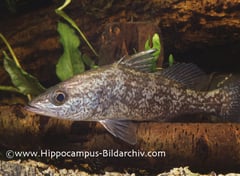
Lates angustifronsTanganyika Lates
Latidae · authority not recorded
The Tanganyika lates, Lates angustifrons, is a giant predatory fish endemic to Lake Tanganyika, growing to 200 cm. Juveniles have turned up in some aquatic stores, but the species is not suited to captive life in any respect, and housing an adult is beyond the reach of most public aquaria. Highly piscivorous, it feeds mainly on cichlids in nature, and adults live throughout the lake, usually around the lake bed.
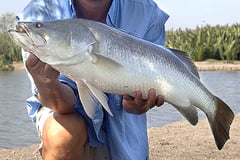
Lates calcariferBarramundi
Latidae · authority not recorded
The barramundi, Lates calcarifer, is a large predatory fish found from the Persian Gulf east through Asia and south to Australia, reaching 200 cm. It lives in fresh, brackish and marine coastal waters, and is diadromous, migrating to brackish or marine water to spawn. All individuals begin life as males before some change sex. Juveniles turn up in some aquatic stores, but it is not suited to captive life in any respect, and it is a prized food fish in many of its native countries.
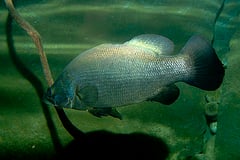
Lates niloticusNile Perch
Latidae · authority not recorded
The Nile perch, Lates niloticus, is a giant predatory fish from Central and Western Africa, reaching 193 cm and up to 200 kg. Introduced into many African countries as a food fish, it is thought to have contributed to the extinction of over 200 endemic species in Lake Victoria, and the IUCN lists it among the world's top 100 invasive species. Juveniles turn up in some aquatic stores, but it is not suited to captive life in any respect.
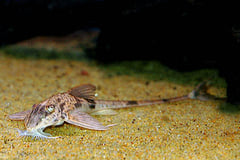
Loricaria simillimaMarbled Whiptail
Loricariidae · authority not recorded
The marbled whiptail, Loricaria simillima, is a whiptail catfish recorded from Venezuela, Ecuador, Peru, Brazil, Paraguay and Argentina. There is a great deal of uncertainty about its identity, and several species or subspecies are probably involved, with darker fish collected from blackwaters and lighter ones from whitewater habitats. The fish in the trade is quite possibly not L. simillima at all. It has been bred in aquaria and shows parental care.

Luciocephalus pulcherGiant Pikehead
Osphronemidae · authority not recorded
The giant pikehead, Luciocephalus pulcher, is a predatory anabantoid from blackwater peat swamps in Thailand, Malaysia, Indonesia and Brunei. Highly piscivorous and notoriously difficult to wean off live foods, it travels poorly and is often sold in a weakened, emaciated state. Once settled it is quite hardy. The male is a mouthbrooder, holding the eggs for around 30 days, and it is best kept in a species tank in acidic water.

Maskaheros reganiRegan's Cichlid
Cichlidae · (Miller, 1974)
Regan's cichlid, Vieja regani, is a large cichlid endemic to the River Coatzacoalcos basin in Mexico, where it lives in rocky rivers. Uncommonly seen, it can be a challenge to accommodate, and it is not uncommon to end up keeping these fish individually. It was previously described as Cichlasoma regani and is still occasionally sold under that name.
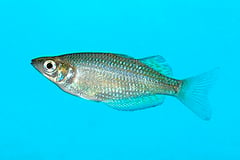
Melanotaenia splendida rubrostriataRed-striped Rainbowfish
Melanotaeniidae · authority not recorded
The red-striped rainbowfish, Melanotaenia splendida rubrostriata, is a rainbowfish from Indonesia and Papua New Guinea. One of the most colourful of the four described subspecies of M. splendida, it lives among vegetation and debris in the tributaries and swamps of coastal plain rivers. The forms and subspecies should not be mixed in the aquarium because they may hybridise, and the drab juveniles can take over 12 months to colour up.

Mesonauta insignis
Cichlidae · authority not recorded
Mesonauta insignis is a cichlid from the Orinoco and Negro drainages in Brazil and Venezuela. It looks very similar to M. festivus, and there is some debate that it is the fish sold in aquatic stores as the flag cichlid. Both species are probably sold under that name, depending on where the fish were caught and exported from. A peaceful cichlid, it becomes more aggressive when breeding.

Microctenopoma ansorgiiOrnate ctenopoma
Anabantidae · authority not recorded
The ornate ctenopoma, Microctenopoma ansorgii, is an anabantoid from the Congo basin in the Republic of Congo and Democratic Republic of Congo. The most colourful of the African anabantoids, it is relatively rare in the hobby because its habitat of densely vegetated small streams is hard to collect from. It can be difficult to acclimatise but is very hardy once settled, and it is a slow-moving fish that is easily out-competed at feeding time.
Nanochromis nudiceps
Cichlidae · authority not recorded
Nanochromis nudiceps is a dwarf cichlid from the Cuvette Centrale region of the Democratic Republic of Congo. Rarely imported, it is easily confused with N. parilus, but males lack the barring in the upper caudal fin and have dark-edged body scales, and females have a spotted lower caudal. It needs very soft, acidic water, will not spawn above pH 6.5 and is not recommended for beginners.
Nanochromis parilus
Cichlidae · authority not recorded
Nanochromis parilus is a dwarf cichlid from the Democratic Republic of Congo, found in slow-moving areas of streams. One of the commoner Nanochromis in the hobby, it is easily confused with N. nudiceps, but males show barring in the upper half of the caudal fin and females have an unpatterned lower caudal. A bi-parental cave spawner, it needs soft, acidic water and is best kept in pairs.

Nanochromis transvestitus
Cichlidae · authority not recorded
Nanochromis transvestitus is a dwarf cichlid known only from Lake Mai-Ndombe, a blackwater lake in the Democratic Republic of Congo. The name refers to the female being the more colourful fish, with a red flush to the belly. It lives in rocky areas of the lake, needs very soft, acidic water, will not usually spawn much above pH 6.0 and is not recommended for beginners.

Neolamprologus boulengeri
Cichlidae · authority not recorded
Neolamprologus boulengeri is a small shell-dwelling cichlid endemic to Lake Tanganyika, found along the Tanzanian shoreline in the north of the lake. It lives among scattered rocks and open sand littered with empty snail shells. It is told apart from N. hecqui and Lamprologus kungweensis by the orange border on its dorsal and anal fins, and it will spawn in small caves if no shells are available.

Neolamprologus brevis
Cichlidae · authority not recorded
Neolamprologus brevis is a shell-dwelling cichlid found widely throughout Lake Tanganyika, and one of the commoner shell dwellers in the hobby. Where few snail shells collect, pairs share the same shell. Its territories are usually no more than 6" across but are defended vigorously. It is told apart from the similar Neolamprologus ocellatus by the vertical barring on its flanks.

Neolamprologus helianthusSunflower Lamprologus
Cichlidae · authority not recorded
The sunflower lamprologus, Neolamprologus helianthus, is a cichlid endemic to Lake Tanganyika, described from Kamakonde on the southwestern shore. A member of the 'Brichardi complex', it is told apart from the others by its overall yellow-orange patterning and v-shaped cheek marking. Species in the complex hybridise freely and should not be mixed in aquaria.

Neolamprologus marunguensis
Cichlidae · authority not recorded
Neolamprologus marunguensis is a cichlid endemic to Lake Tanganyika, found over rocky shorelines around the southwestern shore of the lake. It has a deeply forked tail and was previously sold as Neolamprologus sp. 'walteri'. Relatively peaceful, it becomes very territorial when breeding and is best kept in a species tank.

Neolamprologus multifasciatus
Cichlidae · authority not recorded
Neolamprologus multifasciatus is a shell-brooding cichlid endemic to Lake Tanganyika, and probably the smallest known cichlid species. It lives in fairly deep water around the shoreline, over soft substrates where the empty shells of snails collect. Each fish defends a territory usually no more than 6" across, and a group kept with more shells than fish will form a colony.

Neolamprologus ocellatusOcellated Shell-dweller
Cichlidae · authority not recorded
The ocellated shell-dweller, Neolamprologus ocellatus, is a small shell-brooding cichlid endemic to Lake Tanganyika. It buries its shell until only the entrance shows and defends it vigorously, sometimes burying neighbouring shells as well to keep other fish out. Males grow much larger than females, and a gold morph has become popular in the hobby. The lack of vertical barring on the flanks separates it from the similar N. brevis.

Neolamprologus olivaceous
Cichlidae · authority not recorded
Neolamprologus olivaceous is a cichlid endemic to Lake Tanganyika, where it is found only in Luhanga Bay. A member of the so-called 'Brichardi complex', it hybridises freely with the others and should not be mixed with them in aquaria. The two curved markings on the gill cover distinguish it within the complex, and Konings (1993) proposed that it may be synonymous with N. pulcher.

Neolamprologus savoryiStriped Brichardi
Cichlidae · authority not recorded
The striped brichardi, Neolamprologus savoryi, is a rock-dwelling cichlid endemic to Lake Tanganyika. A member of the so-called 'Brichardi complex', it hybridises freely with the others and should not be mixed with them in aquaria. Its pattern of vertical bars distinguishes it within the complex. An aggressive, territorial species, it is best kept in a species tank.

Neolamprologus sexfasciatusSix-barred Lamprologus
Cichlidae · authority not recorded
The six-barred lamprologus, Neolamprologus sexfasciatus, is a predatory cichlid from the southern part of Lake Tanganyika. It occurs only between Cape Tembwe and Karema, in shallow rocky areas and intermediate zones. Several geographical morphs are available, including 'Sambia' and 'Kipili', varying in base colour from blue to yellow to white. Its aggressive and predatory nature rules it out of the general Tanganyikan community, and only a single pair should be kept.

Neolamprologus similis
Cichlidae · authority not recorded
Neolamprologus similis is a small shell-dwelling cichlid endemic to Lake Tanganyika, and one of the less frequently seen shelldwellers in the hobby. It lives around the shoreline over soft substrates where empty snail shells collect, and defends a territory usually no more than 6" across. Light stripes and additional barring on the head and neck separate it from the similar N. multifasciatus.

Neolamprologus speciosus
Cichlidae · authority not recorded
Neolamprologus speciosus is a shell-brooding cichlid endemic to the south-western end of Lake Tanganyika. Very similar to N. ocellatus, it often carries the trade name 'black ocellatus', and it lives alongside N. stappersi in nature. Males are much larger than females, and it breeds quite easily in snail shells that females bury until only the entrance is visible.
Neolamprologus stappersi
Cichlidae · authority not recorded
Neolamprologus stappersi is a shell-brooding cichlid endemic to Lake Tanganyika, found on the Congo side of the lake between Moliro and Kalemie. Originally thought to be a morph of N. ocellatus, it is still occasionally offered as 'pearly ocellatus' and may be seen under the invalid name L. meleagris. It defends its shell and the small territory around it vigorously, and dried foods are sometimes refused.
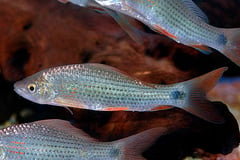
Osteochilus hasseltiiHard-lipped Barb
Cyprinidae · authority not recorded
The hard-lipped barb, Osteochilus hasseltii, is a cyprinid with an enormous range from Myanmar to Vietnam and south to Borneo, Sumatra and Java. Reaching 32 cm, it inhabits slow-moving tributaries and large streams with soft substrates, and migrates into inundated forest to feed and spawn at the onset of the rainy season. A caudal spot, 15-18 dorsal-fin rays and orange flecking on the flanks help identify it.
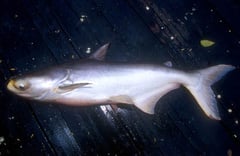
Pangasianodon gigasGiant Mekong Catfish
Pangasiidae · authority not recorded
The giant Mekong catfish, Pangasianodon gigas, is a pelagic shark catfish from the lower Mekong in China, Thailand, Laos, Cambodia and Vietnam. Perhaps the biggest freshwater fish in the world, it has been listed as critically endangered by the IUCN since 2003, after wild stocks fell by over 80% from 1990, and international trade is banned under CITES Appendix I. It should not be considered an aquarium subject under any circumstance.
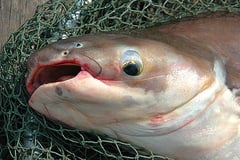
Pangasianodon hypophthalmusIridescent Shark Catfish
Pangasiidae · authority not recorded
The iridescent shark catfish, Pangasionodon hypophthalmus, is a pangasiid catfish from the lower Mekong in Thailand, Laos, Cambodia and Vietnam. It also occurs in the Chao Phraya. The commonest pangasiid in the trade, it is usually sold as a small silvery-blue juvenile with little said about its eventual size. It rarely reaches 130 cm in captivity but easily tops 90 cm and can live for 20 years or more, so it is debatable whether it should be considered an aquarium subject at all.
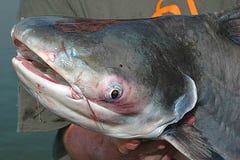
Pangasius sanitwongseiParoon Shark
Pangasiidae · authority not recorded
The paroon shark, Pangasius sanitwongsei, is a giant pangasiid catfish from the lower Mekong in China, Thailand, Laos, Cambodia and Vietnam. It is also found in the Chao Phraya in Thailand. Second only to Pangasianodon gigas in size within its family, it grows to 250 cm and easily tops 120 cm in captivity. Juveniles from commercial farms are exported in large numbers, but the species should not be considered an aquarium subject at all.

Pelvicachromis humilisYellow Kribensis
Cichlidae · authority not recorded
The yellow kribensis, Pelvicachromis humilis, is a cichlid from Sierra Leone, Liberia and Guinea, and the largest known species in its genus. Rare in the hobby, it is seen in several morphs including 'Guinea' and 'Liberia red', some of which may eventually be described as distinct species. It is more elongate than its relatives, with a comparatively long snout, and is aggressive towards conspecifics, so only a single pair should be kept unless the tank is very large.

Pelvicachromis pulcherKribensis
Cichlidae · authority not recorded
The kribensis, Pelvicachromis pulcher, is a cichlid from Nigeria and Cameroon, found in still and slow-moving, heavily vegetated waters. One of the most common cichlids in the hobby since the 1950s, it is almost always captive bred, and farmed fish are far more adaptable to water chemistry than wild ones. A cave spawner that forms monogamous pairs, it is often the first fish bred by newcomers and becomes very territorial when breeding.

Pelvicachromis subocellatusOcellated Kribensis
Cichlidae · authority not recorded
The ocellated kribensis, Pelvicachromis subocellatus, is a cichlid from Nigeria, Gabon and the Democratic Republic of Congo. It inhabits pools and slow-moving streams in coastal areas, some of them brackish. Less commonly seen than other Pelvicachromis, it is available in morphs such as 'Matadi' and 'Moanda', and has a higher, shorter body than its congeners with much lighter spotting in the upper part of the caudal fin.

Pelvicachromis taeniatusStriped Kribensis
Cichlidae · authority not recorded
The striped kribensis, Pelvicachromis taeniatus, is a cichlid from still and slow-moving forest streams and rivers in Nigeria and Cameroon. Over a dozen morphs are available, including 'Dehane', 'Moliwe', 'Lobe' and 'Nigeria Red', and these should not be cross bred if the lines are to stay pure. A more pronounced upper lip, often bright yellow, separates it from congeners, and unlike most Pelvicachromis the males rival the females in colour.
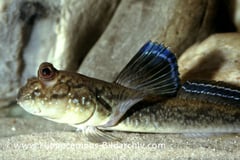
Periophthalmus barbarusAtlantic Mudskipper
Gobiidae · authority not recorded
The Atlantic mudskipper, Periophthalmus barbarus, is a highly amphibious goby from the west African coast, from Mauritania south to Angola. It lives on and around mudflats in estuarine mangrove swamps, so an aquarium needs exposed land and a very humid atmosphere at the same temperature as the water. Males are extremely territorial with one another, and a species tank is preferable in most cases.

Petitella bleheriFirehead Tetra
Characidae · authority not recorded
The firehead tetra, Hemigrammus bleheri, is a characin from blackwater rivers of the Rio Meta and Rio Negro in Colombia and Brazil. Most fish sold as the 'rummy-nose tetra' are this species. Of the three look-alikes, with H. rhodostomus and Petitella georgiae, only H. bleheri has red extending beyond the gill covers, although the red fades in fish in poor condition. Bittencourt et al. (2020) proposed moving it to Petitella. It should be kept in groups of 10 or more.

Petitella georgiaeFalse Rummy-nose
Characidae · authority not recorded
The false rummy-nose, Petitella georgiae, is a small tetra from the Rio Purus in Peru and Brazil and the Rio Negro and Rio Madeira in Brazil. This is one of three very similar species commonly sold as 'rummy-nose tetra', and the lack of a dark blotch at the bottom of the caudal peduncle is one way to separate it from the other two. One of the more tightly shoaling small tetras, it needs a group of at least ten.

Petitella rhodostomaRummy-nose tetra
Characidae · authority not recorded
The rummy-nose tetra, Hemigrammus rhodostomus, is a characin from blackwater rivers of the Rio Orinoco and lower Amazon basin in Venezuela and Brazil. This is the 'real' rummy-nose. Most fish sold under the name are the firehead tetra, H. bleheri, and the 'false' rummy-nose, Petitella georgiae, is also very similar. The head colour, the caudal peduncle blotches and the line from the central caudal band separate the three. Bittencourt et al. (2020) proposed moving it to Petitella.
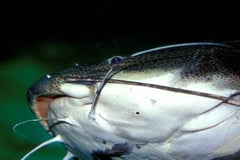
Phractocephalus hemioliopterusRed-tail Catfish
Pimelodidae · authority not recorded
The red-tail catfish, Phractocephalus hemioliopterus, is a giant pimelodid catfish from much of the Amazon and Rio Orinoco basins in South America. The largest specimen recorded by science measured 134 cm and weighed more than 40 kg, and keeping one at home is not recommended without the facilities to house it for life. Juveniles are sold cheaply, and fish dumped when they outgrow their tanks have established populations in the USA and several other countries.
Potamotrygon henleiBlack Stingray
Potamotrygonidae · authority not recorded
The black stingray (P12), Potamotrygon henlei, is a freshwater stingray probably endemic to the Rio Tocantins basin in Brazil. It reaches 60 cm across the disc and occurs in several colour forms, with white or yellow spots on a black to dark brown background. It is often confused with P. leopoldi and P14, and is told apart by spots on the underside of the disc, although some P. leopoldi have shown this patterning too.
Potamotrygon sp. "pearl"Pearl Ray
Potamotrygonidae · authority not recorded
The pearl ray, Potamotrygon sp. 'Pearl', is an undescribed freshwater stingray from the Rio Tapajos in Brazil. It can exceed 60 cm across the disc, and its patterning is highly variable: some fish have golden markings, others almost white, and the darker pigmentation varies in both shade and coverage. Under the newer R-number system it is known as R080.
Potamotrygon yepeziMaracaibo River Stingray
Potamotrygonidae · authority not recorded
The Maracaibo River stingray, Potamotrygon yepezi, is a freshwater stingray from the waters surrounding and feeding Lake Maracaibo in Venezuela. Strictly a freshwater species, it is absent from the brackish lake itself and apparently favours soft mud or sand substrates. Not large for a Potamotrygon at around 40 cm across the disc, it is often confused with P. reticulata, P. humerosa and P. scobina, and the Peruvian P. sp. 'Nazca' is unlikely to be this species.
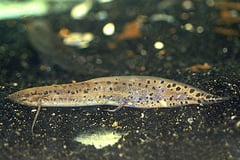
Protopterus annectens annectensAfrican Lungfish
Protopteridae · authority not recorded
The African lungfish, Protopterus annectens annectens, is a lungfish found in 17 African countries, including Senegal, Nigeria, Kenya and Sudan. It inhabits temporary floodplains that dry out completely for part of the year and survives the dry season by aestivating in a mucus cocoon, for several years if need be. The most commonly seen lungfish in the hobby, it reaches 100 cm, bites hard and is best kept singly.
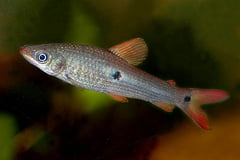
Pseudanos trimaculatusThree-spot Headstander
Anostomidae · authority not recorded
The three-spot headstander, Pseudanos trimaculatus, is an anostomid from Peru, Brazil and Guyana, found in small shoals in deeper water. It was formerly known as Anostomus trimaculatus, and that name is still used in much of the available literature. Aggressive towards its own kind in small numbers, it can be kept in groups of six or more in larger aquaria, and a well-fitting cover is essential since Pseudanos are excellent jumpers.

Pseudocrenilabrus multicolorDwarf Egyptian Mouth-brooder
Cichlidae · authority not recorded
The dwarf Egyptian mouth-brooder, Pseudocrenilabrus multicolor, is a small cichlid from Egypt, Sudan, Uganda, Rwanda, Kenya and Tanzania. One of the first cichlids to be spawned in captivity, it has been in the hobby for over a century and breeds easily as a maternal mouth-brooder. The two subspecies, P. m. multicolor and P. m. victoriae, differ in colour and pattern and should not be kept together, to prevent hybridisation.
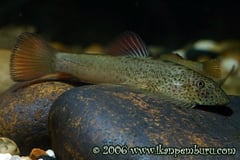
Pseudogastromyzon laticeps
Balitoridae · authority not recorded
Pseudogastromyzon laticeps is a balitorid loach from southeastern China, apparently endemic to the Longjin river drainage in Guangdong province. Like its congeners it has a flattened head and body with horizontally orientated paired fins, adapted to shallow, fast-flowing, highly-oxygenated streams. Based on the images available it appears to have reddish dorsal and caudal fins, and males develop tubercules on the head at sexual maturity.
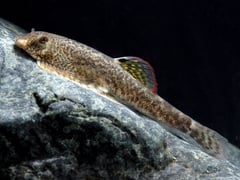
Pseudogastromyzon myersi
Balitoridae · authority not recorded
Traded as the 'Chinese hillstream loach', Pseudogastromyzon myersi is a balitorid from Hong Kong and neighbouring Guangdong province, China. The commonest member of the genus in the hobby, it has often been misidentified as P. cheni, which is not collected for the trade. Aquarium Pseudogastromyzon with a yellow-based dorsal fin and a red distal band should be considered P. myersi. It needs clean, well-oxygenated water and has been bred in aquaria on numerous occasions.
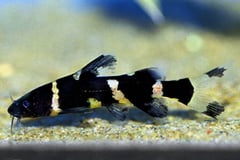
Pseudomystus siamensisAsian Bumblebee Catfish
Bagridae · authority not recorded
The Asian bumblebee catfish, Pseudomystus siamensis, is a bagrid from the lower Mekong and the Chao Phraya river in Thailand. It was formerly placed in Leiocassis, a name still used in much of the literature, and similarly patterned congeners may be sold under its name. Shy and nocturnal, it hides among submerged roots by day, will eat any tankmate small enough, and is territorial towards other bottom-dwellers.
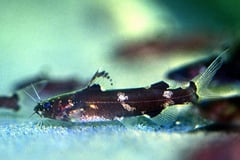
Pseudomystus sp. cf stenomusFalse Asian Bumblebee Catfish
Bagridae · authority not recorded
The false Asian bumblebee catfish, Pseudomystus sp. cf stenomus, is a bagrid from southeastern Thailand and peninsular Malaysia. Usually imported as P. stenomus, which is endemic to Java, it seems to be an undescribed species, and it lacks the striped bumblebee pattern of P. siamensis. Shy and nocturnal, it lurks among roots and rocks in fast-flowing, sandy-bottomed streams by day, and will eat any tankmate small enough.
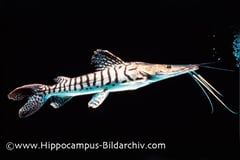
Pseudoplatystoma fasciatumBarred Shovelnose
Pimelodidae · authority not recorded
The barred shovelnose, Pseudoplatystoma fasciatum, is a large pimelodid catfish with a very wide range in South America, from Colombia to Argentina. Recorded at 104 cm and 70 kg, it reaches close to that size quickly in captivity and can live for well over 20 years, so it is debatable whether it should be considered an aquarium subject at all. It is easily confused with P. tigrinum, and both are usually sold as 'tiger shovelnose'.
Pseudoplatystoma tigrinumTiger Shovelnose
Pimelodidae · authority not recorded
The tiger shovelnose, Pseudoplatystoma tigrinum, is a large pimelodid catfish native to the Amazon and Rio Orinoco basins. It grows to around 105 cm and reaches close to that size quickly in captivity, so it is debatable whether it should be considered an aquarium subject at all. It is easily confused with P. fasciatum, which is usually sold under the same name, though P. tigrinum is generally the more uniformly striped. Hybrids with the red-tailed catfish also reach the market.

Pseudotropheus sp. 'acei'
Cichlidae · authority not recorded
Pseudotropheus sp. 'acei' is an undescribed mbuna endemic to the western side of Lake Malawi, around Nkhata Bay, Senga Bay and Karonga. In nature it feeds on algae and other organisms growing on submerged wood, the only known mbuna to do so exclusively, and gathers in schools around branches and logs. Relatively peaceful and easily bred, it is sometimes sold as Gephyrochromis acei, and colour forms such as 'yellow tail' and 'white tail' should not be kept together.

Pterophyllum altumAltum Angel
Cichlidae · authority not recorded
The altum angel, Pterophyllum altum, is a cichlid from Colombia and Venezuela, native to the upper Rio Negro and tributaries of the upper Rio Orinoco. Far less common in the trade than its relative P. scalare, the common angelfish, it is a challenge to keep. It needs very acidic, soft water and high temperatures, most fish are wild-caught and can be difficult to feed, and spawning in captivity is hard to achieve.
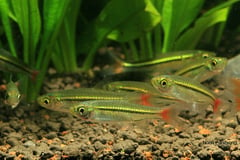
Rasbora borapetensisRed-tailed Rasbora
Cyprinidae · authority not recorded
The red-tailed rasbora, Rasbora borapetensis, is a small cyprinid from the Mekong and Chao Phraya drainages and the Mae Klong in western Thailand. One of the more commonly encountered rasboras in stores, it is also sold as the black-line or magnificent rasbora. The similar R. rubrodorsalis has a bright red blotch in the dorsal fin, whereas in R. borapetensis the dorsal is colourless and only the base of the caudal fin is red. Very peaceful, it often schools quite closely.
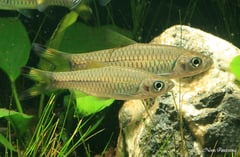
Rasbora caudimaculataGreater Scissortail Rasbora
Cyprinidae · authority not recorded
The greater scissortail rasbora, Rasbora caudimaculata, is a cyprinid probably restricted to Peninsular Malaysia, Borneo and Sumatra. Also sold as the 'red scissortail', it is told from the similar R. trilineata by orange-red colour in the caudal fin, with black tips to the lobes. It has been collected from swift forest streams and sluggish peat swamp blackwaters, and its size, to 150 mm SL, suits it only to larger tanks with sufficiently bold companions.
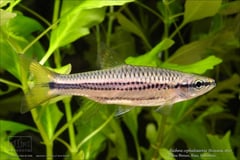
Rasbora cephalotaeniaPorthole Rasbora
Cyprinidae · authority not recorded
The porthole rasbora, Rasbora cephalotaenia, is a cyprinid from Peninsular Malaysia, Borneo, Sumatra and southern Thailand. It inhabits black water streams and rivers in ancient peat swamp forest, where the water is very soft and acidic. The dark lateral stripe is broken into a series of spots, while in the similar R. einthovenii and R. jacobsoni it forms a solid line. Not often exported, it makes an elegant, peaceful resident of the larger community tank.
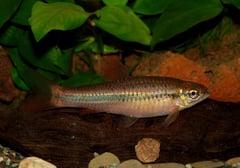
Rasbora cf. dandia
Cyprinidae · authority not recorded
Rasbora cf. dandia is a cyprinid from Sri Lanka and southern India that may well be a form of R. dandia itself. It appears to be widely available in the trade but is often misidentified as R. wilpita, a species confirmed as endemic to a small number of Sri Lankan streams and probably much rarer in the hobby than previously thought. It inhabits virtually all kinds of lowland freshwater habitat, from rivers and streams to rice paddies and reservoirs.
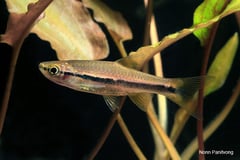
Rasbora einthoveniiBrilliant Rasbora
Cyprinidae · authority not recorded
The brilliant rasbora, Rasbora einthovenii, is a cyprinid from southern Thailand, Peninsular Malaysia, Singapore, Borneo and Sumatra. It mostly inhabits black water streams and rivers associated with peat swamp forest. One of the more commonly seen rasboras in the hobby, it resembles R. jacobsoni but lacks dark reticulated scales above the lateral stripe, and the stripe itself has noticeably uneven or 'crinkly' edges. Most fish in the trade are captive-bred.
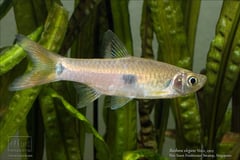
Rasbora elegansElegant Rasbora
Cyprinidae · authority not recorded
The elegant rasbora, Rasbora elegans, is a cyprinid from Peninsular Malaysia, Singapore and the Greater Sunda Islands of Borneo and Sumatra. It lacks the dark lateral stripe of similar members of the genus and carries two spot-like markings on each flank, one below the dorsal-fin origin and one at the caudal peduncle. It has been collected from swift forest streams and peat swamp blackwaters alike, and it needs space to swim: it can act nervously in smaller quarters.
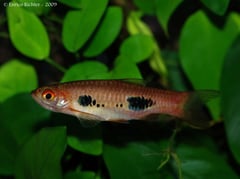
Rasbora kalochromaClown Rasbora
Cyprinidae · authority not recorded
The clown rasbora, Rasbora kalochroma, is a cyprinid from the peat swamp blackwaters of Peninsular Malaysia, Borneo and Sumatra. Its patterning varies with locality. Adults are sometimes confused with R. elegans, a silver fish, while this one is pinkish to reddish. The only congener it may genuinely be mistaken for is the almost identical R. kottelati of northern Sarawak and Brunei, which has an additional dark blotch on the caudal peduncle.
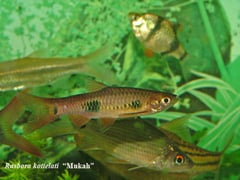
Rasbora kottelati
Cyprinidae · authority not recorded
Rasbora kottelati is a blackwater rasbora endemic to Borneo, restricted to Brunei Darussalam and northern parts of the Malaysian state of Sarawak. It is almost identical to its closest relative R. kalochroma but has an additional oval-shaped dark blotch on the caudal peduncle and lacks the stripe in the middle of the caudal fin. Collections from its native waters occur only sporadically, and its care is largely based on experience with R. kalochroma.
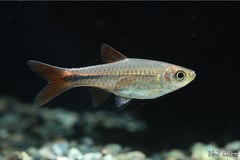
Rasbora lacrimulaRed Cherry Rasbora
Cyprinidae · authority not recorded
The red cherry rasbora, Rasbora lacrimula, is a small cyprinid confirmed only from the Belayan drainage in east Kalimantan, Indonesian Borneo. Also traded as 'Bornean redfin rasbora', 'sunshine rasbora' and 'dwarf volcano rasbora', it first appeared in the hobby in late 2010. Larger fish carry small tubercules on the back behind the dorsal fin, and a faint dark midlateral stripe ends in a teardrop-shaped blotch at the caudal peduncle.
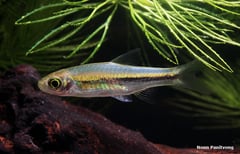
Rasbora paucisqualis
Cyprinidae · authority not recorded
Rasbora paucisqualis is a small rasbora from Peninsular Malaysia, recorded from the states of Johor, Pahang, Selangor, Kelantan and Terengganu. It was described from a single specimen from the aquarium trade, supposedly imported from the Malay Peninsula. Despite reports to the contrary it does not occur in the Mekong drainage, and the fish from there once thought to be conspecific was described as R. amplistriga by Kottelat (2000).
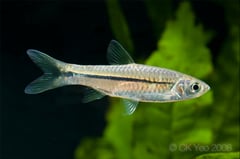
Rasbora paviana
Cyprinidae · authority not recorded
Rasbora paviana is a striped rasbora from the Mekong, Chao Phraya and Mae Klong basins in Thailand, Laos, Cambodia and Vietnam. Much of the literature pictures it under the invalid name R. paviei. It can be hard to separate from R. sumatrana, R. hobelmani and R. laticlavia, but it is the only one of the group found in Indochina, so a known collection locality makes identification easier. It has been collected from hill streams and sluggish lowland waters alike.
Rasbora rasboraGangetic Scissortail Rasbora
Cyprinidae · authority not recorded
The Gangetic scissortail rasbora, Rasbora rasbora, is a cyprinid apparently native to Pakistan, India, Bangladesh, Myanmar and Thailand. Many older records are probably cases of mistaken identity, and recent ones come mostly from the Brahmaputra basin and Myanmar, while records from the Ganges basin are conspicuously absent. The species is rarely seen in the trade and little has been written about its captive care.
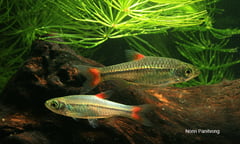
Rasbora rubrodorsalis
Cyprinidae · authority not recorded
Rasbora rubrodorsalis is a small rasbora from Thailand, found most abundantly in the lower Mekong river basin in the northeast of the country. It lives in the shallow margins of still or gently flowing waters such as swamps, marshes and floodplains. The bright red blotch in its dorsal fin separates it from R. borapetensis, a similar fish that shares part of its range and is much commoner in the hobby. It is sometimes sold as R. beauforti or R. sp. cf. beauforti.
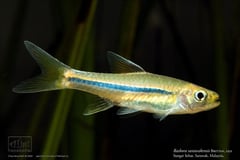
Rasbora sarawakensis
Cyprinidae · authority not recorded
Rasbora sarawakensis is a small rasbora endemic to Borneo, found in Sarawak and the neighbouring Indonesian province of West Kalimantan. It mostly inhabits slow-moving forest streams with thick marginal vegetation, where the water is clear but weakly stained by tannins. Poorly documented in the aquarium literature, it is a very peaceful little fish and apparently quite common across its natural range.
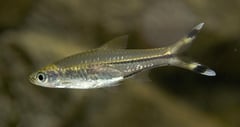
Rasbora trilineataScissortail Rasbora
Cyprinidae · authority not recorded
The scissortail rasbora, Rasbora trilineata, is a cyprinid from the Chao Phraya and lower Mekong basins, Peninsular Malaysia, Sumatra and Borneo. The name comes from the twitching of the caudal fin when the fish is at rest. It is usually sold at a much smaller size than the 15 cm it reaches, so it needs a large tank, and wild fish are increasingly hard to come by as it is produced commercially in several countries.
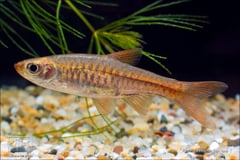
Rasbora vulcanus
Cyprinidae · authority not recorded
Rasbora vulcanus is a small rasbora from West Sumatra, Indonesia, known only from the Batang Si Joontour near the town of Painan. The name refers to the red body colouration of males. It is occasionally sold as R. reticulata or R. cf. reticulata, but the true R. reticulata is a deeper-bodied fish endemic to the island of Nias and lacks the red colouration. Females are pale yellow, and often only the more colourful males are exported.
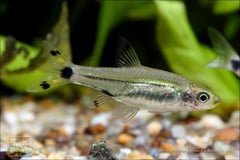
Rasbosoma spilocercaDwarf Scissortail Rasbora
Cyprinidae · authority not recorded
The dwarf scissortail rasbora, Rasbosoma spilocerca, is a small cyprinid from the lower Mekong basin in Laos, Thailand and Cambodia. A miniature look-alike of Rasbora trilineata, it is rarely seen in the hobby, probably because of its plain patterning and rather delicate nature. It inhabits shallow, clear waters with thick submerged vegetation, and its small size and timid behaviour suit it to a tank of other diminutive species.
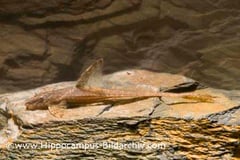
Rineloricaria lanceolataWhiptail Catfish
Loricariidae · authority not recorded
Rineloricaria lanceolata is a whiptail catfish from Peru and Brazil, usually found among leaf litter over sandy substrates. One of the most common species sold as 'whiptail catfish', it breeds quite easily in suitable conditions, although the fry can be tricky to raise. Very peaceful, it is easily out-competed for food by vigorous or aggressive tankmates.
Salminus brasiliensisDorado
Characidae · authority not recorded
The dorado, Salminus brasiliensis, is a large characid from Brazil, Bolivia, Paraguay, Uruguay and Argentina, growing to 1000 mm SL. A highly prized game fish in some of its native waters, it turns up as juveniles in some aquatic stores, but it is not suited to captive life in any respect. Housing one for life is beyond the reach of virtually all hobbyists.
Scleropages leichardtiSpotted Australian Arowana
Osteoglossidae · authority not recorded
The spotted Australian arowana, Scleropages leichardti, is an osteoglossid endemic to the Fitzroy River system of north-eastern Queensland, Australia. Known there as the spotted or southern saratoga, it differs from S. jardinii in its spotted scales, forward-pointing barbels, unpatterned gill covers and silver base colour. Indonesia classes it as protected even though it has never been recorded there, probably through misidentified S. jardinii. The species is rare in the hobby.
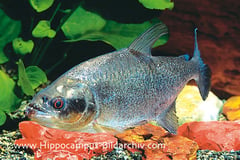
Serrasalmus elongatusPike Piranha
Serrasalmidae · authority not recorded
The pike piranha, Serrasalmus elongatus, is a streamlined piranha from the Amazon and Orinoco basins in Venezuela, Ecuador, Peru, Bolivia and Brazil. Its elongate shape is unique among serrasalmids and makes it possibly the easiest Serrasalmus to identify, although large adults fill out into a more diamond-shaped figure. Known as 'caribe pinche' in its native countries, it is a rare find in the trade and suits only the enthusiast as a specimen fish.
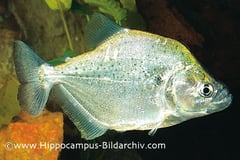
Serrasalmus geryiGéry's Pirambeba
Serrasalmidae · authority not recorded
Géry's pirambeba, Serrasalmus geryi, is a piranha from the Rio Araguaia and Rio Tocantins drainages in Brazil. Sometimes sold as the 'violet-line piranha', it is one of the easiest Serrasalmus to identify because the purple stripe from the lower jaw over the top of the body is unique to it. S. compressus has been sold as S. geryi, and reports of it living in groups are considered tenuous, so it is kept as a specimen fish.
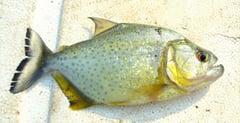
Serrasalmus maculatusMac
Serrasalmidae · authority not recorded
Serrasalmus maculatus, the mac, is a piranha from the Amazon, Paraguay and Paraná river systems, described from the rio Guaporé in western Brazil. It grows to a manageable size, is relatively hardy and is sometimes called the 'gold piranha' or 'golden mac' in the hobby. It has often been confused with S. spilopleura, and it should be considered a specimen fish that does not make a good tankmate for anything else.
Serrasalmus marginatus
Serrasalmidae · authority not recorded
Serrasalmus marginatus is a piranha from the Rio Paraguay and Rio Paraná drainages in Brazil, Paraguay, Uruguay and Argentina. Its main distinguishing feature is the thick, black, v-shaped marking in the anterior portion of the caudal fin, and it is rarely seen in the hobby. Individuals defend feeding territories in the wild, and conspecifics are liable to fight until only one remains, so it is kept singly as a specimen fish.
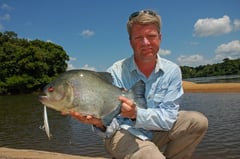
Serrasalmus rhombeusBlack Piranha/Rhom
Serrasalmidae · authority not recorded
Serrasalmus rhombeus, known as the black piranha or rhom, is a large piranha recorded from much of northern South America. It occurs in numerous geographical forms that vary in size, body form and colour, linked by the deep red eye of mature fish, and a species complex has been suggested. Juveniles lack the red eye and are easily mislabelled. Conspecifics fight until only one remains, so it is kept alone.
Serrasalmus sancheziSanchez's Piranha
Serrasalmidae · authority not recorded
Sanchez's piranha, Serrasalmus sanchezi, is a small piranha endemic to Peru, collected from rivers including the Ucayali, Itayi and Pacaya. It is sometimes still sold as 'Spilo cf' or 'Ruby-red Spilo', and its red throat has led to confusion with S. medinai and even Pygocentrus nattereri. The serrae on the underside are arranged irregularly, unlike other Serrasalmus. Whether it can be kept in groups remains hotly debated.
Serrasalmus serrulatus
Serrasalmidae · authority not recorded
Serrasalmus serrulatus is a piranha reported from Peru, western Brazil and Argentina. The validity of that range is unclear, since the name may have been applied to more than one species. It also occupies a particularly confusing taxonomic position within the 'humeralis group' and is very close in appearance to S. eigenmanni, S. hollandi, S. humeralis and S. nalseni. Its habitat is unknown. Conspecifics are liable to fight until only one remains, so it is a specimen fish for the enthusiast.
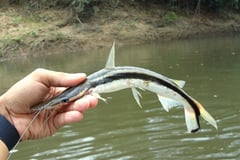
Sorubim limaDuckbill Catfish
Pimelodidae · authority not recorded
The duckbill catfish, Sorubim lima, is a pimelodid catfish recorded from rivers across South America, including the Amazon, Orinoco and Paraná. It is also known as the 'hockey stick catfish' and 'lima shovelnose', and S. elongatus is sometimes sold as it. Sorubim spp. often swim head-down among plants and roots as camouflage. It is quite peaceful but eats anything that fits in its mouth.
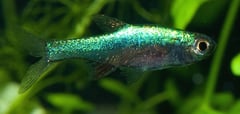
Sundadanio axelrodi
Cyprinidae · authority not recorded
Sundadanio axelrodi is a miniature cyprinid from Borneo, where it inhabits black water streams and pools associated with forest peat swamps. Originally described as Rasbora axelrodi, it is the only member of its genus. Several colour forms exist depending on locality, normally labelled 'red', 'green' or 'blue', and they are best not mixed. Very peaceful but timid, it does best alone or with similarly sized species, in a group of at least 20-30.

Symphysodon aequifasciatusDiscus
Cichlidae · Pellegrin, 1904
The discus, Symphysodon aequifasciatus, is a cichlid from the Amazon in Colombia, Peru and Brazil. It ranges down the Rio Solimões and the main Amazon from the Rio Putumayo to the Tocantins drainage, keeping to slow-moving tributaries and forest pools where it schools in deep, sheltered water around tree roots and rocks. Wild fish reach around 14 cm, and discus are very shy, skittish fish that need plenty of cover.
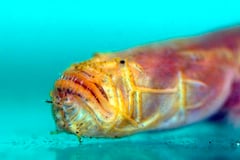
Taenioides cirratusBearded Worm Goby
Gobiidae · authority not recorded
The bearded worm goby, Taenioides cirratus, is a mud-burrowing goby of coastal, usually estuarine waters from India to Japan and New Caledonia. It digs networks of sloping tunnels in the substrate, and has greatly reduced eyes, teeth on the outside of its mouth and the ability to breathe air and survive out of water for some time. Growing to 300 mm SL, it will eat anything small enough and is probably best kept in a species set-up.
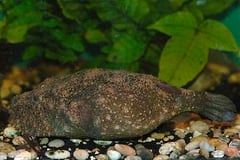
Tetraodon baileyiHairy Puffer
Tetraodontidae · authority not recorded
The hairy puffer, Tetraodon baileyi, is a puffer from Thailand and Laos, where it inhabits rocky areas of large rivers, including whitewater. Rare in the hobby, it is covered in cirri of uncertain function and is completely scaleless. An aggressive and intolerant fish, it should be kept alone and fed snails and unshelled shellfish to keep its teeth ground down.
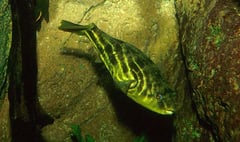
Tetraodon lineatusFahaka Puffer
Tetraodontidae · authority not recorded
The fahaka puffer, Tetraodon lineatus, is a large freshwater puffer from lakes and rivers across northern and West Africa, reaching 43 cm. Also known as the Nile puffer, it was previously named T. fahaka. One of the most aggressive puffers available, it learns to interact with its owner, but should be kept alone and needs no salt in its water.
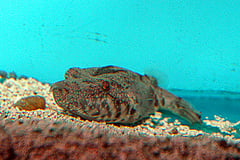
Tetraodon suvattiiArrowhead Puffer
Tetraodontidae · authority not recorded
The arrowhead puffer, Tetraodon suvattii, is a predatory puffer from Thailand and Laos, found over rocky or muddy substrates in main river channels. A true ambush predator, it spends most of its time buried in the substrate and will mimic rocks if it cannot dig in. It will eat any fish that fits in its mouth and takes chunks from larger ones, so it is best kept on its own.
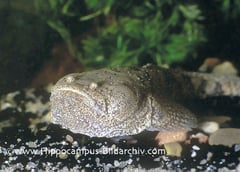
Thalassophryne amazonicaPrehistoric Monster Fish
Batrachoididae · authority not recorded
Thalassophryne amazonica is a freshwater toadfish from Amazon tributaries in Ecuador, Peru and Brazil. The only freshwater member of its genus, it spends most of its time buried in sand and is an obligate piscivore that needs a constant supply of live fish. Like other Thalassophryne, it is venomous, with hollow spines on each opercle and the dorsal fin, though its venom is not known to be very potent.

Thayeria boehlkeiFalse Penguin Tetra
Characidae · authority not recorded
The false penguin tetra, Thayeria boehlkei, is a characin probably restricted to the upper Amazon in Peru and the Rio Araguaia in Brazil. By far the most popular Thayeria in the hobby, it is usually sold as the penguin tetra, a name first given to T. obliqua. Its thick black stripe runs from the lower caudal lobe along the body to the opercle. A schooling species, it should be kept in a group of at least six.
Thayeria ifatiHalf-striped Penguin Tetra
Characidae · authority not recorded
The half-striped penguin tetra, Thayeria ifati, is a characin that appears to be endemic to the rivers Maroni and Approuague in French Guiana. Of the three Thayeria, T. ifati is the least often seen in the hobby. In this species the black stripe is confined to the upper part of the lower caudal lobe, and the dorsal and anal fins develop red tips in good condition. Like its congeners, it swims in an oblique, head-up style.

Thayeria obliquaPenguin Tetra
Characidae · authority not recorded
The penguin tetra, Thayeria obliqua, is a characin from the central Amazon and Rio Tocantins basins and the Rio Guaporé in Brazil. The type species of the genus, it was the original penguin tetra, though T. boehlkei is now usually sold under that name. In T. obliqua the black caudal stripe tapers upwards and fades before reaching the dorsal fin. It should be kept in a group of at least six.
Theraps bocourtiChisel-tooth cichlid
Cichlidae · authority not recorded
The chisel-tooth cichlid, Theraps bocourti, is a Central American cichlid from Lake Izabal and other Atlantic drainages of Guatemala and Belize. Described in 1902, it did not appear in the trade until wild fish were collected by American aquarists in 1994. Males reach at least 30 cm, and it is aggressive and territorial, so tankmates need choosing with care in a very large tank.

Trichogaster fasciataBanded Gourami
Osphronemidae · authority not recorded
The banded gourami, Trichogaster fasciata, is a labyrinth fish from Pakistan, India, Nepal, Bangladesh and Myanmar, found in sluggish, weedy waters. The largest species in its genus, it is a popular food fish in its native countries. Peaceful, it suits most quiet community tanks, but should not be kept with the thick-lipped gourami because the two can hybridise.

Trichogaster laliusDwarf Gourami
Osphronemidae · authority not recorded
The dwarf gourami, Trichogaster lalius, is a labyrinth fish from Pakistan, northern India and Bangladesh. All the fish in the trade are mass-produced, and several line-bred colour forms are sold, including 'Sunset' and 'Neon'. Stock quality has fallen badly, and mass-breeding may have spread dwarf gourami iridovirus (DGIV), which appears to be very infectious and can pass to other species sharing the water.

Tropheus brichardi
Cichlidae · authority not recorded
Tropheus brichardi is a cichlid endemic to the northern end of Lake Tanganyika, found in shallow water around rocky shorelines. Not a good species for the beginner, it is very susceptible to 'bloat', so water quality is of the utmost importance. It exists in numerous colour morphs that hybridise freely and should not be mixed, and some may eventually be described as distinct species.

Tropheus duboisiWhite-Spotted Cichlid
Cichlidae · authority not recorded
The white-spotted cichlid, Tropheus duboisi, is endemic to Lake Tanganyika, found in rocky areas in deeper water than its congeners. Young fish have white or light blue spots on a jet black body, which fade to blue-black with a yellow or white vertical bar as they mature. Like others in the genus it is very susceptible to 'bloat' and not a good species for the beginner.

Uaru amphiacanthoidesUaru
Cichlidae · authority not recorded
The uaru, Uaru amphiacanthoides, is a large cichlid from the Amazon basin in northern Brazil and Guyana, found in clear water tributaries. It occurs in the middle to lower Rio Negro and along the Solimões and main Amazon between the Japurá and Tapajós. Surprisingly peaceful for its size, it needs clean, well-filtered water at the higher end of the temperature scale.
Variabilichromis moorii
Cichlidae · authority not recorded
Variabilichromis moorii is a lamprologine cichlid endemic to the southern part of Lake Tanganyika, living in shallow water around rocky shorelines. All adults are dark, but depending on locality the fry may be dark, yellow or orange. The only known lamprologine that eats filamentous algae, it is often sold as Neolamprologus moorii and is relatively peaceful even when spawning.

Vieja bifasciataRed-spotted Cichlid
Cichlidae · authority not recorded
The red-spotted cichlid, Vieja bifasciata, is a large cichlid from the River Grijalva and Usumacinta basins of Mexico and Guatemala. It is often confused with V. synspila but has two prominent horizontal lines between the eyes. It is moderately to very aggressive depending on the individual, and some fishkeepers have to keep the fish, especially males, alone.

Vieja synspilaRedhead Cichlid
Cichlidae · authority not recorded
The redhead cichlid, Vieja synspila, is a large cichlid endemic to the River Usumacinta basin in Mexico, Guatemala and Belize. The most commonly available Vieja in the hobby, it is widely and incorrectly called V. synspillum. It lives in still or slow-moving lowland rivers and lakes, sometimes in mildly brackish water, and is moderately aggressive.

Vieja zonataOaxaca Cichlid
Cichlidae · authority not recorded
The Oaxaca cichlid, Vieja zonata, is a large cichlid that appears to be endemic to the River Tehuantepec drainage in Mexico. Hardy and easy to keep, though moderately aggressive, it is only occasionally available through specialist cichlid dealers. It can be kept with similarly sized cichlids in a large enough aquarium, and will eat any fish small enough to fit into its mouth.
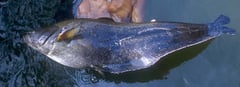
Wallago leeriiStriped Wallago Catfish
Siluridae · authority not recorded
The striped wallago catfish, Wallago leerii, is a large predatory catfish from southeast Asia, including the Mekong basin, that can reach 2 metres. Like all Wallago it has an enormous mouth full of backward pointing teeth, and smaller fish are simply swallowed whole. This is NOT an aquarium fish, though it is imported quite regularly at a small size. In nature it is migratory and moves into inundated forest during the rainy season.
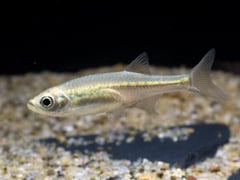
Devario sp. 'purple cypris'
Cyprinidae · authority not recorded
Devario sp. 'purple cypris' is a small, unidentified devario that has appeared in the aquarium trade only on a handful of occasions. It has been widely misidentified as Inlecypris jayarami, but has 9 or 10 lateral bars that increase in size towards the tail, 12 anal-fin rays and a blunter head.

Herichthys cyanoguttatusTexas Cichlid
Cichlidae · authority not recorded
The Texas cichlid, Herichthys cyanoguttatus, is native to the Rio Grande drainage in the southern United States and Mexico. The only cichlid occurring naturally in the USA, it is highly belligerent and territorial, digs constantly and needs a tank of at least 120 cm for a single specimen. The similar H. carpintis is sometimes sold under its name and has larger, scattered flank spots, where H. cyanoguttatus shows obvious lateral rows of small spots.

Ivanacara adoketaZebra Acara
Cichlidae · authority not recorded
The zebra acara, Ivanacara adoketa, is a cichlid from Brazil that appears to be endemic to the middle and upper rio Negro system. It inhabits dark, shaded rainforest streams where the water is stained brown with humic acids and the pH can be as low as 3.0 or 4.0. Rare in the hobby, it is a bi-parental substrate spawner that uses a cave if available, and its eggs develop only in water of little-to-no detectable hardness.
Polypterus weeksiiMottled Bichir
Polypteridae · authority not recorded
The mottled bichir, Polypterus weeksii, is a nocturnal bichir from the Congo basin in the Republic of Congo and Democratic Republic of Congo. One of the 'upper-jawed' polypterids and one of the rarer bichirs in the hobby, it reaches 55 cm. Like its congeners it finds food by smell, breathes atmospheric air, and will eat any tankmate it can fit in its mouth.
Serrasalmus altuveiAltuvei
Serrasalmidae · authority not recorded
Serrasalmus altuvei is a piranha from the Venezuelan section of the Rio Orinoco basin, where it lives in the clear, sunlit waters of the Llanos. Very scarce in the hobby, it turns up mostly among imports of juvenile S. rhombeus and is also known as 'caribe azul' or 'blue caribe'. It belongs to the 'compressed group' and can be very tricky to tell from S. compressus, though juveniles supposedly differ in having speckling only on the upper half of the body.
Serrasalmus manueliManny
Serrasalmidae · authority not recorded
Serrasalmus manueli, sometimes sold as the 'green tiger piranha', is a piranha from parts of the Amazon and Orinoco basins in Brazil and Venezuela. Adults are caught in deep, flowing sections of major river channels and grow to 435 mm SL. Imported fish are notoriously sensitive travellers with high mortality, and this is a species for the specialist that must be kept alone, since adults fight until only one remains.
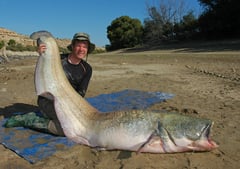
Silurus glanisWels catfish
Siluridae · authority not recorded
The wels catfish, Silurus glanis, is a sheatfish native to rivers draining into the North, Baltic, Black, Caspian and Aral seas. It has been introduced across western and southern Europe, where populations in Italy and Spain grow very large. Juveniles are occasionally available in the aquarium trade, but this species is clearly not a viable subject for the vast majority of private aquarists.
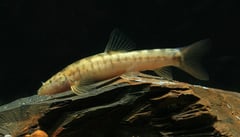
Schistura jarutanini
Nemacheilidae · Kottelat, 1990
Schistura jarutanini is a troglomorphic nemacheilid loach that appears to be endemic to the Ba Dan cave in Kanchanaburi Province, western Thailand. The eyes are reduced or absent but the body retains a degree of pigmentation, and it is found in deeper parts of the cave's subterranean stream. Protected by Thai national law and illegal to remove from its habitat, it is included here for interest only.